Showing posts with label dr nigel speight. Show all posts

Monday, 19 May 2014

Good things: film, dance, books

Last week, I got the DVD of  the documentary film Voices in the Shadows, which came out in 2011 -  of course, I've known about the film for ages, but have never felt in the frame of mind to watch it, until now. The portrayal of severe ME - the most severe imaginable - is harrowing and although I was not this severe, it still taps into my very bad times, and chills me to be reminded of them. This film is beautiful in its simplicity: the multi-systemic, devastating illness ME  has been hijacked by psychiatry, the criteria diluted, the research polluted. Patients are being made worse by brutal regimes of graded exercise. It is well worth watching. The narratives will shock you, even when you think you are jaded and can no longer be shocked by the neglect - and abuse - of the medical profession towards patients with ME. Dr Nigel Speight and  Professors Leonard Jason and Malcolm Hooper  articulate the plight of severe ME sufferers with such grace and compassion, it's hard not to have tears. My anger at the gang of medics who are guilty is reignited. And my heart breaks - again - for those who suffer from severe, unremitting illness. Dr Speight talks of a 'sort of new Stalinism coming into British medicine'.

As I got ill in autumn 1982, before the Wessely school nonsense/conflation/denial -  I had Dr Behan and Dr Ramsay on my side - I was myself never forced by powerful medics to pretend that I was not actually physically ill. Although, it was not a walk in the park getting diagnosed, it took 18 months. And like most PWME, there were people in my life I simply blocked out because of their  lack of understanding. You have to, in order to survive. And I will never forgive those people. I often say that without strong family support this illness could undo you. I also think that it is actually impossible to truly ever understand ME unless you have it. Even now, borderline moderate/severe - housebound much of the time because of post-exertional malaise (PEM) - I can look fine and seem fine for a window, but behind the scenes I feel as I've been hit all over with a mallet and my brain is on fire. I can't form a sentence, I drop words. I  bump into things.

*

And this is gorgeous,  I love the energy in the performance -  actor Sarah Gordy  dancing in 'Violence of Discovery, Calm of  Acceptance'.

*

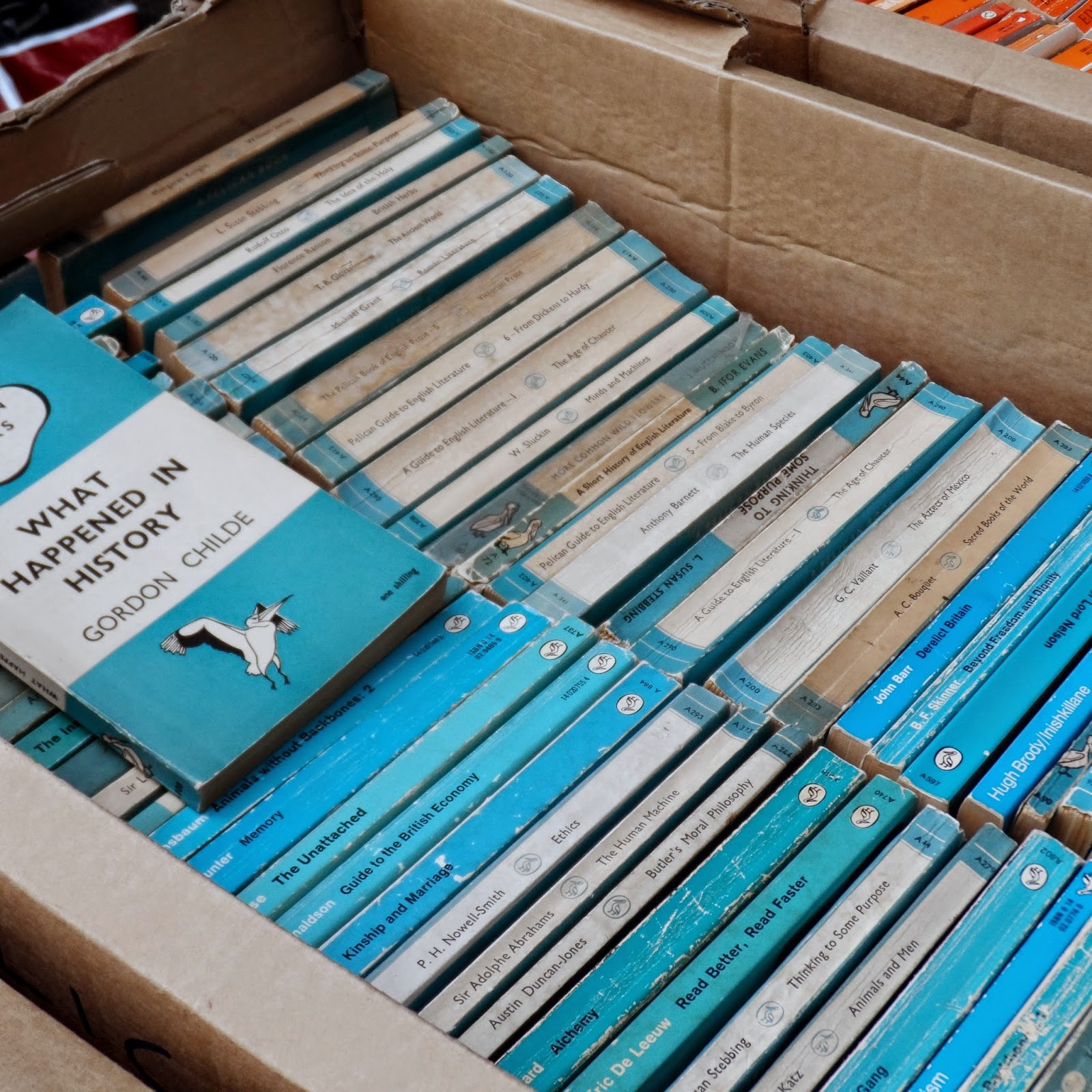
Nothing makes me happier than secondhand book stalls. Such jewels and bargains to be found last week at a Christian Aid book fair in George Street, literary fiction and non-fiction for £1 - boxes and boxes of  books, including Penguins and Pelicans. It was sunny and there were trestle tables outside, it was like Paris. It reminded me of how much I love paper books. And I wondered what secondhand book fairs/shops will be like in fifty years. Will they even exist?
Wednesday, 5 March 2014

Doctors who know what they're talking about


Doctors who know what they're talking about, the opposite of the Wessely school.

And here is more on the nonsense of the PACE trial by Neil Riley, chairman of ME Association. I think we should remind ourselves of what Wessely said in 2011:  'For those who appreciate these things, the trial is a thing of beauty'. He  also described the trial as 'large and elegant'.

Enough to make you weep.

Tuesday, 4 February 2014

Different kinds of light

The exhibition of Chinese lantern warriors at Edinburgh University is beautiful and haunting, the figures sway gently in the wind, the old quad is a gorgeous backdrop. These ninety figures made me think of Jelly Babies marching. And there are benches for resting, always important.


And Bruce Munro's 'Field of Light', which I have not yet seen, has just opened in St Andrew Square. It looks like a glorious field of glass tulips. We are lucky to have these wonderful installations on our doorstep.

Light also in the news that 8000 research journals will now be available free online in public libraries. No more ludicrous paywalls to access  papers of interest.

And more light in American journalist David Tuller's recent article on the absolute inadequacy of the name Chronic Fatigue Syndrome to describe a serious neuroimmune illness (the name was coined in the USA after the Lake Tahoe outbreak in 1984. Dr Dan Peterson has since apologised for the nonsense of such a name). Tuller’s excellent article makes the point that the illness myalgic encephalomyelitis (ME) is not owned by any one speciality, this is true, and this is perhaps why it was possible for psychiatrists in the UK to flood into the ‘void’ and try to own the illness themselves.

I *can* see how the terminology is confusing for outsiders. In the UK, ME has been known as ME since the mid-1950s (and WHO has recognised it as a neurological illness since 1969). It was only towards the end of 1980s that the 'CFS' terminology came in to use in the UK, thanks largely to the core of psychiatrists known as the Wessely school. This school effectively tried to ‘disappear’ ME and replace it with CFS, a nebulous fatigue syndrome that is a thousand miles away from the complex neuroimmune illness that is ME. They started to use the label ‘CFS’, but this slowly became ‘CFS/ME’ as they tried to merge the illnesses and dilute the criteria for ME. And,  confusingly, ME is also now referred to as ‘ME/CFS’ by doctors who *do* believe in ME. And CFS is, even more confusingly, also the research term used across the board. 

My rule of thumb is if you see the term 'CFS/ME', you know you are dealing with skulduggery.

When I was diagnosed with ME in early 1984 - 16 months after becoming ill with Coxsackie b4 virus - by a consultant neurologist, I had never heard of Coxsackie or ME and had to educate myself. It is hard to imagine now how very little information there was in the public arena. Personally, I always refer to my illness as ME, this is the illness I have, I simply don’t know what CFS is. And the fact remains that the psychiatric lobby's choices of treatment - graded exercise and CBT - don’t make people with ME better, and in fact often make people worse. In spite of  its best attempts to 'out' us as a patient population suffering from false illness beliefs, we remain ill. The obfuscation and conflation of ME with nebulous fatigue syndromes is simply not sustainable.

Finally, I welcome this event featuring Dr Mark VanNess speaking about  the safety of exercise in PWME tomorrow in Bristol, and the wonderful Dr Nigel Speight. I wish I could go. Actual scientists, lighting the way, like hundreds of  marching lantern warriors. More on Dr VanNess's work here.


Sunday, 12 January 2014

Part Two of Trusadh: 'The Toxic Tiredness' on BBC Alba

Part Two of  'The Toxic Tiredness' documentary airs tomorrow night - Monday 13th - on BBC Alba at 9pm (and repeated tomorrow at 10pm). My original response to episode two from January 2012 is here.  I am only briefly in part two: 17 secs, 47 mins and 48:50 mins. Professor Behan appears at 35 mins, he diagnosed me in late 1983/early 1984 with severe post-viral fatigue syndrome/myalgic encephalomyelitis, after specific antibody titres of Coxsackie including IgM; lymphocyte subset analysis; detailed single fibre EMG and measurement of jitter; and specific muscle biopsy.

I had by then been ill for almost 18 months after becoming ill with Coxsackie B4 virus, my Honours degree/year abroad in ruins. I remain grateful that I was seen and treated by a consultant neurologist before the Wessely school began to hijack and really take hold of this illness a decade later, conflating it with idiopathic 'chronic fatigue'. Interestingly, in all of his writings, Professor Wessely tends not to reference key-players in the world of ME in the eighties, doctors like  Behan and Melvin Ramsay and Betty  Dowsett and John Richardson.

*
This film with Dr Nigel Speight is also an eye-opener, he intervenes on behalf of children with ME who have not been believed by psychiatrists/paediatricians/social workers. He describes the collusion of such professionals, their false belief that they have effective treatments in the form of graded exercise and CBT. I can only imagine the horror  of being a child or a parent of a child who is severely ill and not believed. I was not yet nineteen when I first became became ill, but at least I could not be bullied into treatments that would make me worse. An ill child is so dependent on others to do what is best for them. And they wonder why people with ME are anti-psychiatry!

If anyone has a child with a diagnosis of ME, Tymes Trust is a brilliant charity. If I had a poor wee one with this illness, this is where I would go for advice. Children do seem to have a better prognosis than adults, but being able to rest sufficiently is paramount to recovery.

Sunday, 20 October 2013

On the same page

I saw Dr Nigel Speight, retired consultant paediatrician, speak yesterday afternoon, it was a joy to listen to a doctor express such openmindedness and curiosity and compassion about ME. He was on the panel of the International Consensus Criteria 2011, so it is not surprising he is such a great advocate. It was frightening to hear what some children with severe ME are being exposed to in terms of psychiatric assessments. Shame on all of those assessors. This from an ME conference in Northern Ireland in August gives a flavour of what he was saying yesterday.

(Interesting too that when he first got involved in ME in the mid-1980s in Durham he was seeing a lot of Coxsackie, which of course is the virus that triggered my own ME.)

*

So Eleanor Catton has won the Man Booker for her second novel The Luminaries, hugely impressive at 28-years-old, her acceptance speech was gorgeous, though I have to say the book itself does not appeal to me.  I don't think it appealed to Robert McCrum either, who wrote this, a bit uncharitable I think,  before the prize was announced. Still, passions run high when it comes to the Booker.  I did agree with him about the Ozeki and my mother liked it even less, she left me a message on Tuesday night saying, Thank God that awful book didn't win (I'd persevered because it was Booker-shortlisted and I believed it had to redeem itself at some point, she persevered because my stepdad had given it to her for her birthday, which means I had given it to her as I choose all my stepdad's gifts for her now, his dementia is, of course, worsening).

 In this Guardian interview, I like Catton's comments:
It is the peculiar constellation of her age, gender and the particular nature of The Luminaries that has, she believes, provoked "a sense of irritation from some critics – that I have been so audacious to have taken up people's time by writing a long book. There's a sense in there of: 'Who do you think you are? You can't do that.' Something else related to that is to do with the omniscient third person narration of the book. There's a feeling of: 'All right, we can tolerate [this] from a man over 50, but we are not going to be spoken to like that by you.'"

In my current writing project, am wrestling with 3rd person omniscient myself, though I will soon be as old as those male critics. But it is a challenge and I will hopefully get there  (I like that much is made of the ten year gap between both Ruth Ozeki and Donna Tartt's last books - for those of us who have horribly limited energy, ten years are nothing.)

 I also enjoyed dipping into this timeline of the Booker, the backstage gossip.

*

Very long novels can be off-putting, and Cornflowerbooks has written a post asking if we are discouraged from reading books  because of their length (I'd say yes).  Still, I am keen on reading The Goldfinch, though have not been able to get into Donna Tartt before. I loved her on The BBC Review Show last week,  her clarity and confidence. When Kirsty Wark suggested that secrets were at the heart of all of her books, she replied that secrets are at the heart of all novels. This I loved. And while Kamila Shamsie (above) raved about The Goldfinch, Julie Myerson was not impressed at all.


And if there were a Booker 2013  for ME doctors, I'd give it to Dr Speight. He has helped children with  ME enormously (I think he said he had seen almost 600 cases nationwide over the years). With fiction you can argue whether a book is good or bad, it is subjective. Medicine, of course, is not always black and white either: experts can disagree, have conflicting views on the best treatments. That is different though than manipulating a neuroimmune illness, turning it into a psychiatric illness, moulding it like Plasticine, as the Wessely school have done since the late 80s. Dr Speight began his talk by apologising for the medical profession's treatment of people with ME. You know you are on exactly the same page when a doctor does this. We need many more like him, those who are passionate about the pursuit of truth.

More on Dr Speight's career here,  scroll down to see.