Showing posts with label twitter. Show all posts

Monday, 8 August 2016

Taking a selfie with a chappal

I saw this last week on Twitter, the image has stayed with me, children improvise and re-enact all the time, but the poignancy of this wee boy using a chappal (flip flop)  to take a selfie is enormous. The smaller boy seems to be wearing sandals that are too big for him, and on the wrong feet.


Sunday, 1 May 2016

Wellcome Book Prize 2016 - ignorance rewarding ignorance

*Updating this post: fantastic news, first ME biobank in Europe is officially opening its doors to external researchers on May 12 at London School of Hygiene and Tropical Medicine. More info here.

I resent using any more energy - it truly takes its toll - on the daft neurologist Suzanne O'Sullivan, but the travesty of her winning the Wellcome Book Prize is too important to ignore. I've been trying to correct her harmful nonsense about ME since she won the prize last week, on Twitter. She herself blocks everyone who challenges her, including the mother of severely ill patient Whitney Dafoe whose father, Stanford scientist Ron Davis, is valiantly trying to complete the ME jigsaw.

In serious scientific circles, there is no longer any doubt that myalgic encephalomyeltis/chronic fatigue syndrome (I hate that name, but it is used in research) is  a serious, complex physical illness - though poorly understood, it is NOT psychiatric or psychological. However, that didn't stop O'Sullivan from including ME in a chapter of her 2015 book, It's All in Your Head, a study of psychosomatic illness - or rather a series of anecdotes about patients she has seen. She has published before on carpal tunnel syndrome and non-epileptic seizures (I have not been able to find any papers on ME, unsurprisingly).  Whatever the merits of the other chapters, O'Sullivan has no expertise whatsoever in ME, but that didn't stop the judges from being seduced by her magnificent nonsense (worth noting I think that no one in the research world has heard of Suzanne O'Sullivan, but she is elevated to an ME 'authority' just by having this book published).

Her ME chapter is, of course, wholly uninformed and manipulative, unoriginal in its prejudice and bias. I reviewed the book last year on Goodreads.  Her Rachel chapter is revealing only in what it omits. It's fairly clear to anyone who is informed about ME -  as patient, carer or true specialist - that O'Sullivan is havering (good Scottish word). She's not going to rock the science, of course, that is progressing nicely - but unfortunately she is persuading new gullible readers that ME is an unconscious switch in our heads that flicks on and mimics serious illness. You couldn't fucking make it up that in 2016 this got the Wellcome Book Prize. The judges - I imagine intelligent and decent people - though only one seems to work in medicine/science - simply rewarded ignorance with ignorance.

What is *most* galling is the fawning, ignorant media, who have indulged her all week, themselves almost wilfully ignorant of biomedical research. They assume a mantle of authority. And readers and reviewers of O'Sullivan too become overnight experts in a neuroimmune illness they know nothing of.

I was told earlier by an obnoxious book reviewer (he was making quips about his own hypochondria and full of praise for her book, saying he'd be 'thrilled' to know he didn't have a serious neurological disorder, and wondering why do patients have  a problem with a likely psychological diagnosis) that the ME chapter is *only* 20 pages and that he had no interest in debating further. I told him I've been ill for 33 years, diagnosed by a consultant neurologist, and 250, 000 in UK have ME, so 20 pages is not just 20 pages; and I suggested perhaps it's best not to tweet about a book if you have no interest in discussing the issues. For this, he blocked me. My voice silenced just like that. Basically told to dry my eyes, we have nothing to complain about. A quarter of a million lives already severely diminished, further harmed by O'Sullivan's nonsense. Yes, book bloggers know best. What a luxury to be able to dismiss those 20 pages! He blocked others too who tried to educate him.

Interestingly, no one in the UK media has yet asked Suzanne O'Sullivan about the toxic PACE trial - which has just been in court over failure to share its data (someone on Amazon has suggested there might be a significance that one of the judges works for QMUL, but surely not, that is just too depressing to contemplate that judges would not be independent. Though the way this illness has been relentlessly politicised since the nineties truly stinks. Personally, I don't believe there was any 'fix', just lazy, old prejudices about ME being confirmed). O'Sullivan predictably praises GET/CBT in her book - cannily, without actually naming PACE - as the most effective treatment, with no reference at all to the harms of graded exercise. Just as she praises Simon Wessely, without naming him. His name, of course,  now carries too much baggage. Her claim that he is 'the person in the UK who has taken this illness the most seriously' is, I'd confidently say, a giant whopper (there are a few in the chapter). She conveniently omits the 1980s' UK specialists: Melvin Ramsay, Peter Behan, Betty Dowsett, John Richardson, and Nigel Speight (my illness was taken very seriously in 1984 by Professor Behan, then Doctor).


And, of course, she disingenuously conflates ME and 'chronic fatigue', just like those psychiatrists she emulates. O'Sullivan - and those like her - seek to control a dying narrative. She has been silencing those who politely challenge her. I was blocked when I simply asked her this. She lives in a little bubble on Twitter, which only lets praise in. Patients with ME have no right of reply. Is this not quite strange for a scientist? The prize is about stimulating scientific debate, one wonders what she is so afraid of. The truth, perhaps?

It has been gruelling having this illness for 33 years, and indescribably exhausting trying to educate others, yet still we are facing this prejudice and nonsense from a small, self-congratulatory club in the UK (USA are miles ahead, although we do have fantastic initiatives here like Invest in ME annual conferences). As someone else said on Twitter, how much evidence do these people need, what will it take? What do they all gain from acting like petulant children, fingers in ears?

I cried when I read that O'Sullivan had won the Wellcome Prize. Could this really be the most deserving book on the shortlist? - it is not even well written, the somewhat toneless chapters all blur into one (not to mention that the made-up patient name 'Camilla' is alienating, but that is a trivial point).  I have now run out of words, trying to educate the seemingly ineducable, but I do still have my precious novel. It remains my weapon. Two of these books tells the truth about Ramsay-ME, one recycles nonsense:


Saturday, 12 September 2015

Art and death and farewells in Glencoe and Greenland

Twitter can be wonderful. I first met artist and writer Nancy Campbell via Twitter, last year in March. Nancy had favourited a snowdrops photo and I discovered she had produced a beautiful book in the form of artist's cards, How to Say 'I Love you' in Greenlandic. I immediately got the book for my stepdad (I may have traded a copy of my novel for Nancy's work, I can't recall - I've done this several times, used my novel as currency for art).

My stepdad spent many happy hours reading through the cards, enunciating the Greenlandic words - I can see and hear him now - correcting me when I got the pronunciation wrong. Childhood memories are important in dementia, and we didn't know the old songs/fairytales/poems that would stimulate him, so these cards played a special role.  When he died, I wrote a message on one of the cards, wrapped gold ribbon round it - a bit 'blingy', but it was all I could find - and placed it in his coffin. I wanted to put more things in - there is an instinct, I think, to put in many objects of comfort for the departing soul. Though, that is, of course, more to comfort ourselves.

I was delighted when Nancy told me she'd applied for an art residency at Ilulissat's Emanuel Petersen Museum, which, before it was a museum, was my stepdad's childhood home. We could not have known that by the time she did the residency my beloved stepdad would have passed away. By sheer coincidence my mother had planned to scatter his ashes in Glencoe, the same week Nancy was in Ilulissat. Nancy kindly asked if there were any mementoes of my stepdad's we would like her to take to Greenland. We decided to send her his order of service with loving messages written on the back by various members of our Scottish/Scandinavian family. I asked Nancy to perform whatever ceremony she could, I suggested making a wee paper boat and floating it away, but was putting the event entirely in her hands. I knew she would know what to do.

Scattering my stepdad's ashes in Glencoe - or more accurately Glen Etive - was a peaceful and beautiful occasion. The sun shone and we played Local Hero soundtrack gently in the background - he loved this music - and my younger nephew played a sad folk song on the violin. Buachaille Etive Mor stood solid and strong in the background. There were deer,  and house martins diving all around. My stepsister put a few drops of whisky on the ground to send him on his way. I brought back some wild flowers and pink heather, the flowers died straight away, the heather has survived and is on my bookshelves.


Early on in their marriage, my mother had a local artist paint Buachaille Etive Mor for my stepdad as a gift. It was one of his favourite spots in the world. The painting hangs in their house and now when I look at the painting I know he is there, physically part of the landscape. Internet connection in Greenland and Glencoe is, unsurprisingly, fickle, so I did not know what Nancy had done on that day, but I did think about Greenland when we were in Glencoe and was curious.

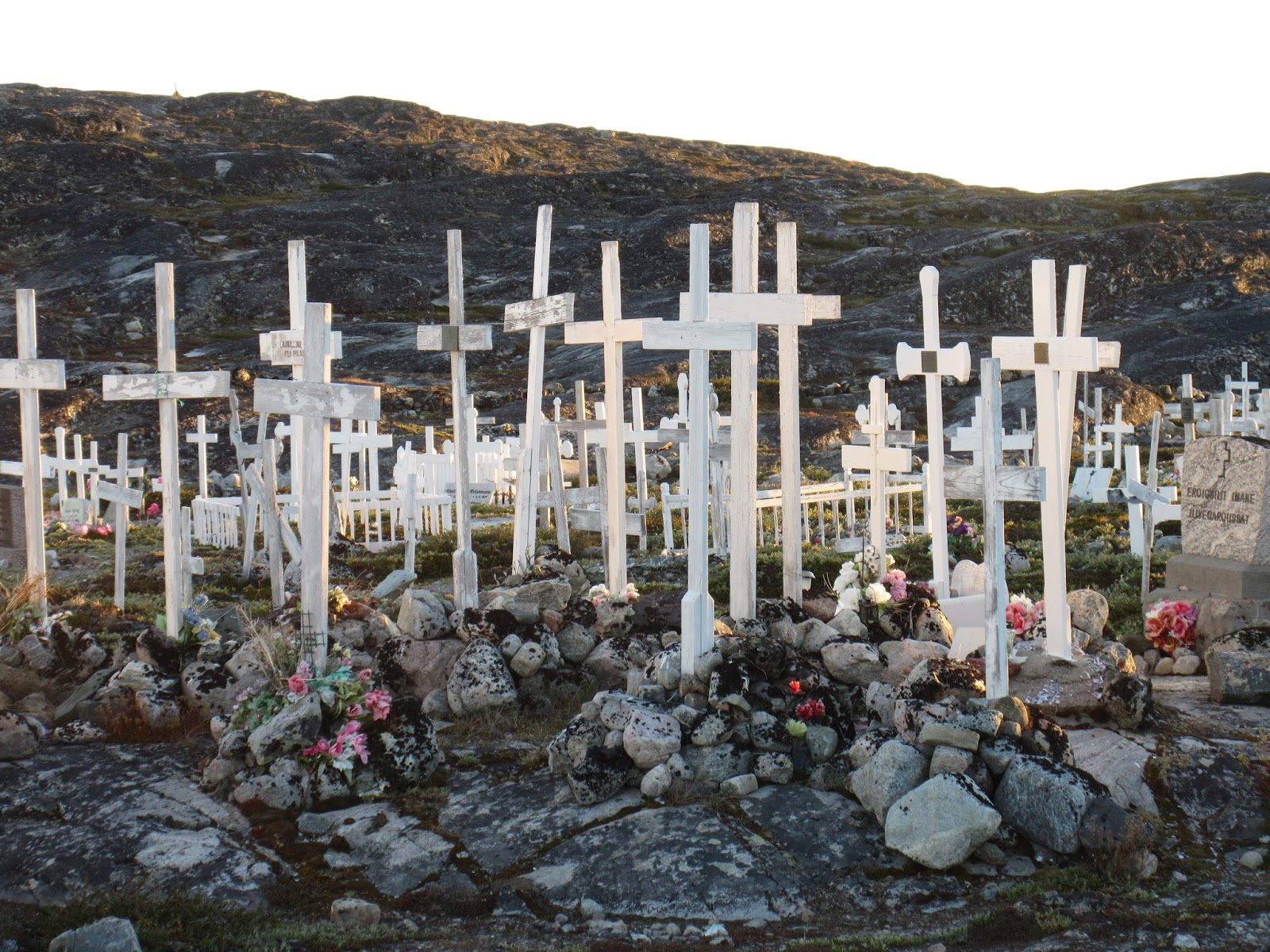
Last week, Nancy sent me a beautifully detailed, long email of what she had done, I read it in tears, touched by her great thoughtfulness and creative gestures. She had placed my stepdad's memorial card on top of the harmonium in the museum for a couple of days, among the stunning Emanuel Petersen paintings. And she put sage leaves around him that she'd brought from her garden in Oxford. She said she liked the idea of sage helping spirits to rest. After the harmonium, for the final goodbye, Nancy chose to place his order of service in an Ilulissat hilltop graveyard, under a piece of gneiss she had chosen as an anchor. She placed him at the southern most tip of the graveyard, pointing towards Scotland. She told me that in Inuit culture, wide views of the sea are important for the location of burial sites. This is a photo of the cemetery taken by Nancy. There are harebells and blueberries growing, and mussel shells and plastic flowers on the graves.

                                                                     Ilulissat, photo by Nancy Campbell, 2015


Nancy and I have never met - though I hope we do, one day - and she did not know my stepdad, but by a quirk of fate, she became intimately involved in our bidding farewell to him. His twin brother, who lives in Copenhagen, hopes to scatter his remaining ashes in Ilulissat next year. Then the farewell will be complete.  I think of how our lives are threaded, my stepdad could never have known that the artist whose cards he enjoyed so much in the last year of his life would be taking him home to Greenland. And Nancy, when she favourited a photograph - garden snowdrops I'd taken on my very unsophisticated phone - could not have known where that would lead.

It is seven months now since my stepdad's passing, my own grief is more gentle, for sure, but it's without exaggeration when I say that he was my best friend. Now that he is gone I know this more than ever. I have yet to meet a kinder man. Thank you, Nancy, for what you did for him.


Sunday, 25 May 2014

Glasgow School of Art, always there like a jewel...

It was like watching an old friend dying right in front of you and being unable to do anything except witness the event, helplessly. This is how many of us felt seeing the pictures and footage - all over social media - on Friday of our stunning Glasgow School of Art on fire.

Even if you didn't attend the art school, it was always there like a jewel, and you knew someone who did. I recall in the eighties going to the degree show of a flatmate of one of my brother's, who looked like David Bowie and had a handsome lover, Mick. (Rumour had it, Mick died of a heroin overdose in the nineties. I have no idea if this is true).  I was in tears watching the news on Friday, not just for the art school, but for Glasgow, I lived there, after all, for many years and it was the closest city to us when I was growing up in west of Scotland. And Charles Rennie Mackintosh is in your DNA, he just is. It seems his glorious  library has been lost but, miraculously, damage to the rest of the building is less than initially feared. And not all of the students' work has been lost. I can't imagine the devastation of losing your degree show project. At least if you lose your novel it is backed up, but how can you back up years of precious art? The most important thing is that everyone got out safely, but as Hugh Pearman said on Twitter: 'Today's destruction proves one thing: if so many people feel bereaved by the loss of a building, then it can be said to have had a soul'.

If you want to help, in any way, here are the details.

Thursday, 13 March 2014

I used to hate Twitter, now I love it

Before I'd ever used it, I hated Twitter, I was a bit Jonathan Franzen and thought it was nonsense. Now, I love it. It's perfect for low energy, you can dip in and out and say what you need to in 140 characters. And there are links to some great resources: I can bookmark articles in a jiffy and read later when my head is up to it (in truth, not all that's bookmarked gets read). My ME symptoms have been pretty bad this last ten days, that feeling of having weights in your head and neck and legs. And dizzy, so damned dizzy. I have fought it, tried to go out - I have shops on my doorstep, literally - only to end up spending long spells of the day in bed. I do restrict the number of people I follow to 500, otherwise it's too much like a flashing cockpit that I can't process. And I'm always tweaking who I follow: I hate to give up on someone whose tweets I like, but needs must.

The truth is that Twitter can be an Aladdin's cave (of course, it can be a hell-hole too, but you just don't go to those dark places of jabber-babble). I was so pleased before Christmas to discover The Mushin Museum in Cardiff, I was directed there by an anaesthetist when I was looking for information on anaesthesia in 1950s/60s for a novella I'm slowly, slowly writing, inspired by my doctor father. You don't use all the facts you learn, but you still need to know them, you need the mental 'furniture'. The curator at the Mushin museum  has been enormously helpful to me. By coincidence, I learned from an old CV just this week that my father had actually worked under Professor Mushin  - whom the museum is named after - in the early 60s. That gave me shivers. 

Then, the other day, I discovered artist/writer Nancy Campbell when she favourited a photo of snowdrops I'd put up that found its way to her. I learned that Nancy has written a gorgeous book called How to Say I Love You in Greenlandic, which I know will be perfect for my stepdad, it will revive his Greenland memories, so important now as he slips further into dementia. Through Twitter, we were able to be in touch directly and I have ordered her book.

I also came across The Istanbul Review recently. This gorgeous Turkey-based literary journal, 'with a presence in Edinburgh', is distributed in the UK by local indie store Looking Glass Books. I submitted some flash fiction to them last week on the off-chance and was delighted to have it accepted.

We all know Franzen gets his knickers in a twist about writers bragging on Twitter, sure, that happens, there can be dreadfully off-putting self-promotion - across all platforms - but you just avoid it. For me, social media is something of a godsend as I can't run around all over the place promoting my novel - but most of us use Twitter wisely when we self-promote - and why the hell shouldn't we publicise our writing, after the blood, sweat and tears that goes into writing, and having a book published!  But we also have a generosity of spirit towards other writers we admire, and that is invaluable.

Twitter is also a great tool for those who are chronically ill,  especially in housebound or bedbound phases. You can feel like shit with a capital S, but send out a tweet, a wee firework into the world, from your pillow. I often think back to my horribly ill days in 80s: unless you had physical visitors, it was a case of writing letters and phoning. Hard to believe now. I was 'amused' - if that is the right word - to come across a young woman with ME who had her many symptoms listed on an App on her phone, ready to present to the specialist she was seeing. We were both diagnosed at twenty, with the same hellish illness, but very different worlds, technologically. Her blog is here, she makes me smile. She loves her lipstick too, never a bad thing.

And, of course, Twitter is great for hearing about the latest research papers on ME - and the skulduggery - without having to trawl through the internet. I follow the excellent Tom Kindlon for this.


Wednesday, 6 February 2013

The Panda Theory, Joseph Anton & an anthology

Gallic Books very kindly sent me a copy of The Panda Theory by Pascal Garnier when I said last week  on Twitter that I'd had to return it to the library before I had finished. I started reading it last July (I think) and got a third of the way. I look forward to starting it again. I finally finished Joseph Anton, I had a lump in my throat when Salman's second son, Milan, was born, I was surprised at my emotion. I also have huge respect - and sadness -  for his ex-wives Clarissa Luard and Elizabeth West. Clarissa sadly died in 1999. I have the Vintage Book of Indian Writing (1997) that he and West edited - in fact, I bought it that year, I see from the date, I always date my books. Interesting now to get the backdrop to the fraughtness round the publication, it was considered risky then for her to have her name on the anthology (it was a secret they were together). It was dipping into this anthology last autumn that I discovered Bapsi Sidhwa's work. And I had no idea Salman was big pals with Bono (I am not a U2 fan).

Sunday, 20 January 2013

Who controls the story?

I've been not particularly well this last week and reading Joseph Anton in bed, it's a long book - 600 pages, which on a Kindle can seem endless, you don't get the same sense of progress you get with a paper book - but compelling even though Salman can be a bit up himself. Whatever you think of the man, he can write, and this book is like a banquet of Michelin food and junk food (the bitchiness, the gossip), on which you gorge and have indigestion afterwards and need to take a break. It is also repetitive, necessarily so, and lots and lots of detail. 

I feel linked with Salman's books as I read Midnight's Children when I was very ill in mid-eighties. I had to stop and start, stop and start, but persevered. Reading this novel was my window on real life when my own life was suffocating and claustrophobic, bedridden as I was with ME. Then five, six years later when all the hullaballoo started I was in London trying to find part-time work, heading (unknowingly) for a catastrophic relapse and the news on TV was of books being burned and I recall watching with my flatmates and feeling baffled, and so very ill (for neuroimmune reasons). Fast forward another six years, and I saw him speak in Edinburgh, I think the Traverse Theatre, and we had to go through airport security (as usual, I had to sit while others kept my place) and  afterwards we left with signed copies of The Moor's Last Sigh (which I still have not read, but I will). Salman says in his memoir that when he was writing TMLS he was annoyed he could not travel to India to do the research and was worried about 'authenticity', but many writers have to imagine the places they are writing about (and he already had much experience of India). I would love, for example, to have the option to go back to Pakistan, I have family there, but I can't risk the vaccinations, or not having the vaccinations, and so I have to rely on memory (of a 6-week trip as a child) and my heart. (Salman's exiled Somalian writer friend Nuruddin Farah advised him to write from what he'd kept in his heart.)


I am struck (not for the first time) by this concept of 'who owns the story', who is in control of the narrative, and while I am trying not to write about ME as I am so fucking bored with it, this is what happened with my illness, the narrative was stolen and distorted by a clique of medics/health editors, and the story has been spun and spun like a spider's web. Thankfully, science is the opposite of these 'purveyors of untruth' and is making headway in spite of it all. This from Open Medicine Institute is encouraging.

And, this is good, an essay on why writers should use Twitter. I used to hate Twitter, thought it was bollocks - and there is a lot of bollocks on there, like the internet in general - but it is also a lovely thing, for many reasons, not least  because it takes hardly any energy. I recently came across this short interview with Dr John Chia via Twitter, he researches treatments for ME triggered by enterovirus (as mine was). And unlike the purveyors of untruth he is very interested in the  original virus that has actually caused ME.

And if anyone is interested, here is Zoe Heller's review of  Joseph Anton, shortlisted for hatchet job of the year. I think she is a little hard on him. And a more sympathetic review here from writer Laila Lalami.


Monday, 29 August 2011

All the fun of the fair (again)

*Fabulous response by Prof Malcolm Hooper to very misleading narrative in last weekend's Observer:

No right-minded person could condone any campaign of vilification against scientists (“Chronic fatigue syndrome researchers face death threats from militants”; The Observer, Sunday 21st August 2011); equally, no right-minded person could condone what psychiatrists such as Professor Wessely have done to the UK ME community for the last 25 years.

** Max Pemberton's edited article which appeared in today's Telegraph (29 Aug). He blocked me on Twitter after I'd responded a few times to his lack of substance (he blocked others too), I have never been blocked or barred from anywhere online, I feel like an insurgent, I shall wear my Max blocking as a badge of honour. He has toned things down, the original, more offensive version here, over which I lost sleep on Friday - I'm sure many did - I was so upset by Max's little indiscretions. He also described the ME Association as 'disingenuous' simply for looking out for the people it represents (now edited out). Yes, they are weavers of fine tales, these blinkered medics. Purveyors of fine untruths.

*** Invest in ME have issued a letter to the Press Complaints Commission regarding recent ME articles in the media which have presented only one viewpoint.

I'm not sure what Simon was doing when I was in a neurology ward having a plasma exchange for my false illness beliefs in 1984, but I'm sure as hell Max was still potty training.

Am having an MRI scan tomorrow - sciatica - and one of my brothers told me it's a 'noisy clanging bastard' - the machine. Still, will be a pleasant change from the persistent din of Wesselymania.

All the fun of the fair.

Saturday, 14 May 2011

Tweets & Kindles & Tulips

Am almost afraid to blog after the last few days of chaos, previous comments still not restored, but I just want to link to an excellent post by Johan Mares. And this is positive news too. I felt like I'd been on a demo on Thursday night after tweeting for #may12th (reading tweets is energy consuming too, a cockpit of information), and I was pleased that Marco Biagi (newly elected MSP) and AL Kennedy (one of my favourite writers) RT'd one of my tweets, but of course the health editors ignored me, they ignored all of us. Someone remarked that Richard Horton (The Lancet editor) has his head in sand, I would like to suggest that his - and all the PACE supporters' - is somewhere considerably less pleasant. This is a timely article on the editing of health journals: 'Are journal editors like used car salesmen?'

The Kindle version of my book was briefly at #92 in literary fiction, I guess it spiked as a result of tweeting. I am told that Kindle is now 80% of market (of ebooks), though when I see one on the bus - kind of infrequent up here - I still think it has something of Star Trek about it.

I went into the garden on Thursday evening - post-demo - even though it was very windy, I needed air. My arms felt like rags, and my head had that horrible heated up, inflamed feeling. The tulips were streamlined by the gusts and made me think of a dog's ears being blown from a car window. They made me smile.

Friday, 11 March 2011

Blogging a tweet if that's okay, and not overkill

Was very pleased to see Michael Nobbs, an artist with ME, tweet: I'd love to make Nasim Marie Jafry's novel The State of Me required reading for friends and family of anyone with ME!

I had no idea Michael was even reading the book.

As our illness continues to be spectacularly misrepresented by those in power - and those not in power - I am just happy that in a small corner of the world my book continues to inform and entertain.

Thank you, Michael, for your words.

Monday, 28 February 2011

Fighting fiction with fact

Just curious: have any of the PACE scientists or journalists who parroted their misleading results apologised to the world's ME community yet - they must be aware of the international condemnation being expressed? No, I didn't think so. And here's the pornography itself, the full text of the PACE trial, thanks for link to @forcedout99. Early on, these good scientists inform us: Myalgic encephalomyelitis is thought by some researchers to be the same disorder - as chronic fatigue syndrome - and by others as different with separate diagnostic criteria.1,2. (But we're going to perpetuate the confusion anyway and spend £4.2 million and have our results applied to people with neuroimmune ME by NICE and all the powers that be. And we're going to further confuse GPs on how to treat people with ME. And we're going to recommend therapies that are actually dangerous for PWME.)

And to balance out the nonsense, an excellent letter to Paul Burstow MP who failed spectacularly last month to understand the difference between ME and CFS during a parliamentary debate (see how the obfuscation obfuscates, those psychiatrists are clever!). The letter is from two ME sufferers (one of whom is Andrea Pring of the very informative Dancing with the Sandman blog, in my sidebar) and is linked via the unstoppable Dr Speedy whom we all know and love.

Okay, tomorrow is March, spring seems to be here and I don't want to give these PACE people another minute of my energy or time. I've fought them as much as I can. They are wrong. I'd rather think about crocuses, so cheeky and robust, the way they get here in spite of the snow. End of story (I wish).

* As a little ps, Wessely argues that 'ME is a belief' in 1994. The actual treacherous lecture notes and not a mention of Dr Melvin Ramsay when referring to Royal Free.

** Whittemore Peterson Institute for Neuroimmune Disease on PACE trial.

Sunday, 20 February 2011

The evils of psychiatry aka the PACE trial

The architects of the PACE trial appear to be very confused - they cannot tell the difference between neuroimmune illness and psychiatric illness. Or maybe they are just evil. I am not even going to link to the published research, it would be like linking to medical porn, I am so angry and disgusted, but really why should we be surprised at their orgiastic cries of CBT and GET? I am equally disgusted at the Guardian for publishing these results as if they had even a grain of credibility. Okay, we can't educate the psychiatrists - denial of neuroimmune ME is their goal and nothing will shift them. And make no mistake, this is about patient neglect, clinical apartheid, deliberate obfuscation. These psychiatrists have made it their career to deny that ME is neurological, they think they can force us into recovery because CBT and GET are cheap to deliver. I wish we could ignore them, treat them as the mad cartoon professors they are - with their treacherous fingers on the CBT/GET button - but incomprehensibly and shockingly the 'expertise' of these vandals still ladders its way down to NICE, the NHS and the DWP. We have to keep fighting them, we have to. However, I am quite honestly, all out of fight at this time and I can't afford to be this stressed, it was undoubtedly the stress of my book being published that led to my developing uveitis and I try to avoid stress as much as possible now. I dread a recurrence of uveitis and I simply can't allow these PACE bastards to get to me. And we can't stand in our city squares for eighteen days - at least, not without CBT and GET miracle cures!!! - but we can try and educate health editors, make them see the truth behind the PACE trial. So, please tweet @TheLancet, @sarahboseley (The Guardian: Study finds therapy and exercise best for ME) and @martinbeckford (The Telegraph: Exercise and therapy can help ME sufferers, study claims), @bbc, and any other editor who published this nonsense. Try and make them see sense and maybe they will think twice about publishing such harmful research on our illness in future. (I don't see a Twitter account for the Indy health editor Jeremy Laurance (Got ME? Just get out and exercise, say scientists) - if anyone knows, please tell me.) Maybe I'm shooting the messenger here, but all thanks to such irresponsible, sensationalist media, the concept of ME as a psycho-social illness is now lodged in the public consciousness again. So tweet these editors the link to the letters Professor Hooper wrote to the MRC. Or tweet them one of the many articles on the flaws of this farcical, dangerous PACE research that didn't actually fucking use patients with neurological ME (brilliant statement from Invest in ME linked above). Education, education, education!

Sunday, 13 February 2011

Guardian books podcast & Egypt

The Guardian podcast on books on illness is here, I was delighted to get a mention (approx 14 mins in), I really did not expect to, thanks again so much to those of you who tweeted the editor. Just shows that being a low profile tweeter - as I most certainly am - still gets results! As is often stated, writing about illness - or any catastrophic situation - is a way of making sense of the chaos, and is undoubtedly therapeutic as well as creative. My decision to write The State of Me as a novel and not a memoir has, in my mind, been reinforced to have been the right decision; illness is still mostly dealt with through non-fiction and I simply opted for a different way. The podcast made me think back to the rocky, rocky road to getting published. I wasn't just writing about being ill, I was writing about an illness that was (is) not believed by many to be physical: it was crucial to have my voice heard.

Also, written as a novel, it had to have more than time moving it along, there had to be plot too. Of course, when your character is very ill for months and years on end, there is no plot, there is only time. We mark our days and hours in terms of feeling like hell, or slightly less than hell. But if you have a love affair at the centre of the book - abracadabra! - there is plot. Being well-versed in chronic illness and stormy longterm love affairs, that was the natural way for me to go.

This podcast is very listenable - I will go back - and features well-known, older books on illness. I've read them all except Robert McCrum's memoir My Year Off (1998) and the Barnes' translation of Alphonse Daudet's In the Land of Pain (that very much appeals, I'd find it too hard in French). Also, good to learn of a new book, The Two Kinds of Decay (2011) by poet, Sarah Manguso. I very much related to her preference of writing in sparse, fragmented prose. Sarah also describes having plasmapheresis as a treatment for her rare autoimmune condition CIPD (diagnosed after half an hour by a neurologist!), which I also had - briefly - as an experimental treatment for ME in 1984 - an autoimmune treatment for a neuroimmune illness. I thought I would die afterwards. 
 
The new plasma was from a Polish donor. The technician told me I had great veins and that I might feel faint during the proceedings. It took three hours. He told me what Highers his son was doing and what colour of carpets him and his wife were getting for their new house. When it was over he said, That’s you, you’re half Polish now. He handed me a see-through bag of my old plasma. It was the colour of dirty goldfish water. A porter wheeled me back to the ward and delivered me to Bob. I had the bag of old plasma on my lap. (Chapter Six)
 
There are, of course, time constraints but the podcast could also have included Candia McWilliams' magnificent memoir on writing and blindness What to Look for in Winter (2010). I also recall enjoying Spalding Gray's slim memoir in the nineties, Gray's Anatomy (1993), his account of searching for a treatment for an eye condition, 'macular pucker'. When I read about others' illness, there must be humour, if the tone is too earnest I will pass. And I've been thinking about what books make me feel 'better'. When I was very ill, I read Midnight's Children, it became my project. I loved it. I cannot pick up my (yellowed) copy now without being taken back to that bleak time. Parvati the Witch is the character I remember.

Interestingly, one of the readers interviewed in the podcast - twenty minutes in - who benefits from attending 'therapeutic reading groups' - actually has ME. It struck me that to have our illness mentioned, like this, is a small step forwards. It is just another illness, one of many illnesses. No drama, no controversy. A woman with ME attends a library project, just as a woman with MS or lupus might.

Just after I realised TSoM was in the podcast on Friday I learned of something truly wonderful, Mubarak had resigned. I cried a little. How fabulous that by standing peacefully in a square for eighteen days you can bring down an entire dictatorship. There are lessons here for all of us. I am overjoyed for the Egyptians, I hope the Palestinians are next, hopelessly naive as that may sound.

Tuesday, 8 February 2011

Podcast on books on illness

The Guardian is doing a podcast tomorrow on books on illness and wants to hear from you about books you have enjoyed. Please tell them about The State of Me!

Tuesday, 16 November 2010

A very long post on balance & pain & beauty

People tell me they enjoy this blog because it gets the balance of ME and non-ME right, how do I manage it? I'm not sure I know. My impulse to write - when I am able - is what has saved me from this illness, even just a couple of sentences. My posts are often short. I constantly have words banging together in my head, I would prefer if they were gently colliding. Still, I could never blog about ME all the time, it would bore the arse off me - remember I've had this since 1983 - but of course I must mention what is important, and my rage and disgust at the non-believers never goes away and intensifies periodically.

But neither can I bear undiluted self-absorption - and you do find it on some ME blogs, ironically those who are less ill tend to be the most solipsistic. You will come across this 'monopolisation of suffering' on non-ME blogs too, I guess it's human nature. Of course, there is a therapy to blogging, and we all construct masks when we blog or FB or tweet - unconsciously or not - but when some people - the least isolated, the most supported - seem constantly unable to see beyond themselves, that depresses me a little.

Unfortunately, those with very severe ME are usually too ill to blog much, they are too busy surviving the day, hoping tomorrow might be slightly less awful. Greenwords is a wonderful example of someone severe blogging, her posts are infrequent, but she does it so bloody well. And she is a dabhand on Twitter. Gardening is her passion, she is mostly unable to do it herself, but she is a 'passive gardener' and I learn stuff from her blog/tweets. (I like blogs where I learn something.) Other (ME) blogs I dip into are Digitalesse (photograpy); Ciara writes gorgeous posts on motherhood and Dr Speedy updates us on all the lunacy with just the right amount of scathing.

There was no blogging when I was very severe, I do wonder what I would have expressed of my illness back then if the internet had been around. Intense chronic symptoms distort your view, it can be hard to think of anything else. I remember I used to write my symptoms down to keep track of them and make bargains with God, whom I've never believed in. I'm no saint but I somehow manage(d) to keep hold of the fact that terrible things - and beautiful things - are going on elsewhere, no matter how much this illness has impacted on me. Like Helen Fleet, my character, I have a sense of absurdity, which no doubt helps me cope. But I can't blog solely about my life when children are being bombed in Lebanon/Gaza, flooded in Pakistan . . . take your pick of the horrors.

Still, some days you just want everything to be good for yourself and that is okay. There are still days my heart could shatter at what I have lost. And those with unremitting, severe ME deserve fucking trophies, they really do. I don't tend to put my worst days and hours up here, I think because a lot of that is in my novel, which is my weapon, and I feel I don't have to fight anymore (though I do, really, we all do).

Life can be extraordinarily painful and extraordinarily beautiful, there is luck and there is bad luck. It is how we respond that makes the pain bearable or unbearable. And how we respond depends on who we are at the core, and also on the support we have. Without support, this illness could very easily undo you.

When I see my wee aunt (who is fifty, she has Down's Syndrome and now dementia) I get the extraordinary pain and beauty at the same time. My heart breaks every time I see her, but when she smiles, it unbreaks and the world lights up. I saw her recently and fed her a miniature Milky Way and helped her drink a small carton of Ribena with a straw. It took over an hour. She is strapped into a wheelchair during the day. I hugged her and kissed her and sang a few verses of the Hokey Cokey, once her favourite song/dance. She can no longer walk or speak or read or write or colour in. I was in a state of total exhaustion for the next few weeks from this visit up north, that scary, jetlagged, all muscles compressed into a tin sensation, clumsy and forgetful, but all that mattered was I'd spent precious time with her.

Even taking the wide and bizarre spectrum of ME into account, if you look around the internet and see just how many claim to have (or have had) ME, I still fear that it is being over-diagnosed in some places, some seem to wear it as a badge, inappropriately. This is the fault of GPs and self-diagnosers who are - understandably - stumbling in the dark because of the nonsense peddled for so long by the Wesselyites. (Yeah, we don't actually know what's wrong with you, let's just call it ME. Now, be a good girl/boy, go and do some star jumps and we will train you not to feel pain.)

With any longterm illness comes much pain and chaos - and moments of beauty. We need balance to cope with it all. I don't always get the balance right in real life, but I hope I can do it on this blog.

*I meant to add this blog before but got distracted, have been tweaking this post for a week, it started as a post about my wee aunt and went in another direction. Holey Vision writes with grace (literally, her dog is called Grace) and humour about life with progressive loss of vision. Her spirit and lack of self-pity are quite something.

Wednesday, 10 November 2010

Unreliable narrators

In fiction, there is the concept of the unreliable narrator, a character you cannot trust, some characters more duplicitous than others. Many of the powerful figures who legislate over ME are unreliable narrators. I'm a little surprised she knows so little about XMRV but Nicola Sturgeon strikes me as a decent enough politician and I hope she actually takes on board what the very fine Sarah Lawry was trying to tell her.

Twitter seems to have something of the unreliable narrator, it has doubled my tweets from 90 to 180. It has done worse elsewhere, adding or subtracting thousands of tweets from others. There seem to be many bugs with the new Twitter layout. Disturbing that a microblogging tool, an instrument of reporting, is telling so many lies.

Friday, 16 April 2010

'A black man in Plymouth'

I've never really 'got' Twitter, am an infrequent user, but last night during the election debate, I saw how fast and furiously bullets of opinion/information can be shot out. It was dazzling, if a little bizarre. And exhausting, a cockpit of letters and symbols to be negotiated.

I was a bit underwhelmed by the debate, none of them are great orators, but Nick Clegg came out best. Cameron was ribbed mercilessly on Twitter for his black man in Plymouth line. I cringed when he said it, and couldn't imagine either of the others having done so. I find myself leaning more and more towards the Lib Dems, the fear, of course, that if you vote for them the Tories get in, and that is just too bleak to contemplate. But maybe we just need to take a leap of faith. And also, it was a Lib Dem MP - John Barrett - who read The State of Me (bought his own copy!) and blogged about it last May (3rd), showed he understood the issues surrounding ME. I sent copies in 2008 to both the Scottish Parliament and my own MP, c/o The House of Commons, but no reply.

I also 'panicked' when I saw our prospective leader(s) were standing up for the debate: How can people stand for an hour and half and speak intelligently? You have to sit down, I thought (my energy radar worrying vicariously). I also found the setting a bit too seventies' game show. We just needed Les Dawson and we would have had Blankety Blank. Alastair Stewart looked knackered and old (I don't watch ITV and probably haven't seen him since the 90s, he looked like he was still recovering from Diana's death). I turned off the televison debate after an hour and listened to the rest on radio.