Showing posts with label dementia. Show all posts

Saturday, 12 September 2015

Art and death and farewells in Glencoe and Greenland

Twitter can be wonderful. I first met artist and writer Nancy Campbell via Twitter, last year in March. Nancy had favourited a snowdrops photo and I discovered she had produced a beautiful book in the form of artist's cards, How to Say 'I Love you' in Greenlandic. I immediately got the book for my stepdad (I may have traded a copy of my novel for Nancy's work, I can't recall - I've done this several times, used my novel as currency for art).

My stepdad spent many happy hours reading through the cards, enunciating the Greenlandic words - I can see and hear him now - correcting me when I got the pronunciation wrong. Childhood memories are important in dementia, and we didn't know the old songs/fairytales/poems that would stimulate him, so these cards played a special role.  When he died, I wrote a message on one of the cards, wrapped gold ribbon round it - a bit 'blingy', but it was all I could find - and placed it in his coffin. I wanted to put more things in - there is an instinct, I think, to put in many objects of comfort for the departing soul. Though, that is, of course, more to comfort ourselves.

I was delighted when Nancy told me she'd applied for an art residency at Ilulissat's Emanuel Petersen Museum, which, before it was a museum, was my stepdad's childhood home. We could not have known that by the time she did the residency my beloved stepdad would have passed away. By sheer coincidence my mother had planned to scatter his ashes in Glencoe, the same week Nancy was in Ilulissat. Nancy kindly asked if there were any mementoes of my stepdad's we would like her to take to Greenland. We decided to send her his order of service with loving messages written on the back by various members of our Scottish/Scandinavian family. I asked Nancy to perform whatever ceremony she could, I suggested making a wee paper boat and floating it away, but was putting the event entirely in her hands. I knew she would know what to do.

Scattering my stepdad's ashes in Glencoe - or more accurately Glen Etive - was a peaceful and beautiful occasion. The sun shone and we played Local Hero soundtrack gently in the background - he loved this music - and my younger nephew played a sad folk song on the violin. Buachaille Etive Mor stood solid and strong in the background. There were deer,  and house martins diving all around. My stepsister put a few drops of whisky on the ground to send him on his way. I brought back some wild flowers and pink heather, the flowers died straight away, the heather has survived and is on my bookshelves.


Early on in their marriage, my mother had a local artist paint Buachaille Etive Mor for my stepdad as a gift. It was one of his favourite spots in the world. The painting hangs in their house and now when I look at the painting I know he is there, physically part of the landscape. Internet connection in Greenland and Glencoe is, unsurprisingly, fickle, so I did not know what Nancy had done on that day, but I did think about Greenland when we were in Glencoe and was curious.

Last week, Nancy sent me a beautifully detailed, long email of what she had done, I read it in tears, touched by her great thoughtfulness and creative gestures. She had placed my stepdad's memorial card on top of the harmonium in the museum for a couple of days, among the stunning Emanuel Petersen paintings. And she put sage leaves around him that she'd brought from her garden in Oxford. She said she liked the idea of sage helping spirits to rest. After the harmonium, for the final goodbye, Nancy chose to place his order of service in an Ilulissat hilltop graveyard, under a piece of gneiss she had chosen as an anchor. She placed him at the southern most tip of the graveyard, pointing towards Scotland. She told me that in Inuit culture, wide views of the sea are important for the location of burial sites. This is a photo of the cemetery taken by Nancy. There are harebells and blueberries growing, and mussel shells and plastic flowers on the graves.
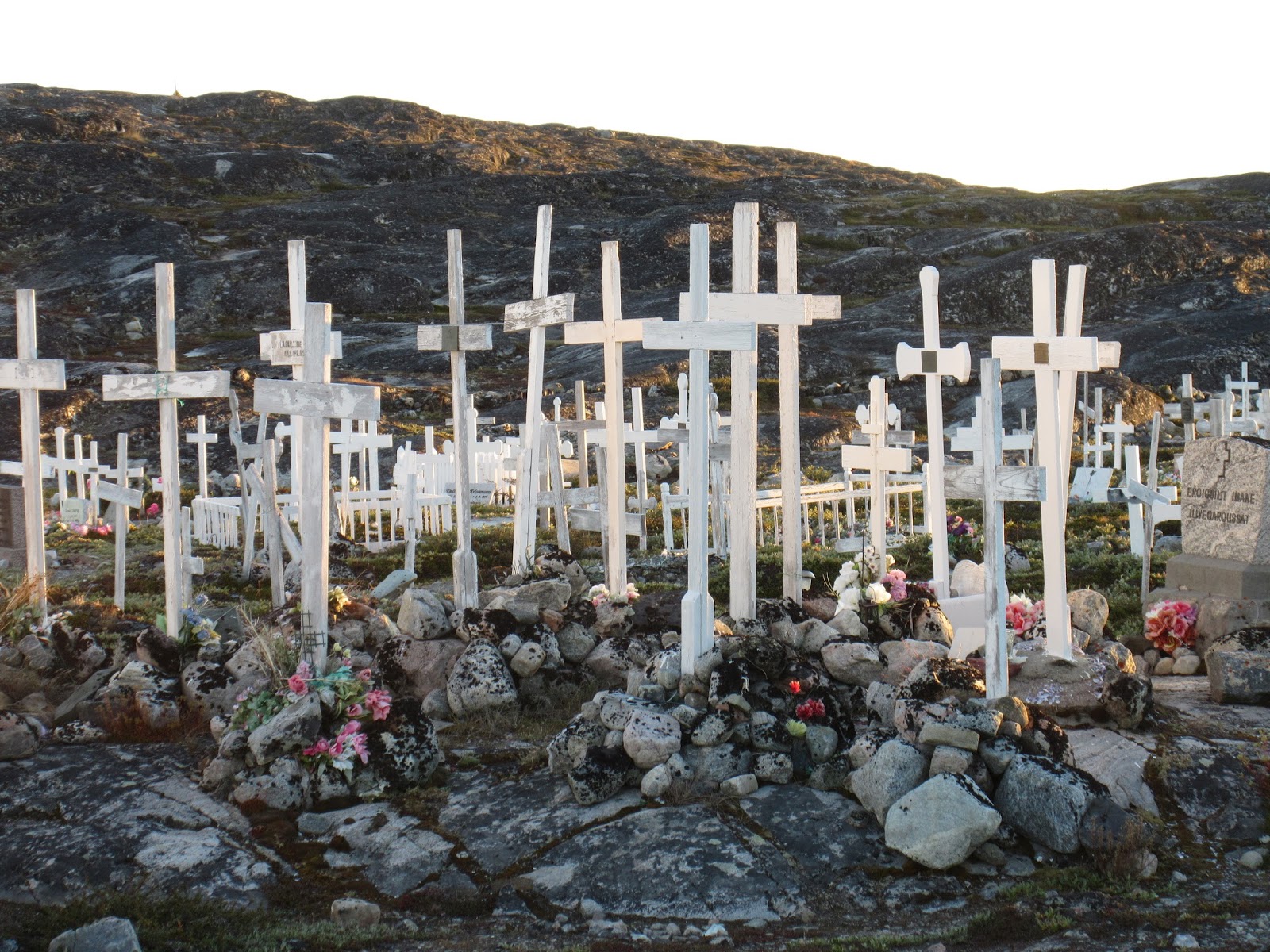
                                                                     Ilulissat, photo by Nancy Campbell, 2015


Nancy and I have never met - though I hope we do, one day - and she did not know my stepdad, but by a quirk of fate, she became intimately involved in our bidding farewell to him. His twin brother, who lives in Copenhagen, hopes to scatter his remaining ashes in Ilulissat next year. Then the farewell will be complete.  I think of how our lives are threaded, my stepdad could never have known that the artist whose cards he enjoyed so much in the last year of his life would be taking him home to Greenland. And Nancy, when she favourited a photograph - garden snowdrops I'd taken on my very unsophisticated phone - could not have known where that would lead.

It is seven months now since my stepdad's passing, my own grief is more gentle, for sure, but it's without exaggeration when I say that he was my best friend. Now that he is gone I know this more than ever. I have yet to meet a kinder man. Thank you, Nancy, for what you did for him.


Friday, 10 July 2015

'Trying out different fathers' - my thoughts on Omar Sharif

Had tears today, hearing that Omar Sharif has died. Sad for his family, but happy for him that he no longer suffers the ravages of dementia. To me, he is more than the handsome Egyptian actor who glittered in Dr Zhivago and Lawrence of Arabia.

I grew up hearing that my father looked like Omar Sharif. My father was my mother's first husband, she met him in the sixties when he was a doctor and she was a nurse, a Mills & Boon romance without the happy ending. My father died in tragic circumstances when I was eight. My memories of him are hazy. He looks handsome in photos, and I can definitely see the resemblance (though I think Omar had the edge). When I first saw Dr Zhivago - aged thirteen? - I couldn't watch Omar Sharif without thinking of  my father. The tram scene had me weeping, and not just because Yuri  doesn't get to see Julie Christie again. I've since seen Dr Zhivago many times over the years, and the tram scene is me watching my father dying, which sounds fanciful, but that is the truth. My memory also tells me that I first saw Dr Zhivago in Karachi, when we visited in 1974 (after my father had passed away), but that is not true, I watched it a few years later at the cinema in Glasgow.

And I still can't even listen to Lara's Theme without welling up.

In May, when the media revealed that Omar Sharif had dementia I had a lump in my throat, having recently lost my beloved stepfather to dementia. To know that this brilliant actor now had dementia  touched me. And when my stepfather passed away, five months ago, I was unable to contemplate even a sentence of the novella I've been slowly, slowly writing, based on my father. My head was full of Greenland, there was no room for Karachi (my father was my father for eight years, my stepfather was my father for thirty-eight years).

The character based on my father is called Omar, I'd juggled many names but Omar fits best. Recently, I've ventured back to the novella when I have 'spare' energy - creative writing is much more physically and mentally demanding that you would think - but I'm a different person writing as I no longer have a stepfather, there is a huge gap where he should be. Moreover, fictionalising my father has its own griefs and complexities: I  think of Bernard MacLaverty who has spoken of 'writing as a way of trying out different fathers'.

I say to my mother sometimes, Did he really look like Omar Sharif? Yes, she says, he did.

RIP, Omar Sharif.  In the meantime, I will try out different fathers.

*I watched Monsieur Ibrahim last year, I recommend it. ** The character is no longer Omar, but I am not saying who he is now, don't want to jinx.


Sunday, 21 June 2015

The longest day

Today is the longest day and also Father's Day - the first one without my beloved stepdad. I can hear his lovely voice. I think of the hours I spent with him showing him pictures of Ilulissat on the iPad. He couldn't grasp how they got there, he thought I had done it, I'd explain, it's the internet and he'd say I didn't know the internet was interested in Greenland.

Since he left, I wear his Harris tweed jacket when I'm cold or missing him, it feels like he's hugging me. Today, I miss him and feel cold, it's freezing, June in Scotland usually is. So the Harris tweed is doubly needed, and I feel like a student in eighties again, when we'd wear  mansized - usually, our boyfriends' - clothes.

An orange poppy bloomed this morning, of course I see it is a sign that he's here.

And below some gorgeous wee pink wildflowers that I rescued before my mother, who was visiting, mowed away.


Thursday, 11 June 2015

Hanging bath mats on the gate

It is eighteen weeks since my wonderful stepdad passed away - I can still not write the word 'died' beside him, in the same sentence. The raw shock and awfulness has faded, but I miss him terribly and still find myself in tears unexpectedly. I found some writing from three years ago, when I was visiting him and my mother:

A seagull shat on me today, I thought, at first, it was a giant raindrop on the back of my hand. I looked up, the sky was empty and blue. My stepdad said he'd seen the shadows of *two* seagulls. Hard to know if he had as he is  retreating more and more into his own world (he puts the olive oil in the fridge, I take it back out, he puts it back in, I take it back out). Then he hung the bath mats on the garden gate to dry, they had been on the clothes horse, but for his own  - perfectly valid, I'm sure - reasons, he wanted the clothes horse back in the garage, and the mats on the garden gate. 

I remember him hanging the bath mats on the garden gate: a chemical engineer with a head full of equations and science, hanging the bath mats on the back gate.

*

So, to mark eighteen weeks without this lovely man,  here he is with his identical twin in their beloved Greenland, probably 1933.


Tuesday, 10 March 2015

Sliding down Mt Everest

This is utterly gorgeous footage of the Himalayas. Made me think of both my dad and my stepdad. In the seventies, we visited Murree Hill Station - in the Himalayan foothills -  with my dad's family in Pakistan, after his death. And a couple of years ago, my step dad had taken to telling us that he had climbed Mount Everest in a day and slid all the way down. He was very well travelled, but we are sure this didn't happen. We got used to his false memories and stopped contradicting him, it was more gentle just to listen.

Thursday, 19 February 2015

It's hard to be original about grief

It's very hard to be original about grief; it's a time to be got through, that is all. Today, I find it hard to believe that I lost my beloved stepfather two weeks ago. After the phone call, the immediate minutes, hours, days passed in a blur. I veered between wailing and relief for the first week. He was 85 years old and had been spiralling further into severe (vascular) dementia, but we did not know he was so poorly, we thought we had him for a good while longer. He died peacefully in his sleep, but his passing was a shock, especially for my mother. He will be spared the indignity of not knowing who he is, not knowing who we are, and so will we. But he has left a huge gap, he was a wonderful man, the kindest man I knew. I was lucky to have him for my stepdad for thirty-eight years. A few weeks ago, I had underlined and tweeted a quote from Damon Galgut's In a Strange Room: 'In every departure, deep down and tiny, like a black seed, there is the fear of death.' I could not have known then I would not see my stepdad again.

The day before he died, he was sitting up in bed eating trifle and reading one of his many Greenland books. When, a few days later, my brother and I accompanied my mother to register the death, the registrar asked us what my stepfather's father's occupation had been, we answered, the governor of western Greenland. The registrar half-smiled as she typed and said, I've never heard that one before. We smiled too and the sun shone and we glimpsed a time when the ache of not having him will have given way to gorgeous memories. Meanwhile, we wait.

Wednesday, 24 September 2014

Five days after the morning after

It seems like months ago we voted to stay or go - I had a tear in the polling booth, it felt like destiny was weighing on you -  a real chance to make a fairer country - but not even a week has passed since the Scottish referendum. Last Thursday night, it felt like Hogmanay, but you didn't know when the bells would be, or if there would even be bells. I sat up 'til just after midnight but had to go to bed, woke up at six, so nervous, saw a FB message from a friend in Australia, saying, I don't understand all these Nos, my heart sank, and I turned on television to see that No had just won. Alex Salmond made a speech. I wept. My mother - I was staying with her for a few days while my stepdad was in respite care -  knew before me - she'd been up during the night. Friday was a day like no other I have experienced: a tangible grief being felt by 1.6 million people in Scotland, while 2 million others were celebrating, or, if they'd voted No out of fear, thanking their lucky stars. Worth noting, again, I think, that many of us who voted Yes - I think almost half - are not nationalists We simply want a better country, a better everything.

But there was  an 85% turnout, which is, in itself, a wonderful thing. Most of my family voted Yes, half of my friends voted No. There were interesting discussions to be had, certainly, but no one fell out.

Of course, the extra powers promised - aka the vow/bribe made to Scotland by a sleekit, panicked Westminster galloping up north when it thought Yes might just win - were instantly clipped onto wider constitutional reform - the question of only English MPs voting on English issues - when Cameron made his victory speech early on Friday morning. When - if at all - we will see those extra powers remains to be seen. I'm not holding my breath. As Lesley Riddoch said, we've been put to the back of the constitutional queue.

I read so much before and after the 18th, it has all blurred into one, but I thought this was a good article by Jonathan Freedland, the day after.  Also enjoyed this yesterday, by Iain Macwhirter.  I am gutted we didn't get independence, but the referendum was a fascinating event to live through and I will keep my polling card forever. I do believe that politics in the UK will never be the same again. SNP membership has doubled since the result on Friday. The Greens and Scottish Socialist Party are enjoying increases too. Labour is standing in the corner in disgrace for its part in joining with Team Tory to scare the bejesus out of us if we voted Yes.

My stepdad came home from respite on Monday and my mother asked him what he thought of the referendum  results. He replied, What referendum?  Knocking his forehead with his knuckles, he said to me: My brain is mud. My intelligence is still here, but my memory is not. He had a postal vote, but has no recollection.  Later, as he poured himself a wee whisky, he shouted through from the kitchen, Where is Arran?

I've had a *horrible* few days of illness, classic ME, and was mostly in bed for three days (tweeting from my pillow). Thirty years on, this is beyond a fucking joke. Still, on Monday I had an hour in my parents' garden reading, an Indian summer indeed (though it's dark now by half seven).

The article in the photo is from The Sunday Herald - the only newspaper to back independence - well worth reading, by Paul Hutcheon. And I ordered 'Autobiography of an Unknown Indian' by  Nirad C Chaudhuri after reading Ian Jack's very interesting pre-Indyref article last week: Is This the End of Britishness?  Personally,  while I love some things about Britain - our precious NHS - increasingly under threat - is a gem of gems - I've never felt particularly British. I feel Scottish, emotionally and psychologically, though my outlook by default is international. My mother is Scottish, my late father was an Indian-born Pakistani (I'm slowly exploring my Pakistani side, such as it is, in my current writing project). My stepfather is Danish, my sister-in-law is German. My most meaningful longterm relationship has been with someone not from UK. Moreover, the referendum to me was not about Britishness or Scottishness, or anti-Englishness - the worst accusation slung around by media - it was about fairness and social justice. I knew we weren't going to wake up in Norway, but a Yes vote would have surely given us the template for a more equal society.
 *
I'm home now and desperately hoping the baby squirrels haven't been hurt by the ever-present, prowling gangster neighbourhood cats. And I just love the poem 'The Morning After' by Christine de Luca: here it is being recited by Scottish 16 and 17-year-olds, first-time voters. Indeed, 'there are dragons to slay whatever happens'.

And here are the results in full. But, as Jonathan Freedland above said, 'When close to half the population of a nation inside a union wants to break away, the state of that union is not strong. It is fragile'.

There are, for sure, interesting times ahead.

*Update And this by Gerry Hassan worth reading too.

Tuesday, 20 May 2014

Reading a novel when you have dementia

I've been thinking about what it's like to read a novel when you have moderate to severe dementia. My stepdad can no longer follow the plot in a film or drama or Antiques Road Show, constantly asking my mother who is who and what is what and when is Thursday, but he still loves to read. Whenever I visit, he always has a book on the go, on the table downstairs and at night by his bedside. I love to see him reading, absorbed in what he is doing, getting pleasure. I watch and wonder how much he is remembering, I'm fascinated by what he retains from page to page. If you ask him what  the book is about he can't really tell you but he might turn it over and read out the blurb on the back.

Sunday, 23 February 2014

Fathers & stepfathers & childhood homes

I was surprised - and flattered - last week to learn I'd been nominated for a *Scottish Asian Women's Award, in the 'achievements against all the odds' category. I wondered what I had done to qualify: it's five years since my novel came out, though perhaps someone saw The Scotsman story or the repeat of the BBC Alba documentary.  I don't, to be honest, feel particularly representative of Scottish Asian women, though I am proud of my Asian roots, they are part of who I am.  If I see an elderly Asian man in the street, my heart collapses gently. I often say I feel  'fake' mixed race as my Pakistani father, born in British India, died when I was eight and I didn't really grow up between two cultures; I am more in tune with what an alcoholic father is than a Pakistani one (I'm in the painfully snail-slow process of writing about him - unexpectedly painful in several ways - although it is a highly fictionalised account). He was doing his medical degree in Bombay at the time of Partition, and I'm fascinated by what that must have been like for him.

I actually withdrew my name from the awards as I couldn't attend the judging panel, it was far too short notice, I must always plan my energy meticulously, though I think they are still trying to arrange a later date for me. I do, of course, feel representative of women (and men) with ME and if this nomination can spread awareness, that is fine and dandy.

I spent yesterday with my Greenland-born Danish stepdad, he continues to drift into his own wee twilight world of dementia. Sometimes, I sit with him and google Greenland just to see what comes up. We look at videos of Ilulissat, the town where he was born, and he exclaims, That's the hospital! Or That's where Per and I had our confirmation, pointing to the beautiful old church. The house he grew up in is now an art museum with a permanent collection of Emanuel Petersen, a Danish  artist. He was overjoyed when I showed him this.  

I was in my own childhood home last summer for the first time in almost thirty years. Last year, some of my Pakistani family visited Scotland, I hadn't seen them for many, many years, we went out to Loch Lomond in two black cabs, ten of us, and we stopped outside the old house. Like a scene from a movie, we lined up against the wall and had our photos taken. The owner was in her garden and kindly invited us round the back to have a look. I was  physically and emotionally shattered from the trip and when I saw my uncle's heels disappearing into the kitchen I thought I was dreaming, but sure enough the owner had invited him in. I went in after him and it was surreal to be in a house that was mine and wasn't mine. The stairs up to the bedrooms seemed so steep and I remembered how I would have to sit down to rest halfway when I became severely ill with ME. The most surreal thing was to look out the window of the back bedroom and see my Pakistani cousins' children playing on the swing.

*update: Uuganaa Ramsay won the Scottish Asian Women's Award 2014. I reviewed her book MONGOL here.

Sunday, 27 October 2013

'While my brain is not shaming me.'

Last week, I took my Danish stepdad to an SNO concert at the UsherHall for his 84th birthday. A hop and a skip from me. He loves classical music, knows much more than me, though has forgotten most of what he knows. It's well-documented that music is beneficial for people with dementia, it seems to unlock memories (I've started visualising dementia as having a huge padlock around your head). Whenever I am with him now I automatically take his hand or link in to his arm. He always tells me that he can't walk fast these days - he has completely forgotten that I can't either, and his pace is perfect for me. 

The conductor was Danish, Thomas Søndergård. My stepdad told me how to pronounce his name and when he came onto the stage he said,  not quietly, There's Klaus.  It’s not Klaus, it's Thomas, I whispered back. I had the programme on my lap and he must have taken it about ten times during the concert and read it and handed it back to me. He also had his walking stick between his legs, propping up his hands periodically. I kept an eye on the stick, afraid it would fall and clatter. I felt like I was doing my own conducting, making sure things would stay calm. I kept looking at his knees, he was wearing his new brown cords, so dapper! 

If I sit for more than twenty minutes I get vicious pins and needles, so I kept moving my feet, subtly (I hate fidgeters myself and want to stab them). I held my stepdad’s hand off and on and kept looking at his face to see his responses to the orchestra. At times, he seemed transported by the music, at times, he was not focused at all, looking around the hall. He kissed the side of my head a couple of times.  During the Mendelssohn, he turned to me and said, not quietly, Good pianist. I gently said Ssh, and he said, twice, They can’t hear us. I suppose he had a point. And the pianist was wonderful. I was fascinated by the whole orchestra, their arms, all those arms,  violins and cellos, all that lactic acid. I can’t see this kind of thing without marvelling at the ability to sustain movement without utter exhaustion. 

At the interval I’d pre-ordered a wee Glenmorangie for my stepdad, and the bar, standing only, had kindly put two seats aside for us. My stepdad was happy, but asked if he could have ice in his whisky. He has never in his life taken ice. On the way home, I asked him if he had enjoyed himself and he said, Up to a point. He enjoyed the Mendelssohn but found the Brahms finale 'a bit too fierce'. We both loved the second movement. Later, he said to me, While my brain is not shaming me, can I thank you for the lovely time you gave me? He is still aware that he has memory problems and will sometimes knock his head with his fist in frustration. He had already thanked me several times and will do so again the next time I see him.  I loved my evening out with him, I had a gorgeous time.

Sunday, 20 October 2013

On the same page

I saw Dr Nigel Speight, retired consultant paediatrician, speak yesterday afternoon, it was a joy to listen to a doctor express such openmindedness and curiosity and compassion about ME. He was on the panel of the International Consensus Criteria 2011, so it is not surprising he is such a great advocate. It was frightening to hear what some children with severe ME are being exposed to in terms of psychiatric assessments. Shame on all of those assessors. This from an ME conference in Northern Ireland in August gives a flavour of what he was saying yesterday.

(Interesting too that when he first got involved in ME in the mid-1980s in Durham he was seeing a lot of Coxsackie, which of course is the virus that triggered my own ME.)

*

So Eleanor Catton has won the Man Booker for her second novel The Luminaries, hugely impressive at 28-years-old, her acceptance speech was gorgeous, though I have to say the book itself does not appeal to me.  I don't think it appealed to Robert McCrum either, who wrote this, a bit uncharitable I think,  before the prize was announced. Still, passions run high when it comes to the Booker.  I did agree with him about the Ozeki and my mother liked it even less, she left me a message on Tuesday night saying, Thank God that awful book didn't win (I'd persevered because it was Booker-shortlisted and I believed it had to redeem itself at some point, she persevered because my stepdad had given it to her for her birthday, which means I had given it to her as I choose all my stepdad's gifts for her now, his dementia is, of course, worsening).

 In this Guardian interview, I like Catton's comments:
It is the peculiar constellation of her age, gender and the particular nature of The Luminaries that has, she believes, provoked "a sense of irritation from some critics – that I have been so audacious to have taken up people's time by writing a long book. There's a sense in there of: 'Who do you think you are? You can't do that.' Something else related to that is to do with the omniscient third person narration of the book. There's a feeling of: 'All right, we can tolerate [this] from a man over 50, but we are not going to be spoken to like that by you.'"

In my current writing project, am wrestling with 3rd person omniscient myself, though I will soon be as old as those male critics. But it is a challenge and I will hopefully get there  (I like that much is made of the ten year gap between both Ruth Ozeki and Donna Tartt's last books - for those of us who have horribly limited energy, ten years are nothing.)

 I also enjoyed dipping into this timeline of the Booker, the backstage gossip.

*

Very long novels can be off-putting, and Cornflowerbooks has written a post asking if we are discouraged from reading books  because of their length (I'd say yes).  Still, I am keen on reading The Goldfinch, though have not been able to get into Donna Tartt before. I loved her on The BBC Review Show last week,  her clarity and confidence. When Kirsty Wark suggested that secrets were at the heart of all of her books, she replied that secrets are at the heart of all novels. This I loved. And while Kamila Shamsie (above) raved about The Goldfinch, Julie Myerson was not impressed at all.


And if there were a Booker 2013  for ME doctors, I'd give it to Dr Speight. He has helped children with  ME enormously (I think he said he had seen almost 600 cases nationwide over the years). With fiction you can argue whether a book is good or bad, it is subjective. Medicine, of course, is not always black and white either: experts can disagree, have conflicting views on the best treatments. That is different though than manipulating a neuroimmune illness, turning it into a psychiatric illness, moulding it like Plasticine, as the Wessely school have done since the late 80s. Dr Speight began his talk by apologising for the medical profession's treatment of people with ME. You know you are on exactly the same page when a doctor does this. We need many more like him, those who are passionate about the pursuit of truth.

More on Dr Speight's career here,  scroll down to see.

Wednesday, 8 May 2013

Reading from a Chesterfield with Lister looking on...

Last week, I read at the Dissecting Edinburgh 'Writing Medicine' event in Surgeons' Hall, alongside Alison Summers and Tracey Rosenberg (their websites are listed in the previous link). Alison is writing a novel about Pick's disease, and Tracey, a novelist, has also published poetry about cancer. The venue was changed from the pathology museum to the library and what a gorgeous library those surgeons have!  I had a wonderful Chesterfield armchair and  Lister looked down from his painting behind me  - I felt protected. I should say I was not on my best form, I was wrecked  even before the reading - I was in bed until four o'clock -  but that lends to the authenticity, I guess. Alison and Tracey are both great performers, I loved their energy. This is only the second time I have read from The State of Me in public - though I did read a short extract on the BBC Alba documentary 'Toxic Tiredness' in 2011, but that felt different, the audience was not yet present, I read to a camera man at my kitchen table (you can be more sassy in your kitchen). I was saying to friends, after Surgeons' Hall, that at my Waterstone's launch in  2008 - it still had an apostrophe then! -  it felt very much like I was reading fiction aloud,  my precious novel out at last, after all the hype and craziness before publication. This time though, I felt almost tearful when I was practising the extracts beforehand - it felt like I was reading about my life - Helen Feet's plasma exchange in the eighties, and  I felt sad.  But what a treat to have read in Surgeons' Hall. And lovely to see some of my friends there and new faces too, though it is a big tangle of colour when everyone is focused on you. My head gets that inflated/pumped up feeling and I have to take myself away and untangle the threads.

* Delighted to hear from Alison that she loved The State of Me, which she has just finished reading.

Wednesday, 1 May 2013

The power of narrative (for good and ill)

I am increasingly interested in why we read stories, I think it might make you a better writer if you understand the seduction of narrative (though maybe it is better not to think about these things at all, and just write).  I've been dipping into The Storytelling Animal by Jonathan Gottschall:  The riddle of fiction comes to this: Evolution is ruthlessly utilitarian. How has the seeming luxury of fiction not been eliminated from human life? My stepdad continues to bemuse us with narratives based on false memories - and what else is narrative if not memory? - he told us at the weekend that he had travelled across India by train in the nineties. He also referred to dinner plates as 'big flats', which is just poetry. I've been horrified at the pre-election violence in Pakistan (my family on my father's side live in Karachi). This clip from a couple of weeks ago is unbearable to watch, capturing a young boy's trauma after a bomb has gone off in Peshawar.  I cannot claim to understand much of the political narrative that is playing out in Pakistan at the moment, but my heart sinks at the seemingly  endless cycle of violence. This is an interesting article  by doctor and writer Qanta Ahmed, who lives in New York. She explores the twisted, nihilistic  narrative that seduces young men like the Boston bombers - there is no motive, just narrative which brings 'meaning' to their senseless and cruel  acts.

Sunday, 7 April 2013

Poetry of dementia (2)

Last weekend, I was googling Greenland just to see if I could find anything of interest for my stepdad (he grew up there in 1930s and '40s), and we came across this article from the Independent on how they can now grow vegetables in Southern Greenland because of warmer temperatures. I printed the article and he read it a couple of times. Where did you get this? he asked, fascinated. The internet, I replied, everything is on the internet now. That's great, he said, I didn't know the internet was interested in Greenland.

Friday, 16 November 2012

Doctors & patients & writers ...

I attended a talk mid-week on doctors who also write, a hop and a skip from me. It was a long talk, almost two hours, and I found it so hard to concentrate towards end but it was very enjoyable hearing these three medics talk about their dual lives. You do not come across writing doctors very often and I was especially interested in their concerns about self-censorship when they also have such important social roles as doctors. During the Q&A someone referenced Virginia Woolf's essay 'On Being Ill'  - she wonders why there is so little fiction written on illness - and it seemed a good point to mention The State of Me. I said I was a patient turned writer and that self-censorship can be an issue for all writers. These doctors were all charming speakers - two are GPs, one is a child psychiatrist - and I wonder what their thoughts were when I said I have ME and have written a novel about it, that I was passionate about education through fiction. I did not mention my name or the book's title, but I wish now I had taken copies to give them.

After last week's travesty of science - and Prof Malcolm Hooper has written, as always, an eloquent response - I really have  no idea how we fix the distorted narrative. I think we have to look to the rest of the world, international biomedical research.

I have remembered a BMJ podcast from 2010 where Simon talked about ME. (This was during XMRV hype -  I always remained neutral, if XMRV was the answer, great, if not, let's move on to next thing (and we know how that all turned out). However, I have personally known since 1983 that my illness is connected in some way to my immune response to the Coxsackie B4 virus. The often not very bright media now tries and twists it to make out that it's only since XMRV that patients/researchers have linked ME to a virus. And that no XMRV = no virus. Not so.)

Anyway, in this podcast, Simon speaks around 4.25 mins in about the broad/narrow definitions of the illness, which of course is the whole crux of the conflation and chaos, though he does not seem too concerned with the chaos. The patients Simon sees/researches apparently get better with CBT and graded exercise therapy (GET), whereas those of us with my illness get worse with exercise, and I will keep saying this to those who will not listen. It struck me also that he had spoken back then about the need for other researchers to get involved, and 24 mins in, sounding very relaxed, says: 'Other disciplines should get more involved because CFS is under-researched' ...'and you'd be surprised to learn is actually  a very enjoyable and  very rewarding area of research.'

Very enjoyable and very rewarding.

No mention of the 'acute hostility and bravery' that last week earned him the John Maddox prize. The acute hostility - and I am not questioning that threats were made, I am sure they were, and no one would want to condone this - was, unnecessarily, ramped up to unbearable degrees  last year by a hysterical media, which  resulted in an entire patient population being (further) demonised. We can only wish  that Simon had perhaps practised some self-censorship in his dealings with the media.

Of course, if you actually *know* about the politics surrounding this illness  the Maddox award video seems like a spoof, like something from Drop the Dead Donkey - a newsroom satire from 90s -  an observation made by my mother. They're all daft, she said, shaking her head when I showed her. Bloody bastards, said my stepdad - who now has dementia - and later came into the living room with a pan on his head  - he loves joking with hats - but he has always been a source of great support to us throughout my illness, especially at the beginning, the utter, utter hell.

Am highlighting again this young scientist's blog where an informative discussion went on after the Maddox prize - it makes a change to have a thread where PWME are not drowned out by obnoxious, hostile, uninformed voices. *And then there is another young medic who exuberantly denounced PWME for 'stigmatising mental illness' and told us we have to grow up. He has obviously been fed the Wessely school narrative, and nothing else, but I  hoped he would be willing to educate himself and learn there is another narrative to explore.

After my novel came out in 2008 I breathed a huge sigh of relief, I honestly thought I'd never have to defend my corner again, I felt my job was done. But when we are continually assaulted  - and it *does* feel like assault - by twisted narratives and half-truths, we have to speak up, though it is truly and godawfully  sapping.

We have to speak up. These are our lives.

*I see this page has been removed, perhaps the young medic at www.thetwentyfirstfloor.com had a rethink about being so rude about an illness he clearly knows little about...


Wednesday, 16 May 2012

Gorgeous

At the weekend, my nephews' village primary school won an inter-school football tournament, an unexpected victory.  I heard that one wee boy who didn't even play - too young - took his shirt off and did a lap of honour. Gorgeous. The team is  being taken to an Italian restaurant for lunch this week, what a fabulous treat (I can't recall anything remotely as sumptuous at primary school). But this is a  generation of nephews who ask for Jamie's summer salad in their packed lunches.

My older nephew, still glowing, actually glowing, from the gold cup victory, can now play 'Mull of Kintyre' on the trumpet. He wanted to skype and play to my mother, not realising she is too ill just now. I can't wait for my session.

And: 'The clouds are punctuating the ceiling': my stepdad's explanation of the crazy May sun/shower cycle we're having.

*for those not in UK, this is Jamie.


Tuesday, 8 May 2012

The poetry of dementia (1)

My Danish stepdad is (gently) forgetting his English as his dementia progresses and  last night he, quite fabulously, referred to fish fingers as 'fish pins'.  Lamp posts are now 'light poles' and lifeguards are 'sea rangers'. My mum has been ill and  as we waited for her having out-patient tests yesterday, he said: 'She is no ordinary, everyday human being of any kind, she is my wife.' Tautological, but wonderful (and heartbreaking). Later, my mum and I were chatting about how she is never  ill - the only times she recalls are malaria when she took us to Pakistan in seventies; having to have a salmon bone removed by general anaesthetic during a trip to Finland in nineties, and, more recently, a slipped disc. My stepdad turned to us and said: What's that about Ed Miliband? 

'Salmon bone in Finland' heard as Ed Miliband: the poetry of dementia.

Saturday, 29 October 2011

Memories

Sadly, two of my friends have lost a parent recently, aged early seventies, and yet my lovely stepdad just celebrated his 82nd birthday, he is physically doing pretty well, has had both knees replaced,  has survived prostate cancer and he always looks dapper, even when he is just shuffling round the house, I think that is because he is Danish - he never looks untidy. Still, he is now in his third year of vascular dementia, so there is much untidiness of thought. He calls Tinker, Tailor, Soldier, Spy  - Tinker, Tailor, Soldier, Spiderman, and he is not joking. I know about dementia, I volunteered for Alzheimer's Scotland for five years in the nineties and my wee aunt got dementia in her forties, a few years ago - the combination of Down's and dementia surely one of Nature's cruellest quirks, she died in July. My stepdad has always had quirky sayings and I'm not sure now whether what he says is a result of his memory being destroyed, or just his own way of saying things: I don't have eyes in my neck (I don't have eyes on the back of my head) and  It's on my house  (It's on me, I'm paying). It was 'on his house', and we had coffee in Waterstone's and on the way in he asked if they still had my book, so he remembered my book launch from three years ago, I was impressed. But later he fell, missing the last step, not realising the bannister curved in the other direction, I did not see this mishap, my mother was with him, on their way to the toilets, but he assured me  'he had no wounds'. I am so glad he is fictionalised as Nab in my novel, some of his wonderful traits in print forever.

Friday, 8 October 2010

NICE and Aricept

Delighted to see that NICE has revised its stance on prescribing Aricept for dementia patients in the early stages. This is wonderful news indeed. I used to volunteer for Alzheimer's Scotland in the nineties so am well aware of the issues. Also, now experiencing the illness closer to home, a couple of family members. Just shows how wrong NICE can be.