Showing posts with label greenland. Show all posts

Monday, 10 April 2017

A Book of Banished Words

Delighted to have a short piece in Nancy Campbell's just published The Polar Tombola: A Book of Banished Words (photo from @BirdEditions).


More on  Nancy's live literature event  here: What happens when a language begins to disappear?


I first met Nancy on Twitter via a photo of a snowdrop three years ago and we came to 'know' each other through my dear late stepdad. My own banished word is described in 'The Hoot of an Owl', here is a fragment:

Coxsackie – pronounced cook-sah-kee – is the name of a small town on the Hudson River in upstate New York. Derived from Native American language, it’s said to mean the ‘hoot of an owl’. Poetic when whispered, but Coxsackie can also be a bully, swaggering its hard-sounding ‘C’s.
*

Life is truly stranger than fiction. How could I have known in winter 1982 that the hellish illness that had ruined my year in France - yet to be diagnosed as Coxsackie virus, which in turn triggered ME - would, thirty-five years later, be represented in a piece in a beautiful art book whose author had (by then) done a residency in my stepdad's childhood home in Greenland?

Tuesday, 24 January 2017

A change of mind...

Fiction titles are sometimes changed to be more nuanced and suit the country of publication. For example, Miss Smilla's Feeling For Snow by Peter Høeg, translated from the Danish - I gave it my dear late stepdad in 1993 - was published as Smilla's Sense of Snow in the USA. Smilla - a half Danish scientist with an Inuit mother -  has 'a feeling for snow', which is helping her solve the death of an Inuit child who is her neighbour's son in Copenhagen.


What may be more surprising is that the UK title of Suzanne O'Sullivan's popular-science book It's All in Your Head (2015) has been changed to Is it All in Your Head? for  recent  publication in USA.


This title change from bold declaration to interrogative has, I'd bet, nothing to do with British/American English differences but more suggests that publishers are now well aware of the fire O'Sullivan has come under for her ludicrous, irresponsible and harmful chapter 'Rachel', in which she frames ME/CFS as psychosomatic. This 'subtle tweak', of course, does nothing to ennoble the content, but does highlight a lack of certainty, which is surely a little embarrassing for a prize-winning science book. We can only hope that the next tweaking will be Is it All in Suzanne's Head?

*

This is a very good recent paper from Leonard Jason and Julia Newton and others, which explains the differences in criteria between 'chronic fatigue syndrome' and myalgic encephalomyelitis - signalling how crucial it is to know which disease we are diagnosing/studying (Suzanne O'Sullivan would do well to read it). Ramsay-defined ME - also known as classic ME - has the most physically impaired patients - and to fit the criteria you must have: acute onset with three major symptom categories: post-exertional malaise, neurological manifestations,  autonomic manifestations. Of course, I have all of these, though in the eighties, we didn't yet call the tell-tale burning/exhaustion in muscles 'post-exertional malaise' (PEM), we didn't know not being able to stand was 'orthostatic intolerance', and we didn't know not being able to remember the names of neighbours we had known for twenty years was 'brain fog' - we just felt as if we were dying.

Saturday, 7 January 2017

On fathers: Om Puri, Hisham Matar and some short writing

Saddened to learn that Om Puri has died aged only sixty-six. I loved him, of course, as the flawed Pakistani father in East is East. And as the taxi driver in My Son the Fanatic (based on a short story by Hanif Kureishi). I watched him more recently in Satyajit Ray's 1981 film Sadgati/Deliverance - Puri, in his early thirties, gave a devastating performance as an 'untouchable'.

*
The last book I read in 2016 was Hisham Matar's The Return. Anne Enright describes it as a terrible and lovely book, and it is: the writing is lovely and the truth is terrible, the knowing and not knowing the brutality of his father's death at the hands of the Gaddafi regime in the nineties. I underlined several passages as I read, words that stay in my head: 'I have always wondered if it is possible to lose your father without sensing the particular moment of his death'.

*

Happy that 2017 will see with the upcoming publication (print and digital) of Bath Flash Fiction anthology - I had a story longlisted almost a year ago - 'A widow with a bowl of wine and lipstick coming off'. This flash was inspired by seeing my dear stepfather in the funeral parlour in February 2015, the image still shocks me, though it was one of peace, but nothing about it was real, nothing.

I've not written much flash fiction, I've read more, but I think flash titles are very important, they act like a hinge for what's unfolding. I see flash fiction like fireworks - small with a beautiful punch - but still demanding time and energy in creating. Flash lends itself well to low energy writing. And as you tweak even 300 words,  you know more than ever, as you shift the words around in such a small space, how arbitrary it all is.  The story was accepted by an online literary journal at the same time as it was longlisted and I had to decide where I wanted it placed. I look forward to seeing my words - which with time passing now seem 'remote'  - see the light of day.

Saturday, 12 September 2015

Art and death and farewells in Glencoe and Greenland

Twitter can be wonderful. I first met artist and writer Nancy Campbell via Twitter, last year in March. Nancy had favourited a snowdrops photo and I discovered she had produced a beautiful book in the form of artist's cards, How to Say 'I Love you' in Greenlandic. I immediately got the book for my stepdad (I may have traded a copy of my novel for Nancy's work, I can't recall - I've done this several times, used my novel as currency for art).

My stepdad spent many happy hours reading through the cards, enunciating the Greenlandic words - I can see and hear him now - correcting me when I got the pronunciation wrong. Childhood memories are important in dementia, and we didn't know the old songs/fairytales/poems that would stimulate him, so these cards played a special role.  When he died, I wrote a message on one of the cards, wrapped gold ribbon round it - a bit 'blingy', but it was all I could find - and placed it in his coffin. I wanted to put more things in - there is an instinct, I think, to put in many objects of comfort for the departing soul. Though, that is, of course, more to comfort ourselves.

I was delighted when Nancy told me she'd applied for an art residency at Ilulissat's Emanuel Petersen Museum, which, before it was a museum, was my stepdad's childhood home. We could not have known that by the time she did the residency my beloved stepdad would have passed away. By sheer coincidence my mother had planned to scatter his ashes in Glencoe, the same week Nancy was in Ilulissat. Nancy kindly asked if there were any mementoes of my stepdad's we would like her to take to Greenland. We decided to send her his order of service with loving messages written on the back by various members of our Scottish/Scandinavian family. I asked Nancy to perform whatever ceremony she could, I suggested making a wee paper boat and floating it away, but was putting the event entirely in her hands. I knew she would know what to do.

Scattering my stepdad's ashes in Glencoe - or more accurately Glen Etive - was a peaceful and beautiful occasion. The sun shone and we played Local Hero soundtrack gently in the background - he loved this music - and my younger nephew played a sad folk song on the violin. Buachaille Etive Mor stood solid and strong in the background. There were deer,  and house martins diving all around. My stepsister put a few drops of whisky on the ground to send him on his way. I brought back some wild flowers and pink heather, the flowers died straight away, the heather has survived and is on my bookshelves.


Early on in their marriage, my mother had a local artist paint Buachaille Etive Mor for my stepdad as a gift. It was one of his favourite spots in the world. The painting hangs in their house and now when I look at the painting I know he is there, physically part of the landscape. Internet connection in Greenland and Glencoe is, unsurprisingly, fickle, so I did not know what Nancy had done on that day, but I did think about Greenland when we were in Glencoe and was curious.

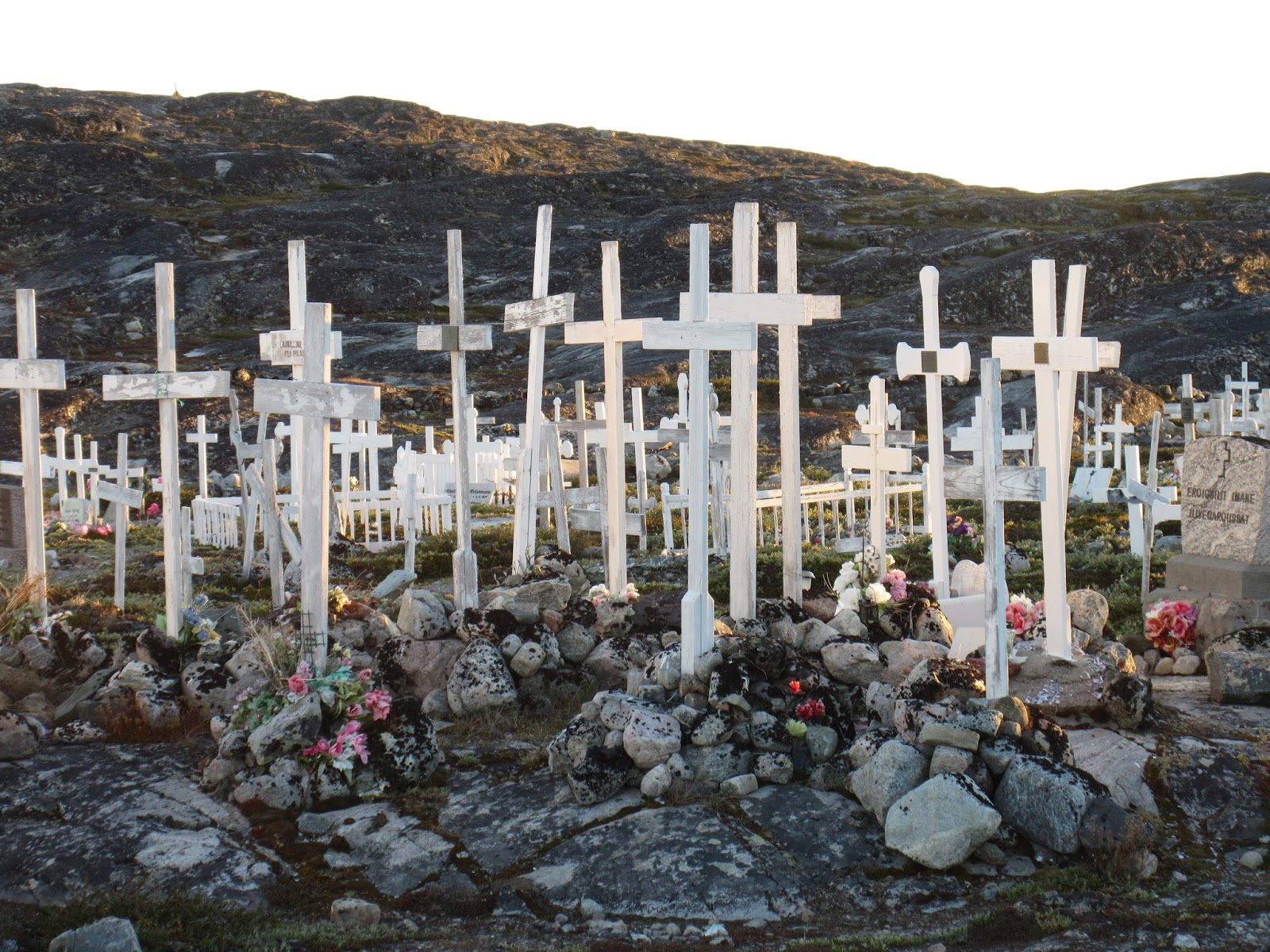
Last week, Nancy sent me a beautifully detailed, long email of what she had done, I read it in tears, touched by her great thoughtfulness and creative gestures. She had placed my stepdad's memorial card on top of the harmonium in the museum for a couple of days, among the stunning Emanuel Petersen paintings. And she put sage leaves around him that she'd brought from her garden in Oxford. She said she liked the idea of sage helping spirits to rest. After the harmonium, for the final goodbye, Nancy chose to place his order of service in an Ilulissat hilltop graveyard, under a piece of gneiss she had chosen as an anchor. She placed him at the southern most tip of the graveyard, pointing towards Scotland. She told me that in Inuit culture, wide views of the sea are important for the location of burial sites. This is a photo of the cemetery taken by Nancy. There are harebells and blueberries growing, and mussel shells and plastic flowers on the graves.
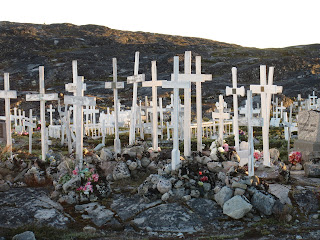
                                                                     Ilulissat, photo by Nancy Campbell, 2015


Nancy and I have never met - though I hope we do, one day - and she did not know my stepdad, but by a quirk of fate, she became intimately involved in our bidding farewell to him. His twin brother, who lives in Copenhagen, hopes to scatter his remaining ashes in Ilulissat next year. Then the farewell will be complete.  I think of how our lives are threaded, my stepdad could never have known that the artist whose cards he enjoyed so much in the last year of his life would be taking him home to Greenland. And Nancy, when she favourited a photograph - garden snowdrops I'd taken on my very unsophisticated phone - could not have known where that would lead.

It is seven months now since my stepdad's passing, my own grief is more gentle, for sure, but it's without exaggeration when I say that he was my best friend. Now that he is gone I know this more than ever. I have yet to meet a kinder man. Thank you, Nancy, for what you did for him.


Thursday, 11 June 2015

Hanging bath mats on the gate

It is eighteen weeks since my wonderful stepdad passed away - I can still not write the word 'died' beside him, in the same sentence. The raw shock and awfulness has faded, but I miss him terribly and still find myself in tears unexpectedly. I found some writing from three years ago, when I was visiting him and my mother:

A seagull shat on me today, I thought, at first, it was a giant raindrop on the back of my hand. I looked up, the sky was empty and blue. My stepdad said he'd seen the shadows of *two* seagulls. Hard to know if he had as he is  retreating more and more into his own world (he puts the olive oil in the fridge, I take it back out, he puts it back in, I take it back out). Then he hung the bath mats on the garden gate to dry, they had been on the clothes horse, but for his own  - perfectly valid, I'm sure - reasons, he wanted the clothes horse back in the garage, and the mats on the garden gate. 

I remember him hanging the bath mats on the garden gate: a chemical engineer with a head full of equations and science, hanging the bath mats on the back gate.

*

So, to mark eighteen weeks without this lovely man,  here he is with his identical twin in their beloved Greenland, probably 1933.


Thursday, 19 February 2015

It's hard to be original about grief

It's very hard to be original about grief; it's a time to be got through, that is all. Today, I find it hard to believe that I lost my beloved stepfather two weeks ago. After the phone call, the immediate minutes, hours, days passed in a blur. I veered between wailing and relief for the first week. He was 85 years old and had been spiralling further into severe (vascular) dementia, but we did not know he was so poorly, we thought we had him for a good while longer. He died peacefully in his sleep, but his passing was a shock, especially for my mother. He will be spared the indignity of not knowing who he is, not knowing who we are, and so will we. But he has left a huge gap, he was a wonderful man, the kindest man I knew. I was lucky to have him for my stepdad for thirty-eight years. A few weeks ago, I had underlined and tweeted a quote from Damon Galgut's In a Strange Room: 'In every departure, deep down and tiny, like a black seed, there is the fear of death.' I could not have known then I would not see my stepdad again.

The day before he died, he was sitting up in bed eating trifle and reading one of his many Greenland books. When, a few days later, my brother and I accompanied my mother to register the death, the registrar asked us what my stepfather's father's occupation had been, we answered, the governor of western Greenland. The registrar half-smiled as she typed and said, I've never heard that one before. We smiled too and the sun shone and we glimpsed a time when the ache of not having him will have given way to gorgeous memories. Meanwhile, we wait.

Thursday, 13 March 2014

I used to hate Twitter, now I love it

Before I'd ever used it, I hated Twitter, I was a bit Jonathan Franzen and thought it was nonsense. Now, I love it. It's perfect for low energy, you can dip in and out and say what you need to in 140 characters. And there are links to some great resources: I can bookmark articles in a jiffy and read later when my head is up to it (in truth, not all that's bookmarked gets read). My ME symptoms have been pretty bad this last ten days, that feeling of having weights in your head and neck and legs. And dizzy, so damned dizzy. I have fought it, tried to go out - I have shops on my doorstep, literally - only to end up spending long spells of the day in bed. I do restrict the number of people I follow to 500, otherwise it's too much like a flashing cockpit that I can't process. And I'm always tweaking who I follow: I hate to give up on someone whose tweets I like, but needs must.

The truth is that Twitter can be an Aladdin's cave (of course, it can be a hell-hole too, but you just don't go to those dark places of jabber-babble). I was so pleased before Christmas to discover The Mushin Museum in Cardiff, I was directed there by an anaesthetist when I was looking for information on anaesthesia in 1950s/60s for a novella I'm slowly, slowly writing, inspired by my doctor father. You don't use all the facts you learn, but you still need to know them, you need the mental 'furniture'. The curator at the Mushin museum  has been enormously helpful to me. By coincidence, I learned from an old CV just this week that my father had actually worked under Professor Mushin  - whom the museum is named after - in the early 60s. That gave me shivers. 

Then, the other day, I discovered artist/writer Nancy Campbell when she favourited a photo of snowdrops I'd put up that found its way to her. I learned that Nancy has written a gorgeous book called How to Say I Love You in Greenlandic, which I know will be perfect for my stepdad, it will revive his Greenland memories, so important now as he slips further into dementia. Through Twitter, we were able to be in touch directly and I have ordered her book.

I also came across The Istanbul Review recently. This gorgeous Turkey-based literary journal, 'with a presence in Edinburgh', is distributed in the UK by local indie store Looking Glass Books. I submitted some flash fiction to them last week on the off-chance and was delighted to have it accepted.

We all know Franzen gets his knickers in a twist about writers bragging on Twitter, sure, that happens, there can be dreadfully off-putting self-promotion - across all platforms - but you just avoid it. For me, social media is something of a godsend as I can't run around all over the place promoting my novel - but most of us use Twitter wisely when we self-promote - and why the hell shouldn't we publicise our writing, after the blood, sweat and tears that goes into writing, and having a book published!  But we also have a generosity of spirit towards other writers we admire, and that is invaluable.

Twitter is also a great tool for those who are chronically ill,  especially in housebound or bedbound phases. You can feel like shit with a capital S, but send out a tweet, a wee firework into the world, from your pillow. I often think back to my horribly ill days in 80s: unless you had physical visitors, it was a case of writing letters and phoning. Hard to believe now. I was 'amused' - if that is the right word - to come across a young woman with ME who had her many symptoms listed on an App on her phone, ready to present to the specialist she was seeing. We were both diagnosed at twenty, with the same hellish illness, but very different worlds, technologically. Her blog is here, she makes me smile. She loves her lipstick too, never a bad thing.

And, of course, Twitter is great for hearing about the latest research papers on ME - and the skulduggery - without having to trawl through the internet. I follow the excellent Tom Kindlon for this.