Showing posts with label art. Show all posts

Sunday, 21 April 2019

The Invalid by Matisse

I had never seen or heard of  Matisse's The Invalid until I saw it on Twitter last week and I can't stop thinking about it. This painting would have brought me comfort as a severely ill bedbound young woman in eighties. I would have had the postcard on my wall. I wish there were a postcard I could get hold of. I can't find out much about it except it was painted in 1899.


Wednesday, 10 May 2017

Dr Avindra Nath's research. And lovely books

I'm so very, very heartened by the research that is currently going in USA at the National Institute of Health with Dr Avindra Nath as principle investigator (PI). Dr Nath is a neuroimmunologist and exactly the calibre of scientist we need in ME research. His hypothesis is that ME is 'triggered by a viral illness that results in immune-mediated brain dysfunction'. His work is described as a 'deep-diving' into the disease, he is looking at not just one aspect but every aspect. Long overdue!!! Brian Vastag is a former science reporter for the Washington Post, now disabled by ME - he got ill almost five years ago. He's one of Dr Nath's patients - you have to have had a clear infectious trigger and been ill for less than five years - and has been tweeting some interesting details of the study. This is a lovely photo of doctor and patient (from Brian's timeline) - such mutual respect and warmth on display (can you even begin to imagine that scenario here with our so-called 'CFS experts'?).


More than thirty years ago, Peter Behan, the consultant neurologist who diagnosed me, was  looking into viral damage and mitochondrial dysfunction (I recently came across this article from 1985 in the The Journal of Infection. He describes muscle abnormalities in fifty ME patients, I'm uncertain if I was one of them but I had all the tests he refers to):


His paper states: 'The illness was severe, with a high morbidity, and a disastrous effect on their lives'. Of course, medical technology is way more advanced now and I'm optimistic about what will be uncovered in the years ahead. Just tragic though that a core in the medical profession, specifically UK psychiatrists, have held back biomedical research with their self-serving theories of false illness beliefs, and their wilful and sinister conflation of ME with 'chronic fatigue'. That's thirty-three years of my life I'll never get back - thanks, in no small part, to their biopsychosocial idealogy.

*

Been meaning for a while to mention Marion Michell's book Supinely Sublimely (2016).


Marion is a German-born artist, based in London. She is very severely ill and I can imagine what it cost her to produce this slim book of meditations and art. I love the cover, which if you look closely has tiny paper boats as faces. There is a sense too of being shackled, at least, I see chains, and what is ME if it is not a kind of prison, in all its grimly fluctuating, punitive severity. The book is perfect for dipping into and there are gems such as: 'Limbs, jaws, skull, the hair on my head hurt, my hands had been stamped on, and something pounded my ribs and stole my air. Half a week later, I am still returning''.

*


Another book I very much enjoyed recently is Zeeba Sadiq's 38 Bahadurabad (1996), a gorgeous mix of fiction and autobiography, it describes a young woman growing up in Karachi in 1960s with a doctor father who has spent time in Britain. I loved it, especially the chapter called 'Lame Auntie', the writing is exquisite. I was truly sad to learn that Zeeba had passed away suddenly in 2010 after suffering a brain aneuryism, we're almost the same age.

Monday, 10 April 2017

A Book of Banished Words

Delighted to have a short piece in Nancy Campbell's just published The Polar Tombola: A Book of Banished Words (photo from @BirdEditions).


More on  Nancy's live literature event  here: What happens when a language begins to disappear?


I first met Nancy on Twitter via a photo of a snowdrop three years ago and we came to 'know' each other through my dear late stepdad. My own banished word is described in 'The Hoot of an Owl', here is a fragment:

Coxsackie – pronounced cook-sah-kee – is the name of a small town on the Hudson River in upstate New York. Derived from Native American language, it’s said to mean the ‘hoot of an owl’. Poetic when whispered, but Coxsackie can also be a bully, swaggering its hard-sounding ‘C’s.
*

Life is truly stranger than fiction. How could I have known in winter 1982 that the hellish illness that had ruined my year in France - yet to be diagnosed as Coxsackie virus, which in turn triggered ME - would, thirty-five years later, be represented in a piece in a beautiful art book whose author had (by then) done a residency in my stepdad's childhood home in Greenland?

Friday, 18 November 2016

The world is fucked and books are all we have

The world is fucked and books are all we have. When things are tough, I look for illumination in poetry, nothing has helped, but then a few days ago someone tweeted 'Apes' (1990) by Adam Zagajewski.

 Apes

One day apes made their grab for power.
Gold seal-rings,
starched shirts,
aromatic Havanas,
feet squashed into patent leather.
Deeply involved in our other pursuits,
we didn’t notice: someone read Aristotle,
someone else was wholly in love.
Rulers’ speeches became somewhat more chaotic,
they even gibbered, but still,
when did we ever really listen? Music was better.
Wars: ever more savage; prisons:
stinking worse than before.
Apes, it seems, made their grab for power.

Poem by Adam Zagajewski, from Without End

 *

On my bedside table just now are these:


Last weekend, I read Claudia Rankine's prose-poem Citizen, which is startling and unsettling (for me, more prose than poem, but well worth reading). I often stop books for no good reason and take weeks/months to go back, it may be a concentration thing. This summer, I stopped The Vegetarian a third of the way through and started a thriller (Apple Tree  Yard by Louise Doughty, which I loved). I will go back to The Vegetarian soon (I also really liked the story behind the translation). The Blue Devils of Nada by Albert Murray is a gorgeous dipping-in book of essays and there are some gems there. I will also, of course, go back to James Baldwin (started and stopped for no good reason). Jackie Kay's Trumpet is a secondhand book passed on to me, which I look forward to.

*

The Goldfinch painting by Carel Fabritius has come to Edinburgh (how sad he died aged 32), which prompted me to start my Kindle version of Donna Tartt's Pulitzer-winning novel - I've had it for two years, unread. I'm 100 pages in and love the plot, but the style is too wordy for my liking. The micro-details clutter the prose, which is exhausting to read. I recall mixed reviews at the time. Julie Myerson was not too keen. Not sure I can stay the course. I think it would make a great film though.

*

A couple of weeks ago, I watched John Berger and Susan Sontag discussing the process of reading and writing in 'To Tell a Story' on Channel 4 in 1983. The discussion was part of a series called VOICES (I don't remember VOICES, Channel 4 had just started and I was at the beginning of the nightmare of what turned out to be ME). Berger and Sontag are so compelling, you agree with both of them even when they have opposing views. Their earnestness almost seems quaint now, but I was struck by their respectful disagreement with one another. They are mesmerising to watch and listen to.

And I have just discovered Scottish doctor, filmmaker and  poet Margaret Tait (1918-1999), what a remarkable woman. (‘Emily’: ‘Emily Dickinson shut herself in a room / And wrote about her pain. / She wrote too about joy’.) You can hear a recording of Margaret Tait reading 'Emily' and other poems  here on the Scottish Poetry Library website.

*

And Leonard Cohen is dead, that is hard to know. Since 1980, I have loved his poetry and his music and his beauty. He was old-ish, I guess, 82, but I have so many folded-up memories that his songs unfold again. 'Suzanne' is mentioned in my novel. ('...and she feeds you tea and oranges that come all the way from China' has to be one of the most beautiful lines ever).
 
I cried last Wednesday morning when I learned Trump was elected and I cried again two days later when I learned that Leonard  had died.

Sunday, 11 September 2016

Like being in a boxing match

I'm very prone to post-cold coughs that go on forever - possibly because I have chronic sinusitis (from over-using mothballs years ago) and I can't use steroidal decongestant sprays  because of my eyes - but this has to have been the worst, almost five weeks of coughing. I had a vile summer cold beginning of July, that came and went, then a few weeks later I developed a cough from nowhere. Three lots of antibiotics and now an inhaler (which I think is helping, though I had to get a spacer, I just couldn't use it properly, all new territory for me). I am coughing much less now, but my poor ribs are still battered after more than four weeks of coughing and it feels like I am boxing myself whenever I cough or breathe deeply - the pain is so sharp and sudden. If I feel I am going to cough I have to clutch a pillow to my chest to try and cushion the blow. And even when not coughing, it can feel like having a clamp round your heart. I'm entirely used to back pain and am necking prescription painkillers (plus Ibuprofen) I use for my back for my ribs. I was hugely relieved that I got through my six-monthly eye check-up on Monday without coughing.

***

The  razamatazz and spin of the PACE trial saga has also felt a bit like a boxing match.  After spending £250 000 to prevent the recovery data from being released - QMUL are finally releasing the data,  a result, of course, of the recent tribunal. There has been, understandably, celebration and much anticipation on social media: the narrative of harmful nonsense has finally been toppled.

This graph (by Simon McGrath) represents published Lancet data (2011) versus original protocol-specified data (2016): 


The graph is explained more fully  here by Tom Kindlon, an Irish patient, who has worked hard to debunk PACE. Tom has been ill for over twenty years and is housebound as a result of graded exercise therapy (GET). Aside from the appalling anti-science of PACE, it is the narrative of 'mad, bad patients' that has been so galling, as health journalists unquestioningly and sycophantically jumped on the PACE bandwagon, ('cos The Lancet said it, it must be true). The Science Media Centre is certainly culpable for the way it has perpetuated this narrative of 'militant, dangerous ME sufferers':
“Mr Matthees points to press releases from the Science Media Centre, a body working with PACE researchers, to the effect that they were “engineering the coverage” to “frame the narrative” in such a fashion to discredit those with legitimate criticisms as misguided extremists by sensationalising a small number of indefensible actions to the detriment of the vulnerable wider patient ‘community’. This has been highlighted by respected scientists, and clinicians (see p87­90/B7). Rather, no evidence of a ‘silent majority’ in support of the PACE trial has been put forward.”[1]

All ME patients and advocates have much to thank Alem Matthees for, the ME sufferer in Australia, who is currently bedridden from his efforts of challenging PACE. It is unacceptable that someone with ME would have to go through so much in order to get to the truth. I hope the PACE team are  proud of themselves.

Tom Kindlon had this to say, which made me smile.

***

And thanks to @kafkaboots for telling me about Pierre Bonnard's Le Boxeur, it fits right in with this post:


More of Bonnard here, I love The White Cat too.


Thursday, 11 February 2016

Penelope Lively on ageing reminds me of getting used to being ill at twenty

I've just started Penelope Lively's memoir Ammonites and Leaping Fish, I had not heard of this book and am glad that artist and writer Nancy nudged me in its direction. For a long time, I've been reading about South Asia in 1940s and 1950s in an attempt to put together some kind of fictionalised version of my father, and Nancy told me Penelope talks about Suez in 1950s, which is perfect as my dad travelled by ship from Pakistan to UK at least once in that decade (I even found the passenger list). I'm not yet at the Suez part, but Penelope's chapter on old age makes me smile. Talking about adapting to old age - she is 80 - she says:
You get used to it. And that surprises me. You get used to diminishment, to a body that is stalled, an impediment? Well, yes, you do. An alter ego is amazed, aghast perhaps - myself in the roaring forties, when robust health was an assumption, a given, something you barely noticed because it was always there. Acceptance has set in, somehow, has crept up on you, which is just as well, because the alternative - perpetual rage and resentment - would not help matters. You are now this other person, your earlier selves are out there, familiar, well remembered, but you have to come to terms with a different incarnation.
Getting used to a different incarnation is, of course, very different when you are young and the catastrophe of illness has punched into your life. I always say it takes about a decade to get used to having ME. That's probably how long it took me. In The State of Me when Helen is still horribly ill, aged 21, in bed, she lists 10 things about her old life:
6. Looking at photos of other self in other life. Tracing finger over old self, a smiling girl in a hockey team. My hockey stick lay like a corpse in the back of my cupboard, club foot poking through my clothes, reminding me of my frailty. I had tried to throw it out twice, but Nab had brought it back in.
And in real life I didn't really ever have difficulty accepting, it just was, though at the beginning, when acutely ill, I was more terrified than anything of how ill you could feel and not be dying. I think I have always dealt with my illness with dignity, but there may well be some rage at the fucking circus of psychiatrists who have made life so hard for us by denying our illness is physical. The PACE trial is crumbling though. And we have Americans - journalist and academic David Tuller and professor of psychology James Coyne - to thank for that.

(And I had to look up ammonite. )

Saturday, 12 September 2015

Art and death and farewells in Glencoe and Greenland

Twitter can be wonderful. I first met artist and writer Nancy Campbell via Twitter, last year in March. Nancy had favourited a snowdrops photo and I discovered she had produced a beautiful book in the form of artist's cards, How to Say 'I Love you' in Greenlandic. I immediately got the book for my stepdad (I may have traded a copy of my novel for Nancy's work, I can't recall - I've done this several times, used my novel as currency for art).

My stepdad spent many happy hours reading through the cards, enunciating the Greenlandic words - I can see and hear him now - correcting me when I got the pronunciation wrong. Childhood memories are important in dementia, and we didn't know the old songs/fairytales/poems that would stimulate him, so these cards played a special role.  When he died, I wrote a message on one of the cards, wrapped gold ribbon round it - a bit 'blingy', but it was all I could find - and placed it in his coffin. I wanted to put more things in - there is an instinct, I think, to put in many objects of comfort for the departing soul. Though, that is, of course, more to comfort ourselves.

I was delighted when Nancy told me she'd applied for an art residency at Ilulissat's Emanuel Petersen Museum, which, before it was a museum, was my stepdad's childhood home. We could not have known that by the time she did the residency my beloved stepdad would have passed away. By sheer coincidence my mother had planned to scatter his ashes in Glencoe, the same week Nancy was in Ilulissat. Nancy kindly asked if there were any mementoes of my stepdad's we would like her to take to Greenland. We decided to send her his order of service with loving messages written on the back by various members of our Scottish/Scandinavian family. I asked Nancy to perform whatever ceremony she could, I suggested making a wee paper boat and floating it away, but was putting the event entirely in her hands. I knew she would know what to do.

Scattering my stepdad's ashes in Glencoe - or more accurately Glen Etive - was a peaceful and beautiful occasion. The sun shone and we played Local Hero soundtrack gently in the background - he loved this music - and my younger nephew played a sad folk song on the violin. Buachaille Etive Mor stood solid and strong in the background. There were deer,  and house martins diving all around. My stepsister put a few drops of whisky on the ground to send him on his way. I brought back some wild flowers and pink heather, the flowers died straight away, the heather has survived and is on my bookshelves.


Early on in their marriage, my mother had a local artist paint Buachaille Etive Mor for my stepdad as a gift. It was one of his favourite spots in the world. The painting hangs in their house and now when I look at the painting I know he is there, physically part of the landscape. Internet connection in Greenland and Glencoe is, unsurprisingly, fickle, so I did not know what Nancy had done on that day, but I did think about Greenland when we were in Glencoe and was curious.

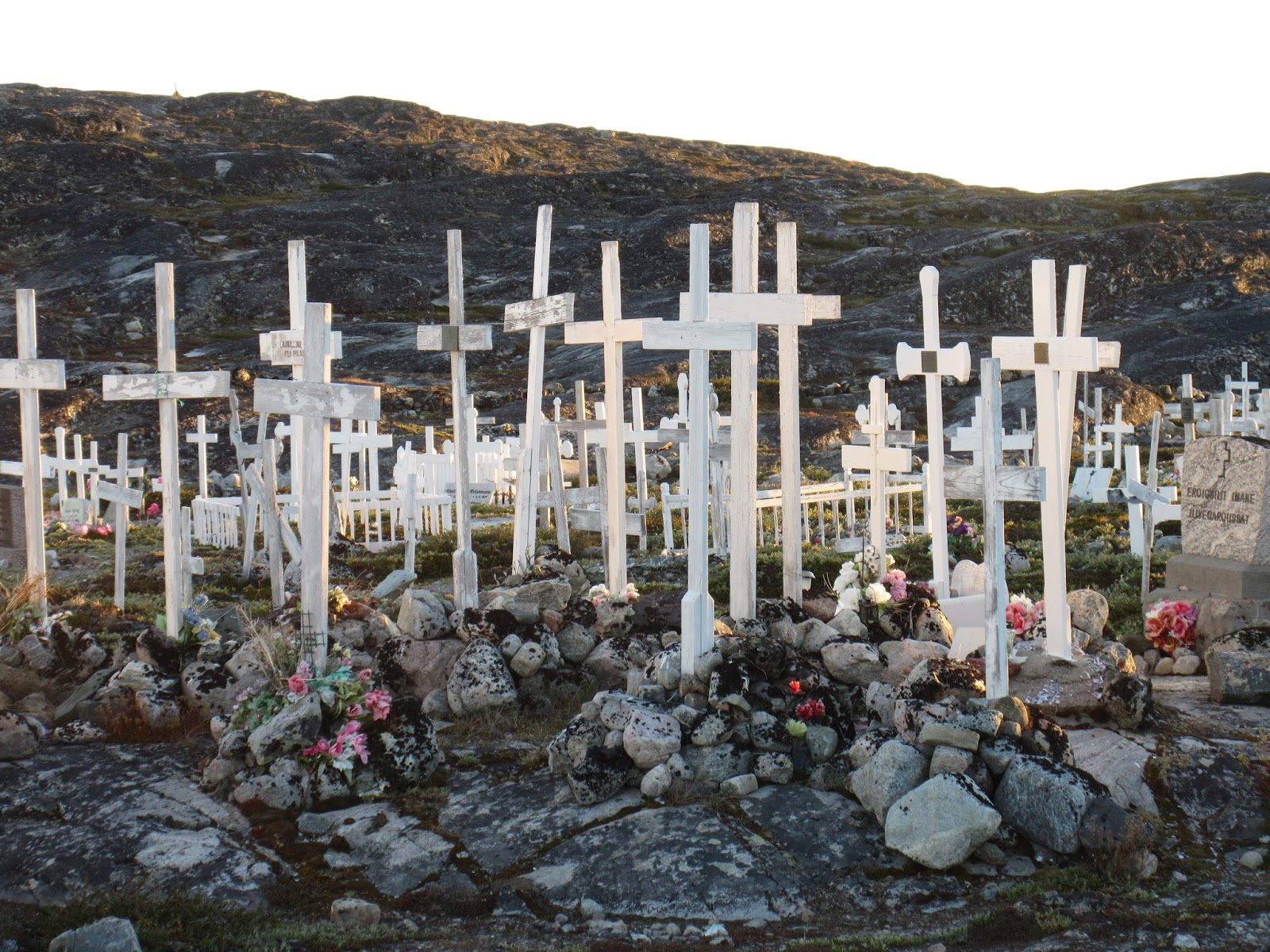
Last week, Nancy sent me a beautifully detailed, long email of what she had done, I read it in tears, touched by her great thoughtfulness and creative gestures. She had placed my stepdad's memorial card on top of the harmonium in the museum for a couple of days, among the stunning Emanuel Petersen paintings. And she put sage leaves around him that she'd brought from her garden in Oxford. She said she liked the idea of sage helping spirits to rest. After the harmonium, for the final goodbye, Nancy chose to place his order of service in an Ilulissat hilltop graveyard, under a piece of gneiss she had chosen as an anchor. She placed him at the southern most tip of the graveyard, pointing towards Scotland. She told me that in Inuit culture, wide views of the sea are important for the location of burial sites. This is a photo of the cemetery taken by Nancy. There are harebells and blueberries growing, and mussel shells and plastic flowers on the graves.
                                                                     Ilulissat, photo by Nancy Campbell, 2015


Nancy and I have never met - though I hope we do, one day - and she did not know my stepdad, but by a quirk of fate, she became intimately involved in our bidding farewell to him. His twin brother, who lives in Copenhagen, hopes to scatter his remaining ashes in Ilulissat next year. Then the farewell will be complete.  I think of how our lives are threaded, my stepdad could never have known that the artist whose cards he enjoyed so much in the last year of his life would be taking him home to Greenland. And Nancy, when she favourited a photograph - garden snowdrops I'd taken on my very unsophisticated phone - could not have known where that would lead.

It is seven months now since my stepdad's passing, my own grief is more gentle, for sure, but it's without exaggeration when I say that he was my best friend. Now that he is gone I know this more than ever. I have yet to meet a kinder man. Thank you, Nancy, for what you did for him.


Friday, 5 June 2015

A Series of Unexpected Events - The Well Made Project

As part of London  Creativity and Wellbeing week 4-12 June, The Well Made Project is hosting an online exhibition called A Series of Unexpected Events. 


'Over the course of a week, this online exhibition on art and health will publish an artwork by a different artist each day. These distinct pieces, each conveying the impact of a life event, will gradually build up a wider narrative around wellbeing.'


Extracts of my novel will be used at some point, I don't know how/when/where, which makes it even more interesting!

Even if you are not on Tumblr you can subscribe to the event here.

Enjoy.

Monday, 30 March 2015

Michael Wolf's 'bastard chairs'

I love this project bastard chairs by German photographer Michael Wolf. I want to sit on them all (I am always looking for somewhere to sit and wish there were more benches, though Edinburgh is not too bad).


Thursday, 2 October 2014

Colm Toibin & Hanif Kureishi & Bach

This is just perfect from Colm Tóibín, a five minute film on writing generally, and specifically on fictionalising family trauma. I agree with him about having to write the loss: using fiction to fix it and 'get it back'. A kind of rearranging, putting things back in place. I strongly feel my own writing of fiction is a response to catastrophe. I also love his comment about being able to go back to a piece of writing ten years later (what I'm currently doing, my progress is a just faster than glacial but I'm happy with the words I'm getting down). And I've been listening to Hanif Kureishi snippets on Radio 3's 'Essential Classics' - he always has gems. He says that in a world of 'lies and silence', we need art and music and novels - especially novels - to tell us the truth (1 hr and 45 mins in). I've fallen in love with this Bach piece - Prelude in B minor - from the same program (1 hr and 38 mins in). And writing this I have realised I have something in common with both these writers: like Colm Tóibín I lost my father at a young age (though I was younger), and like Hanif Kureishi I have a Pakistani father. I don't think, though, I have anything in common with Bach.

Wednesday, 27 August 2014

The Istanbul Review: Issue 5

Delighted that the gorgeous The Istanbul Review Issue 5 is now on sale in Looking Glass Books, a wonderful indie book store in Edinburgh. I have flash fiction in this one. This issue also has writing by Elif Shafak and Lesley Glaister. And the stunning cover artwork - and art within - is by Canan  Berber. The Istanbul Review gives 2.5% of its profits to NGOs across the world promoting literacy.


Sunday, 25 May 2014

Glasgow School of Art, always there like a jewel...

It was like watching an old friend dying right in front of you and being unable to do anything except witness the event, helplessly. This is how many of us felt seeing the pictures and footage - all over social media - on Friday of our stunning Glasgow School of Art on fire.

Even if you didn't attend the art school, it was always there like a jewel, and you knew someone who did. I recall in the eighties going to the degree show of a flatmate of one of my brother's, who looked like David Bowie and had a handsome lover, Mick. (Rumour had it, Mick died of a heroin overdose in the nineties. I have no idea if this is true).  I was in tears watching the news on Friday, not just for the art school, but for Glasgow, I lived there, after all, for many years and it was the closest city to us when I was growing up in west of Scotland. And Charles Rennie Mackintosh is in your DNA, he just is. It seems his glorious  library has been lost but, miraculously, damage to the rest of the building is less than initially feared. And not all of the students' work has been lost. I can't imagine the devastation of losing your degree show project. At least if you lose your novel it is backed up, but how can you back up years of precious art? The most important thing is that everyone got out safely, but as Hugh Pearman said on Twitter: 'Today's destruction proves one thing: if so many people feel bereaved by the loss of a building, then it can be said to have had a soul'.

If you want to help, in any way, here are the details.

Sunday, 23 February 2014

Fathers & stepfathers & childhood homes

I was surprised - and flattered - last week to learn I'd been nominated for a *Scottish Asian Women's Award, in the 'achievements against all the odds' category. I wondered what I had done to qualify: it's five years since my novel came out, though perhaps someone saw The Scotsman story or the repeat of the BBC Alba documentary.  I don't, to be honest, feel particularly representative of Scottish Asian women, though I am proud of my Asian roots, they are part of who I am.  If I see an elderly Asian man in the street, my heart collapses gently. I often say I feel  'fake' mixed race as my Pakistani father, born in British India, died when I was eight and I didn't really grow up between two cultures; I am more in tune with what an alcoholic father is than a Pakistani one (I'm in the painfully snail-slow process of writing about him - unexpectedly painful in several ways - although it is a highly fictionalised account). He was doing his medical degree in Bombay at the time of Partition, and I'm fascinated by what that must have been like for him.

I actually withdrew my name from the awards as I couldn't attend the judging panel, it was far too short notice, I must always plan my energy meticulously, though I think they are still trying to arrange a later date for me. I do, of course, feel representative of women (and men) with ME and if this nomination can spread awareness, that is fine and dandy.

I spent yesterday with my Greenland-born Danish stepdad, he continues to drift into his own wee twilight world of dementia. Sometimes, I sit with him and google Greenland just to see what comes up. We look at videos of Ilulissat, the town where he was born, and he exclaims, That's the hospital! Or That's where Per and I had our confirmation, pointing to the beautiful old church. The house he grew up in is now an art museum with a permanent collection of Emanuel Petersen, a Danish  artist. He was overjoyed when I showed him this.  

I was in my own childhood home last summer for the first time in almost thirty years. Last year, some of my Pakistani family visited Scotland, I hadn't seen them for many, many years, we went out to Loch Lomond in two black cabs, ten of us, and we stopped outside the old house. Like a scene from a movie, we lined up against the wall and had our photos taken. The owner was in her garden and kindly invited us round the back to have a look. I was  physically and emotionally shattered from the trip and when I saw my uncle's heels disappearing into the kitchen I thought I was dreaming, but sure enough the owner had invited him in. I went in after him and it was surreal to be in a house that was mine and wasn't mine. The stairs up to the bedrooms seemed so steep and I remembered how I would have to sit down to rest halfway when I became severely ill with ME. The most surreal thing was to look out the window of the back bedroom and see my Pakistani cousins' children playing on the swing.

*update: Uuganaa Ramsay won the Scottish Asian Women's Award 2014. I reviewed her book MONGOL here.

Tuesday, 4 February 2014

Different kinds of light

The exhibition of Chinese lantern warriors at Edinburgh University is beautiful and haunting, the figures sway gently in the wind, the old quad is a gorgeous backdrop. These ninety figures made me think of Jelly Babies marching. And there are benches for resting, always important.


And Bruce Munro's 'Field of Light', which I have not yet seen, has just opened in St Andrew Square. It looks like a glorious field of glass tulips. We are lucky to have these wonderful installations on our doorstep.

Light also in the news that 8000 research journals will now be available free online in public libraries. No more ludicrous paywalls to access  papers of interest.

And more light in American journalist David Tuller's recent article on the absolute inadequacy of the name Chronic Fatigue Syndrome to describe a serious neuroimmune illness (the name was coined in the USA after the Lake Tahoe outbreak in 1984. Dr Dan Peterson has since apologised for the nonsense of such a name). Tuller’s excellent article makes the point that the illness myalgic encephalomyelitis (ME) is not owned by any one speciality, this is true, and this is perhaps why it was possible for psychiatrists in the UK to flood into the ‘void’ and try to own the illness themselves.

I *can* see how the terminology is confusing for outsiders. In the UK, ME has been known as ME since the mid-1950s (and WHO has recognised it as a neurological illness since 1969). It was only towards the end of 1980s that the 'CFS' terminology came in to use in the UK, thanks largely to the core of psychiatrists known as the Wessely school. This school effectively tried to ‘disappear’ ME and replace it with CFS, a nebulous fatigue syndrome that is a thousand miles away from the complex neuroimmune illness that is ME. They started to use the label ‘CFS’, but this slowly became ‘CFS/ME’ as they tried to merge the illnesses and dilute the criteria for ME. And,  confusingly, ME is also now referred to as ‘ME/CFS’ by doctors who *do* believe in ME. And CFS is, even more confusingly, also the research term used across the board. 

My rule of thumb is if you see the term 'CFS/ME', you know you are dealing with skulduggery.

When I was diagnosed with ME in early 1984 - 16 months after becoming ill with Coxsackie b4 virus - by a consultant neurologist, I had never heard of Coxsackie or ME and had to educate myself. It is hard to imagine now how very little information there was in the public arena. Personally, I always refer to my illness as ME, this is the illness I have, I simply don’t know what CFS is. And the fact remains that the psychiatric lobby's choices of treatment - graded exercise and CBT - don’t make people with ME better, and in fact often make people worse. In spite of  its best attempts to 'out' us as a patient population suffering from false illness beliefs, we remain ill. The obfuscation and conflation of ME with nebulous fatigue syndromes is simply not sustainable.

Finally, I welcome this event featuring Dr Mark VanNess speaking about  the safety of exercise in PWME tomorrow in Bristol, and the wonderful Dr Nigel Speight. I wish I could go. Actual scientists, lighting the way, like hundreds of  marching lantern warriors. More on Dr VanNess's work here.


Monday, 6 January 2014

Art & catastrophe, & BBC Alba documentary, repeated on 6 and 13 January

The BBC Alba 'Toxic Tiredness' documentary from January 2012 is being repeated tonight at 9pm*. The Gaelic parts are, of course, subtitled. I previously blogged about both episodes here (part one) and here (part two). I appear in episode one right at the beginning looking like a bag lady, with my usually rather funky prescription sunglasses - they filmed us at weird angles outside for a few shots, the effect is alienating and disorienting, maybe that was the intention. And then at approx - 2.30, 7:30, 13, 18:30, 24, 29, 40:50 and 48 mins (I talk about the novel here and read an extract).

And Professor Peter Behan, the consultant neurologist who diagnosed me in 1983/84, appears in episode two, 35 mins in. He is magnificent. I especially liked:

  '... there is an essential biochemical component to the illness which needs to be elucidated, and research should be along the grounds into these illnesses rather than dealing with psychological talk the talk nonsense'

Dr Charles Shepherd  of the ME Association - also diagnosed by Peter Behan -  makes a great contribution too (though I don't necessarily agree with *everything* he says). The early-mid eighties was still a hard time to get a diagnosis, it took me almost 18 months, but  the psychobabble that we know today was yet to reach its dizzying heights of obfuscation -  this conflation of  serious neuroimmune illness with 'chronic fatigue' has, as we know only too well, done untold damage. We can only hope that science is now progressing, albeit slowly, unfettered by the hijackers. Here's to some decent biomedical research in 2014.

* Part 1 repeated Tuesday 7th at 10pm and soon on iPlayer

*

And I came across these wonderful photos by Penny Clare the other day on the Centre for Medical Humanities blog. She took them while severely affected and bedridden. I particularly like A fingernail celebrates New Year (I don't want to breach copyright so am not posting any photos here).

 More of Penny's photos can be seen on the excellent Phoenix Rising site.


For me, these photos highlight the link between creativity and illness, we are 'forced' by the illness into places we never knew we would go. We are still ourselves but catastrophe has given us a different way of expression. I often think of my novel/fiction as  my response to catastrophe. Writing often is.

Sunday, 23 December 2012

Manto & translation, & Pakistani fathers

This is Saadat Hasan Manto's Mottled Dawn, Fifty Sketches and Stories of Partition, published by Penguin India. The cover is exquisite, it came the other day. The painting is 'Melting Wit' (2005, acrylic on canvas) by N. S. Harsha. I'm not sure if the clowns are bleeding or melting. Harsha says: 'I fill my work with gaps and loose ends; I want to lead and mislead the viewer. Ambiguity makes a picture very exciting'.

I've already read 'Toba Tek Singh' online - the first story in this anthology -  and have also read the introduction by Daniyal Mueenuddin, whose own short story 'A Spoiled Man' from In Other Rooms, Other Wonders is one of the saddest stories I've ever read. I look forward to the rest of Manto's  deceptively simple yet brutal and sometimes funny stories about Partition. It struck me that Manto was only seven years older than my Indian-born Pakistani father, who migrated to Karachi briefly in the late forties before coming to the west to work as a doctor. Manto migrated to Lahore from Bombay, but he was never happy there. Both of them died as not old men through alcohol excess.

These stories have been translated by Khalid Hasan and I was interested to read that Aatish Taseer - the estranged son of  the assassinated Pakistani politician (himself the nephew of poet Faiz Ahmed Faiz ) - does not approve of Hasan's translations, suggesting he lacks 'the simplicity, speed and vitality' of the original prose. He has translated Manto himself in an anthology of Selected Stories (Random House). I downloaded these last month and have read a couple. This reviewer is critical of Taseer's criticism of Hasan as a translator. As I only know a few words in Urdu - banana, water and thank you - I have to trust that whoever has translated has done a fine job.

And, on translation, here is a list of the best books of 2012.


Sunday, 11 March 2012

Instead...

Maybe instead of giving my old CDs away to noble causes I should have smashed them and made beautiful animal sculptures. These are simply gorgeous by an Australian artist, Sean E Avery.

Friday, 22 July 2011

Robert Louis Stevenson

I've been dipping into the collected letters of Robert Louis Stevenson, he makes me smile: Yesterday I had toothache, and today I have a crick in my neck. These are details, but eloquent to me. I like his lack of self-pity (he was ill with TB for most of his life).

I also came across his description of John Sargents' painting of him and his wife Fanny: Sargent was down again and painted a portrait of me walking about in my own dining room, in my own velveteen jacket and twisting, as I go my own moustache; at one corner a glimpse of my wife in an Indian dress and seated in a chair that was once my grandfather's, but since some months goes by the name of Henry James's for it was where the novelist loved to sit...

We did Weir of Hermiston in my final year at school, I really should re-read it. He died before it was finished, he was only forty-four. When I read the book, I had no sense of how tragically early his death was. I was sixteen.

Sunday, 17 October 2010

Leaves & kids


I just watched four leaves fall and spin to the ground, one after the other. I wondered how they 'know' when to leave the tree, what is their precise moment. My cousin's nine-year-old was here last weekend and asked if she could rake. (I can't rake and always get others to do the leaves.) The feisty wee girl that she is got two piles of leaves. Her four-year-old brother 'helped'. It was warm enough to sit out with coats and my cousin and I had coffee in plastic cups and Hula Hoops while the kids worked. Then they started to argue over whose pile was whose and the rakes went back in the shed. After dinner, I was telling my cousin about the Pope and her girl drew this in five minutes. She is a wee talent.