Showing posts with label film. Show all posts

Wednesday, 14 November 2018

Autobiographical novel: 'a prosthetic voice' (Alexander Chee). And (films of) Guru Dutt

I recently dipped into Alexander Chee's collection of essays How to Write an Autobiographical Novel. I find reading about writing to be reassuring: you learn things that you already knew but didn't know you knew. It's the kind of book where you want to write down fragments and keep them close to your heart. Chee describes his first (autobiographical) novel as a 'prosthetic voice', which gives voice to those things too difficult to speak about, in his case, sexual abuse. His image of prosthesis is, I think,  quite brilliant.
And so while I wrote this novel, it didn't feel like I could say that I chose to write this novel. The writing felt both like an autonomic process, as compulsory as breathing or the beat of the heart, and at the same time as if an invisible creature had moved into a corner of my mind and begun building itself, making visible parts out of things dismantled from my memory, summoned from my imagination. I was spelling out a message that would allow me to talk to myself and to others. The novel that emerged was about things I could not speak of in life, in some cases literally. I would lie, or I would feel a weight on my chest as if someone was sitting there. But when the novel was done, I could read from it. A prosthetic voice.

The State of Me - hard to believe it was published ten years ago, its message as relevant today - wasn't for me a fictionalisation  about something too difficult to talk about, but rather a representation of the anger and injustice that people with ME have felt for decades due to a wilful reframing/misrepresentation of the illness by a core of the medical/political establishment. The novel had to be written, but the difficulties in writing it were much more the physical/cognitive challenges of ME than an inability to voice the subject. (I also, of course, faced the structural challenges of writing a novel that face all writers, ill or not.)

Chee's concept of  'prosthetic voice' does, though, resonate for me when I go to the project/novella which is partly about my late Pakistani father, the project that often has me thinking of Bernard MacLaverty's description of writing as 'a way of trying out different fathers'. This is exactly what I am doing - when I can - and something in me is a little broken the whole time. The theme of my novella is 'not knowing'.

It's fascinating to learn about writers/artists who would have been contemporaries of my father. I've just discovered Guru Dutt, an Indian director and actor, famous for Pyaasa, Kaagaz Ke Phool (Paper Flowers) and Chaudhvin Ka Chand. Dutt died aged only thirty-nine in 1964 from probable suicide, he had mixed sleeping pills and alcohol.  He had attempted suicide before. Knowing Dutt's life story made it even more emotional watching Pyaasa, the story of a shunned poet, who only finds success when he is (wrongly) presumed dead. And Kaagaz Ke Phool, a melodramatic tale of a director's flop (prescient as Kaagaz Ke Phool also flopped) - had me in tears at the end. Real tears rolling down my cheeks.  When we respond to films we are, of course, not responding to just the fictional narrative but to the narratives in our own lives. I especially love the framing of the film - the opening and closing scenes - with Suresh Sinha as an old man looking back on his life.

I thought of Saddat Hasan Manto and wondered if he had ever met Dutt in Bombay (Manto left his beloved Bombay for Lahore shortly after partition). When googling Manto and Dutt, I came across this review, which likens Guru Dutt's Pyaasa to Nandita Das's recent biopic Manto. Manto and Dutt certainly shared sensibilities, a concern for those in the margins, those disenfranchised, in Manto's case specifically those harmed by Partition (on both sides).

Manto was seven years older than my father. Dutt was six years younger than my father. All were in Bombay in 1947. My father was not working in film, or as a writer, he was a medical student, who had interrupted his studies to join the Indian Air Force during the Second World War. What these three  men would come to have in common was an addiction to alcohol, an addiction tragically implicated in all of their deaths. They were not old men when they died, Manto was forty-two, my father was fifty-three (I was eight). I fancifully allow myself to imagine the three of them meeting up in Bombay before Partition, wondering what they would have spoken about.

I've discovered that Nasreen Munni Kabir made a Channel 4 documentary  in 1989 called In Search of Guru Dutt. I have ordered her book on Dutt. The beautiful and luminous Waheeda Rehman appears in all three films mentioned above. I understand that she and Dutt had an  affair, which ended his marriage to Geeta Dutt.  Geeta Dutt was also the hugely talented playback singer for Rehman's songs. Geeta, I have read, had a breakdown and became alcoholic after Dutt's death. She died in 1972, leaving behind their three children, two sons and a daughter, Nina (Nina was just a baby when her father died). It is heartbreaking that Tarun Gutt, their eldest son also took his own life and Arun Dutt - who was involved in preserving his father's legacy - died of alcohol-related illness in 2014.

Having now also seen Chaudhvin Ka Chand I am left with a huge nostalgia for a period in Indian film-making in 1950s I did not even live through. I think the melodrama, the heightened reality, the muted gorgeousness of monochrome all tap into a process in my head and heart (the not knowing). The wonderful singer for Guru Dutt, in these three films, is Mohammed Rafi, who died aged fifty-five (though it is Hemant Kumar who sings 'Jane Woh Kaise Log' in Pyaasa). I also loved the actor 'Johnny Walker', who brought humanity and slapstick (much needed, to balance the sadness) in his role as the masseur in Pyaasa. I have read Johhny Walker and Guru Dutt were great friends in real life.

Reading Chee's essays and watching Dutt's films, something collided gently in me - it reinforced how important art and film and fiction are in understanding our lives, both for those who create the art and those who consume. Making the hard stuff bearable.


Wednesday, 13 June 2018

Ten years since The State of Me - publishing & illness (&Lionel Shriver)

This August it will  be ten years since the The State of Me was published. I'm still very proud of the novel and it remains my weapon in the fight for truth about my illness. A decade has been enough time for me to get over the roller coaster of the publishing process - and I have happily mostly forgotten the shock of it all. It was like a never-ending game of snakes and ladders. As a result of the liquidation of my indie publisher, the novel did not receive the marketing it should have done - but I remain very grateful my precious work was not lost in the drama and that HarperCollins rescued the book. This review by writer Elizabeth Baines remains one of my favourite reviews.

The path to being published was though unbelievably stressful and possibly contributed to my later developing idiopathic bilateral uveitis, a rare and serious autoimmune eye condition, where your iris attacks itself. It was a truly awful time, pouring steroids into my eyes, with the side effects of increased eye pressure, which also had to be treated (I'm sure ME was implicated and I still get six-monthly checks at eye hospital). I still remember at the time a friend telling me not to read  José Saramago's Blindness, which I, of course, did read.

If I were well, I'd no doubt be on to my third, or even fourth novel, by now, but I live necessarily in the margins of the writing world. It is often said you are only as good as your last book, but I'm happy to say that my novel is still being read quietly in the background, giving people pleasure and educating about ME.

I was delighted recently that Nick Duerden, a journalist and writer who has made a good recovery from his own very disabling postviral illness, messaged me and said he found the book 'very powerful and gripping'. He also said: 'You write fear, confusion and anger very well indeed. It moved me'. Nick is author of the recent memoir Get Well Soon (Green Tree, 2018). In the same week, Scottish film director and screen writer May Miles Thomas sent me a lovely card saying how much she had enjoyed the novel. I'd sent May a copy as a thank you for having the opportunity to watch her brilliant and hypnotic film Voyageuse free online on Vimeo.  Voyageuse made me think a lot about the layers of storytelling and how we (re)construct a life. I highly recommend this film.

I have been asked by Lighthouse Books to speak about writing and disability at a one hour event with other ill/disabled writers (I identify as chronically ill rather than disabled, the social model of disability does not in my view serve people with ME particularly well). I have said yes though I never know how I will be on the day, but am flattered as it's a decade since The State of Me was published. I've been shortlisted for a couple of short fiction awards since then, and had short non/fiction published here and there - details in sidebar - but because I live with ME, every minute of every day, I am the polar opposite of prolific (my novella-in-progress in 2015 is still in progress).

I do, though, know about the writing process - The State of Me took probably eight or nine years to write/publish in all - and I do, of course, know intimately about chronic illness. Writing is harder when you are ill. Everything is harder when you are ill. But writing (even as slowly as I do) sustains me. I would love to publish another book in my lifetime, I may be sixty by the time that happens, and I am not joking when I say that. Approaching my mid-fifties, I find I am thinking more about life and death and what we do in  a lifetime. I'm also more acutely aware of just how much my illness has thieved from me. (Interesting to read this interview with Elizabeth Strout who didn't publish her first novel until she was forty-two (I was forty-four). She went on to win a Pulitzer.)

*

Lionel Shriver has been off on one of her wee rants again - this time she is bemoaning the fact that Penguin Random House has a diversity drive. She petulantly writes:
“Thus from now until 2025, literary excellence will be secondary to ticking all those ethnicity, gender, disability, sexual preference and crap-education boxes. We can safely infer from that email that if an agent submits a manuscript written by a gay transgender Caribbean who dropped out of school at seven and powers around town on a mobility scooter, it will be published, whether or not said manuscript is an incoherent, tedious, meandering and insensible pile of mixed-paper recycling. Good luck with that business model. Publishers may eschew standards, but readers will still have some."
How can she be so goddam myopic and insecure? Diversity can only ever be a force for good (as long as we are talking about actual meaningful representation and not just tokenism). Do we really want to be reading the same novels about the same characters by the same people over and over again? There is an excellent response to Lionel's nonsense here.

I can honestly though say I have never felt discriminated against in terms of ethnicity (in fact, mixed race writers are all the rage) or disability, though one agent unprofessionally left her job without telling me, I imagine she did not realise just how slowly I wrote. It was a huge shock to me, but somehow I picked myself up and kept writing, slowly, slowly. Self-belief and the importance of bearing witness to the catastrophe of my illness was what drove me. But like many debut writers, I just felt constantly thwarted by the gate-keeping mechanisms of publishing in general. To be constantly told how good your writing was but because of marketing/pigeonholing there was no 'fit' for your book was soul-crushing. I think though pigeonholing is less rigid now, fiction and memoir are more readily blurred. The idea of what constitutes a novel is much more fluid.

When my novel was eventually published ten years ago, it had nothing to do with representation of illness/disability -  the notion of diversity was not being trumpeted back then. My novel was published in spite of my illness rather than because of. It was published on its own merit, as novels should be. Also, I'm mixed race but The State of Me has nothing to do with race - I'm sure Lionel would be very confused: a mixed race author with a white main character whose illness/disability informs the whole novel. Also, my character does not use a mobility scooter, but I had my first try of one a few weeks ago at the Botanics in Edinburgh and it was bloody liberating.

*

Illness brings a walling off, there are simply aspects of being a writer that are impossible for me. I cannot embark upon the circuit of readings and  festivals that is required of writers these days. The performance part is, for many, a significant part of the writing life. I was lucky that (pre-liquidation) my indie publisher had no concerns about my being unable to do the running around and promoting. It does break my heart a little that I am walled off like this, but that is the case with many aspects of my life. Many years ago in late nineties, I was shortlisted for the Robert Louis Stevenson Award on the basis of a short story. The award is a month in France in Grez-sur-Loing where RLS spent much time. It looks blissful and restful and surely promotes one's creativity. I seduced myself into applying  as my undergraduate year in France in 1983 was cut short because of the onset of ME and I felt that RLS, himself ill his whole adult life, would have wanted me to go. But had I won I would have been unable to go as I learned later that you have to cycle through the forest to get your groceries.

Still, a decade ago I had my book launch in Waterstone's on George Street (it still had the comma then, though now closed down) - it was probably the happiest moment of my life.


Saturday, 10 February 2018

The walling off that illness brings

At the end of January I spoke at a Scottish Parliament event to raise awareness about the dire lack of services for ME sufferers: there are currently no consultants in Scotland with expertise in ME - and only one specialist nurse in Fife. We do, disturbingly, have the Lothian ME/CFS clinic - again, no expertise in actual ME, it appears to treat 'chronic fatigue' - and people are reporting harms from graded exercise therapy on offer. I met a young woman who now uses a wheelchair because of being made worse by graded exercise. And a mother spoke of her young son having a seizure because of graded exercise. This is horrifying. And they are not alone, many with an ME diagnosis have reported worsening of symptoms because of exercise therapies they have been pretty much coerced into. This exacerbation of symptoms is unsurprising as ME sufferers have poorly understood mitochondrial dysfunction. We *cannot* exercise without provoking highly disabling post-exertional malaise. My abnormal EMG and muscle biopsy from 1984 demonstrated this.

The platform of the event was a twenty minute showing of UNREST film (my review here) and Jennifer Brea, the director of the film, spoke via Skype. When it was my turn to speak, I was more emotional than I thought I'd be, I had to pause a few times, the words clogged in my throat, I was sure I would cry. There was  a palpable collective trauma in the room, the harm visited on ME patients was obvious in the mood of the audience. I do hope the sixteen MSPs who attended will follow up with action and address the issues this much neglected patient population faces. I gave a copy of The State of Me to Joan McAlpine, the MSP for South Scotland, we were both at Glasgow Uni in eighties, so I thought the novel might resonate for her.

There is going to be  a debate in Westminster on 22 February about the harms of PACE - this has been secured by Glasgow North West MP, Carol Monaghan. It is crucial - and hugely welcome - that this is happening. The tables are turning, though the clowns who have harmed us will not bat an eyelid and indeed continue to defend the nonsense of GET/CBT as primary treatment for a neuroimmune illness - the fact that patients are being made more ill doesn't seem to touch them. How convenient to wear so easily such armour against the truth.

I have been thinking about autumn 1983 when my fellow students who had completed their years abroad were gathered excitedly in the Modern Languages Building for the start of the new academic year - the Junior Honours year (our fourth year of study). There was so much to catch up on - this, of course, was pre-Internet - you had to actually see people or phone or write in order to know their news. I remember having to sit on a table in the hallway - it was mobbed, my legs were weak, I had constant pain in my spine - and feeling entirely walled off from the buzz and the joy of it all. I felt like an impostor.

I had only been able to do six weeks of my year in France and had to abandon it in the end. I would  not be starting Junior Honours - I'd been on course to do joint French and English Honours and got glowing comments in my second year English exams -  but had now signed up for just one class a week, which would enable me to finish an Ordinary Arts degree. I'd been diagnosed with Coxsackie B4 by then and had just started seeing Professor Behan - happily, there was an ME specialist in Scotland in 1980s - but I'd not yet had my ME diagnosis. I was very poorly but, there I was, still trying to keep a foot in the well world - much to my detriment, of course (I had no idea of the horror ahead). I could cry thinking about it now.

Saturday, 21 October 2017

My thoughts on UNREST (2017) ★ ★ ★ ★

*Update, September 2019: My review below is based on my careful viewing - twice - of UNREST in autumn 2017, I was sent the screener by Jennifer Brea's PR team. I was around this time invited to speak at a local ODEON showing of UNREST but was too ill to commit. I did take part in a very successful Scottish Parliament UNREST event in early 2018, where Jennifer skyped in to the session. It is important to note that since then Jennifer Brea has been diagnosed with cervical cranial instability (CCI) and tethered cord - she had various neurosurgeries in late 2018 which have resulted, very happily for her, in a return  to full health. There is thus far no medical explanation as to why fusion surgery for CCI would cure ME virtually overnight and I think this suggests that Jennifer *could* perhaps have been misdiagnosed with ME in first place, and may explain why it seemed that she was at times 'inhabiting' the role of a person with ME. Please note, this is my opinion, I am not saying Jennifer did not have ME, I am stating my own feelings based on her film and also her often confusing commentary on Twitter. (I - and I am certainly not alone - have noticed worrying inconsistencies and contradictions and hyperbole in her narrative.)

Jennifer's may well be a cautionary tale and could perhaps turn out to be instrumental in having discovered a new (albeit unusual) differential diagnosis of ME. Chiari - another structural abnormality causing brainstem compression - is already  listed under differential diagnosis in the ME Association clinical guideline, which is co-authored by consultant neurologist Abhijit Chaudhuri. I certainly think UNREST is still valuable, the other severely affected patients' stories are compelling, but there must, in my opinion, be a caveat/update in any screenings, especially when the film is being used for continuing medical education (CME) in USA.

***

UNREST is a new film from USA about ME directed by thirty-five year old Jennifer Brea. The film has garnered much praise and documents Brea's own descent into ME (or CFS as it's interchangeably referred to in the film - this is not without problem as the toxic reframing of ME as CFS remains unexplored). Still, ME sufferers have been starved of representation (though we've also had VOICES FROM THE SHADOWS (2011) and FORGOTTEN PLAGUE (2015)) and it's unsurprising there's been such a buzz about the film. I'm passionate about education and I tried hard to watch UNREST as someone who knows nothing about ME, to see what it taught me. This was almost impossible to do (to put my own experience and knowledge to the side). UNREST is not just about illness, it's about how technology connected Brea to other 'shut in' people, invisible - housebound and bedbound with ME.  We are all networked, now, globally, if we choose to be. In a way, the theme is the obsolescence of the written word for communicating lived experience.

I found UNREST to be powerful in its illumination of ME - particularly through the inclusion of three very severely ill younger patients - and I found myself in tears frequently. But I also found the film lacked clarity in places. The politicisation of the illness is glossed over, as is previous advocacy, but it would be impossible to investigate the politics of ME in a 90 minute documentary - and this is very much Brea's own story (not a UK story where the horrors of PACE still abound). I think those more recently diagnosed, still grappling with the hell of it all, will find the film resonates hugely for them.

The film looks beautiful and, at times, has a dream-like quality: this reflects the sense of unreality that comes in the early stages of this illness, the sense that it can't actually be possible to be so alarmingly ill without any recognised treatment path. I loved the lighting, the shadows, the focusing on objects, like blue jars on a window sill with snow falling behind, to mark the passing of time. When writing about chronic illness there is little sense of plot, nothing changes, so you have to amplify small moments. A ceiling fan, a ladybird, a pair of high heels - unworn shoes are an important #millionsmissing campaign symbol - objects that take on immense meaning when you may be staring at them for hours on end, too ill to do anything else.

Having been ill since 1982 - and gone through my own hell as an eighteen year old -  I'm naturally a little jaded, but it was impossible not to cry at the extreme circumstances of Jessica Taylor-Bearman (UK), Karina Hansen (Denmark) and Whitney Dafoe (USA). I already knew a little about all of them. The image of poor twenty-seven year old Karina sitting on her bed, back home with her parents after being forcibly institutionalised for three years, will haunt me for a long time. The expression on her face is something that is hard to see (or unsee). Danish psychiatrist Per Fink is the villain in this piece and I couldn't help but have the very personal memory of my dear late Danish stepfather who supported me unfailingly throughout my illness. Twenty-six year old Jessica has been ill since she was fourteen and was in hospital for four years. She has severe osteoporosis as a result of being bedridden for so long. She has champagne held to her lips by her dad and counts back to the birthdays she has spent in bed (I thought of my own twenty-first in bed in 1984, which I fictionalised almost twenty-five years later, Helen Fleet, bedbound, feels like ‘a clown, a grotesque invalid wearing bright red lipstick and titanium earrings’). And Whitney, the son of Stanford professor Ron Davis, is unremittingly and severely ill, inhabiting a dark and hellish place - he  cannot even speak.

Brea decided to film herself to document what was happening, as doctors were not taking her symptoms seriously. She goes through what is familiar to many of us, trailing from specialist to specialist until we find someone with the expertise and knowledge to identify what is actually wrong (those more recently diagnosed or new to the illness may find Brea's own story more immersive than someone like myself, ill for decades). Seven years ago, she had a high fever, she  appeared to recover, but still never felt quite well. She would drag herself to classes. She  got infection after infection and would experience suddenly not being able to pick up a glass of water or sign her name on a cheque. On bike rides, instead of being able to do twelve miles, as before, she could only do six (this is not in the film but I've seen mentioned in a recent Times interview). After no joy with other doctors, she is eventually diagnosed with conversion disorder by a neurologist and walks home from the appointment to see if it is all in her head, as she has been told. She narrates that she collapses when she gets home and is in bed for most of the next two years.

She discovers others with similar symptoms online and wonders if she too might have ME (this, of course, is the Wesselyian fantasy, ME sufferers diagnosing themselves on the Internet. In Professor Wessely's world, patients are discouraged from educating themselves in case they discover that they are actually physically ill). Brea learns much about the illness through social media. This would have been the stuff of science fiction in the eighties. I'd never heard of ME. I remember looking up Coxsackie in the university library and the heavy book burning my arms. It is hard now to convey the paucity of information thirty years ago.  Brea consults New York's ME specialist Dr Enlander  - though he is not named in the film - and is prescribed Valcyte - an antiviral drug - which leads to her improving in two days and being able to walk again. This seems almost miraculous and it frustrated me that there was no discussion about Valcyte - what it is, what it does - some viewers may have wondered why we are not all taking Valcyte. It is an off-label treatment, which has not helped everyone who has tried it - and indeed can make some feel worse. And is not easily available to most (NICE guidelines in UK do not recommend antivirals,  unsurprisingly, as 'CFS' clinics prefer to treat ME sufferers with wholly inappropriate graded exercise and CBT. These guidelines are now, thankfully, under review, not before time).

Brea acknowledges that she was lucky to have access to a specialist. I felt, though, I wanted to know more about her actual diagnosis. We see her having lots of blood taken, I wanted to know what the tests were for. Being diagnosed is such a significant moment for those of us who have struggled to be believed: I went through the hell of Coxsackie B4 virus, undiagnosed for nine months, which then 'evolved' monstrously into ME. The Coxsackie diagnosis was a key moment - crucial to my getting a referral to neurologist Prof Behan, who worked closely with Dr Melvin Ramsay - all those years ago. My GP could no longer say I was imagining tremors in my muscles.

The film did make me think about how different a diagnosis is now than in the eighties. I was horrified in 1984 that I might stay ill for another five years (that was the advice back then - that it might 'burn itself out' in five years). I did not know how I would be able to stand the physical hell of ME for that long. I'm glad I had no idea of the true prognosis. Now, of course, those with an ME diagnosis know that that they might stay ill for decades. Brea speaks tearfully in the film of the grief and loss that the illness brings, she reflects candidly that she is doing 'a good job' by not killing herself.  I was struck by the scene where via Skype,  Jennifer asks Jessica, who is lying down flat in bed, almost ethereal, being filmed from  above: How did  you stay sane?

I remember too crying a lot at the beginning of my illness. I felt so ill, completely poisoned. It was terrifying ('How can you feel so ill and not be dying?' as my character Helen Fleet says). I'm sure I articulated my grief too back then but I can't now remember. I think it took me a decade to truly adjust to the illness. I missed my academic self. I wanted to know more about how Brea felt having to give up her PhD. She never refers to it after her diagnosis. Decades on, I still feel a kind of grief that I had to abandon my year studying in France in 1982/3 - and that I was unable to complete my French and English Honours degree.

I was conscious, though, while watching the film that it is a constructed piece of art, an artifice, like any narrative, and a couple of Brea's own scenes felt slightly 'theatrical', at least, to me. I don't mean acted, rather enacted. For me, this detracted from authenticity. It felt, at times, that she was re-enacting what she had experienced rather than experiencing it in that moment. I imagined numerous 'takes' to capture the reality of the illness. I compared it in my head to writing a scene, which you polish and polish until it's perfect (I could be totally wrong, of course, these are only my thoughts). Also, I was interested that much remains unsaid in the film. For example, Brea is not seen having to cope with the very damaging disbelief from family or friends, as many of us have done at some point in our illness (of course, she may well have done, we don't know, we only know what she reports). We see her interacting only with her husband, Omar, who is noble and loving and patient. He only loses his cool - understandably - when Brea attempts extreme mould avoidance as a treatment for her illness. Earlier in the film, when Brea has had an acute episode after over-exertion at a Princeton reunion, Omar - in tears himself - makes an observation that resonated for me: other people's pity is hard to bear.

Brea makes a crucial point when she says that one of the reasons the illness is not always believed is because we are hidden so much of the time. We spend so much time indoors recovering from small exertions. No one sees us at our worst. Some sufferers, tragically, cannot move from bed at all and are totally dependent on others for care. And there are a minority of ME sufferers whose illness is actually progressive. There is a brief but good description from Dr Nancy Klimas on mitochondrial dysfunction and the problems with aerobic exercise that ME sufferers have.

As I understand it, these days, Brea uses a power wheelchair when she is outdoors, but has now improved sufficiently to be able to promote her film in the USA and other countries (Brea also says she has POTS, though this is not referenced in the film. I think she should have mentioned this, as POTS and ME often 'overlap'). Improvement is always to be celebrated in ME, it's wonderful when it happens, though her current schedule seems impossible to sustain for someone with ME, certainly, the illness I know as ME.

Then again, I don't know anyone who is taking Valcyte. I guess it allows for a much greater level of functioning in some. While I have slight concerns that Brea is somewhat unrepresentative of many with ME, I, of course, recognise that we all can and do have different staminas and symptoms - and  symptoms do fluctuate. I also know that because of the lack of belief we've faced, we can be fiercely wedded to our own experience of the illness. And the rhetoric of 'oh, how can she do that?' can be extremely harmful (we've all faced it, I'm sure). But all of us - with true ME - share the cardinal symptom of post-exertional malaise (PEM). We are defined by exertion-intolerance: fatigability not fatigue. And in between times we are always invisible, always 'recovering' from an escalation of symptoms. The differences, though, between mild, moderate, severe and very severe ME are night and day.

There are small moments that perhaps only someone with ME will see. In one scene, a young woman Casie - whose mother, the quite fabulous Leeray, also has ME - says her arms are getting tired, when holding up her iPad to show photos. A small moment, but instantly recognisable - and important to portray. The last few minutes of the film focus on the #millionsmissing campaign, a campaign conceived by Stacy Hodges. Those empty shoes are such a potent symbol: most of us put our shoes on to go out into the world every day. Those of us with ME often can't and don't. There are ME sufferers who have not had to buy new shoes for years. There are ME sufferers who have killed themselves because they cannot stand it any more. There are also ME sufferers who have died of the consequences of extremely severe ME.

The film ends with beautifully stirring music - the score is by Bear McCreary - and Brea telling us that while the illness has destroyed her life and she wishes every day that she were well again, that she has embraced a different, new life. She expresses gratitude for the lessons the illness has taught her. To be honest, I found this hard to understand - and  a little saccharine. I could never be grateful for the catastrophe of my illness, but you just can't compare seven years with thirty-five, our landscapes are entirely different. Though, I can also say I have never at any stage of my illness felt 'grateful'. The illness has been much too harsh, physically. And I have lost too much. The enforced 'stillness' of the illness has given me a useful perspective as writer but I would swap that in a second for never having had ME in first place.

Perhaps, though, Brea's optimism is part of the narrative arc, a conscious 'happy' ending to such a bleak tale. And perhaps, importantly, her own ending - and significant improvement (thanks to medication) - also gives hope to younger and/or newer sufferers. The film is an exhausting watch. Before the credits, we see the names rolling of some of those who have died as a result of having ME (I think they had taken their own lives). I sat silent for a few minutes, after the film ended, I couldn't speak (and I imagine seeing this in the cinema would enhance the  emotion I felt, I watched on laptop, was sent a link by UNREST UK team).

I'd like doctors and politicians - and anyone who is cynical about the illness - to see UNREST.  I'm glad it's being shown in medical schools. But I'd also have liked to have seen more of the science that we do know - and I fear that the lack of political context may prevent the film having as much impact as it could. The medical and political scandal of what has happened to ME sufferers is never fully articulated. I wish, for example, footage of Stanford's Professor Montoya apologising to sufferers for the way the medical profession has treated them had been included.

In the UK, ME is synonymous with the hijacking and reframing of the illness as 'chronic fatigue' in the 1990s by  Simon Wessely and colleagues -  the ascent of UK psychiatrists cannot be ignored, nor the toxic influence they have had worldwide on the perception of ME, with their relentless and ruthless promotion of the biopsychosocial model - and wilful conflation of criteria of ME and CFS. While the film packs a huge emotional punch, I'm not sure how much it will punch politically in the UK. The biopsychosocial narrative is so embedded, it will take a juggernaut to shift it. Hannah McGill and Leslie Felperin, both respected film reviewers, still referred ignorantly to the physical v psychological debate as if the robust science of physiological abnormalities simply doesn't exist (though the Guardian has historically been dreadful with ME coverage). Mark Kermode gave a lovely review, though he was already empathetic.

We need journalists and doctors - and everyone else - to come out of UNREST enraged at what ME sufferers have endured, and unequivocal that ME is a physical illness - it is not enough that they feel greatly moved by the plight of very sick people.  Still, the film is giving the illness a much needed, greater visibility - and kudos to the UNREST team for pulling this off. I very much hope this visibility can translate to more research funding, which is what we need above all.  I dislike starring systems - they lack nuance and subtlety - but having given my response in great detail above, I happily give UNREST four out of five stars as an art work about ME.

*Just to add that UNREST was funded through Kickstarter and it's a testament to the generosity and hope of ME sufferers and their families - and their faith in the process - that UNREST has had the media coverage/distribution/success it has.

Sunday, 9 July 2017

'Re-writing the hurt' (Jeanette Winterson)

Podcasts can fill me with dread because *sometimes* they are dull and you (often) can't fast-forward. I listened last night - lying down with my eyes closed - to a Jeanette Winterson podcast from 2012, it is a joy and delight. Her clarity and honesty soar and you could listen to her forever. She talks about 're-writing the hurt' in order to be able to cope with the narrative or the memory of what happened. On the writing of truth versus fiction she says she realised - with sadness - after Oranges are Not the Only Fruit that she had written a story that she 'could live with', the other was too painful, she 'could not survive it'. 

As I write slowly, slowly about my Pakistani father, often weeks, even months, with no writing - always thinking, though, always - I understand this more than ever: the stories we (re)write often make the truth bearable. I often say truth comes more easily through fiction. I think it's one reason I had to fictionalise my illness for The State of Me - the physical hell and wilderness of  this illness  -  being a political football, to hell with actual patients - is just too painful.

*

I'm reading (non-fiction) The Upstairs Wife by Rafia Zakaria. It's beautifully written and the Partition elements resonate for me, particularly descriptions of Saddar in Karachi, as that is where my father's family migrated to from north India in late 1940s/early 1950s.


I'm also reading (fiction) Memoirs of a Polar Bear by Yoko Tawada, which is funny and clever and heartbreaking, told from the point of view of three polar bears, an unnamed grandmother/memoirist, her daughter Tosca (though Barbara, her trainer, narrates parts too), and Tosca's son Knut (based on the real Knut in Berlin Zoo). The memoirist polar bear starts off in the circus and when being trained to get up on hind-legs by appliance of heat says: 'I'd always thought it was the floor feeling pain - not me - so it was the floor that had to change - not me - to make the pain go away'.

*

I watched Toni Erdmann on DVD a couple of weeks ago, very different, funny and quirky, if a little unsettling. It is three hours long though and I had to watch it in two parts, no big hardship. It doesn't feel long, and that is the main thing. And is a film that leaves you feeling happy.

Saturday, 7 January 2017

On fathers: Om Puri, Hisham Matar and some short writing

Saddened to learn that Om Puri has died aged only sixty-six. I loved him, of course, as the flawed Pakistani father in East is East. And as the taxi driver in My Son the Fanatic (based on a short story by Hanif Kureishi). I watched him more recently in Satyajit Ray's 1981 film Sadgati/Deliverance - Puri, in his early thirties, gave a devastating performance as an 'untouchable'.

*
The last book I read in 2016 was Hisham Matar's The Return. Anne Enright describes it as a terrible and lovely book, and it is: the writing is lovely and the truth is terrible, the knowing and not knowing the brutality of his father's death at the hands of the Gaddafi regime in the nineties. I underlined several passages as I read, words that stay in my head: 'I have always wondered if it is possible to lose your father without sensing the particular moment of his death'.

*

Happy that 2017 will see with the upcoming publication (print and digital) of Bath Flash Fiction anthology - I had a story longlisted almost a year ago - 'A widow with a bowl of wine and lipstick coming off'. This flash was inspired by seeing my dear stepfather in the funeral parlour in February 2015, the image still shocks me, though it was one of peace, but nothing about it was real, nothing.

I've not written much flash fiction, I've read more, but I think flash titles are very important, they act like a hinge for what's unfolding. I see flash fiction like fireworks - small with a beautiful punch - but still demanding time and energy in creating. Flash lends itself well to low energy writing. And as you tweak even 300 words,  you know more than ever, as you shift the words around in such a small space, how arbitrary it all is.  The story was accepted by an online literary journal at the same time as it was longlisted and I had to decide where I wanted it placed. I look forward to seeing my words - which with time passing now seem 'remote'  - see the light of day.

Friday, 18 November 2016

The world is fucked and books are all we have

The world is fucked and books are all we have. When things are tough, I look for illumination in poetry, nothing has helped, but then a few days ago someone tweeted 'Apes' (1990) by Adam Zagajewski.

 Apes

One day apes made their grab for power.
Gold seal-rings,
starched shirts,
aromatic Havanas,
feet squashed into patent leather.
Deeply involved in our other pursuits,
we didn’t notice: someone read Aristotle,
someone else was wholly in love.
Rulers’ speeches became somewhat more chaotic,
they even gibbered, but still,
when did we ever really listen? Music was better.
Wars: ever more savage; prisons:
stinking worse than before.
Apes, it seems, made their grab for power.

Poem by Adam Zagajewski, from Without End

 *

On my bedside table just now are these:


Last weekend, I read Claudia Rankine's prose-poem Citizen, which is startling and unsettling (for me, more prose than poem, but well worth reading). I often stop books for no good reason and take weeks/months to go back, it may be a concentration thing. This summer, I stopped The Vegetarian a third of the way through and started a thriller (Apple Tree  Yard by Louise Doughty, which I loved). I will go back to The Vegetarian soon (I also really liked the story behind the translation). The Blue Devils of Nada by Albert Murray is a gorgeous dipping-in book of essays and there are some gems there. I will also, of course, go back to James Baldwin (started and stopped for no good reason). Jackie Kay's Trumpet is a secondhand book passed on to me, which I look forward to.

*

The Goldfinch painting by Carel Fabritius has come to Edinburgh (how sad he died aged 32), which prompted me to start my Kindle version of Donna Tartt's Pulitzer-winning novel - I've had it for two years, unread. I'm 100 pages in and love the plot, but the style is too wordy for my liking. The micro-details clutter the prose, which is exhausting to read. I recall mixed reviews at the time. Julie Myerson was not too keen. Not sure I can stay the course. I think it would make a great film though.

*

A couple of weeks ago, I watched John Berger and Susan Sontag discussing the process of reading and writing in 'To Tell a Story' on Channel 4 in 1983. The discussion was part of a series called VOICES (I don't remember VOICES, Channel 4 had just started and I was at the beginning of the nightmare of what turned out to be ME). Berger and Sontag are so compelling, you agree with both of them even when they have opposing views. Their earnestness almost seems quaint now, but I was struck by their respectful disagreement with one another. They are mesmerising to watch and listen to.

And I have just discovered Scottish doctor, filmmaker and  poet Margaret Tait (1918-1999), what a remarkable woman. (‘Emily’: ‘Emily Dickinson shut herself in a room / And wrote about her pain. / She wrote too about joy’.) You can hear a recording of Margaret Tait reading 'Emily' and other poems  here on the Scottish Poetry Library website.

*

And Leonard Cohen is dead, that is hard to know. Since 1980, I have loved his poetry and his music and his beauty. He was old-ish, I guess, 82, but I have so many folded-up memories that his songs unfold again. 'Suzanne' is mentioned in my novel. ('...and she feeds you tea and oranges that come all the way from China' has to be one of the most beautiful lines ever).
 
I cried last Wednesday morning when I learned Trump was elected and I cried again two days later when I learned that Leonard  had died.

Monday, 23 May 2016

Introduction to James Baldwin

I have never read James Baldwin - there is no reason, so many books are (necessarily, due to time and energy) unread - but after seeing this twelve minute film by Sedat Pakay, From Another Place (1973), I was mesmerised, and bought Giovanni's Room. I did not know that Baldwin spent significant time in Istanbul. The film is exquisite, his voice seduced me and I had to have him.


Hillary Johnson, author of Osler's Web, has also recommended that I read Negroland, a memoir by Margo Jefferson, an American journalist and critic.


Tuesday, 12 January 2016

'Five Years'

I cried last night watching this BBC Two documentary 'Five Years', which focuses on five key years of David Bowie's work. I loved most of his seventies' stuff, the later music less so. I also loved the clips - 1 hour 9 minutes into the programme - of him playing John Merrick in The Elephant Man, with exquisite vulnerability and beautiful ugliness.

I had not followed Bowie's music for a long time but there was a time when he was all I listened to, in my teens and twenties (alongside Leonard Cohen and Frank Zappa). The outpouring of sadness on social media is, of course, not just the passing of an extraordinary and unique artist - aged only 69 - but the mourning of our own Bowie-wrapped memories (and that wrapping has beautiful, silver bows).

But now a shift has taken place and our memories are, in a way, suddenly hollow. 

I had all of his albums, my cousin and I exchanged 'Heroes' and 'Space Oddity' as Christmas gifts one year, I don't remember who gave what, but he was so physically beautiful on both covers. I remember how the 'Diamond Dogs' cover folded out. It was sumptuous. And how I could never get into  'Lodger', I'd play it over and over, hoping to like it more, but having to admit to myself I didn't...

I remember seeing the German film Christiane F. at a Glasgow cinema (no longer there), mesmerised by the Bowie soundtrack. The boyfriend I went with died many years ago from a brain haemorrhage,  I don't know the circumstances, we had lost touch, but I remember what I wore to the cinema that night, a long red cotton Indian print dress.

(I also remember the pink trousers I wore, dancing to 'John I'm Only Dancing' in the QM Union.)

I don't have a favourite track, it's almost impossible to choose one, but the song that always pierces me is 'Five Years' and it is in my novel. When I was told by a consultant neurologist in 1984 - almost eighteen months after becoming ill with Coxsackie virus - that I had myalgic encephalomyelitis (ME) and it could last for five years, I was horrified and truly didn't know how I could bear feeling so  ill for another five years. I was twenty years old. My character Helen Fleet says:

On the way home in the car, I hoped we’d crash and that I’d be killed instantly and Rita would walk away without a scratch. I kept thinking of the David Bowie song ‘Five Years’: . . . five years left to cry in . . . steady drums, louder and louder and louder . . . five years, stuck on my eyes, high violiny bit. (The State of Me, Chapter Five)


It's hard, I think,  to describe Bowie without resorting to dreadful clichés - all I can say is I have a lump in my throat and even writing this I have tears. Yesterday, I realised how much of a part he had played in my growing up. When I hear the tinkling at the beginning of 'Ashes to Ashes', I am back in my childhood living room in 1980, aged sixteen, not yet ill, watching Top of the Pops. At New Year, I tweeted this, it feels a bit dislocating now. 


Tuesday, 5 January 2016

The Appa Dance (made us happy as carpets)

We had much hilarity with MadLibs over the holidays. My eleven year old nephew introduced us to the game. You're asked for adjectives, adverbs, nouns, names and places, but only the questioner knows the title of the story. A narrative emerges, flash fiction, nonsensical and surreal. Appa is my nephews' nickname for me, sometimes they will call me Appa instead of Auntie Nasim. (My brothers and I had a very old aunt in Pakistan when we visited in the seventies, we knew her as Auntie Appa, we did not know then that 'apa' was Urdu for elder sister, we thought Appa (two 'p's) was her name.

The Latest Dance Craze
Have you heard about the latest dance craze sweeping Paris? It's called The Appa! Slip on your hunting shoes, turn up the speakers on your Christmas tree and let's master the moves that put this bleak dance on the map: put your hands on your shins, stomp your nose and strike a sad pose. Take fourteen colourful steps to the left, spin irresponsibly, then take two boisterous steps to the right. Throw your mouth in the air and sway your foxes from side to side. For the big finish, stick out your belly button and wiggle it excitedly. Repeat all of these circular steps until the song is over.

It reminded me of The Time Warp in Rocky Horror. In the early eighties, we spent many a happy night as students in the cinema, doing all the actions. In another Madlibs,  'happy as carpets' came up. I want to use that gorgeous phrase in a story.

*Update I received this photo on Twitter of the 'happiest carpets I know', stunning image of dyed rugs drying in Tangiers:


Sunday, 20 September 2015

Two papers and two films

I very much enjoyed this paper by Rose Richards: Writing the Othered Self: Autoethnography and the Problem of Objectification in Writing About Illness and Disability - she writes from the point of view of someone who has had a kidney transplant and notes that there are not many narratives around her particular illness. I found lots  resonated, although the paper refers to non-fiction/academic writing.

Also, a recent USA report via ME Research UK  is well worth a look, I have not read the whole report, it's very long, but the key arguments about ME are there. I've quoted a short paragraph via a tweet.

And I recommend two films I saw on DVD this month - both, by chance, about actors rehearsing for a play, and the lines they rehearse echoing real life. Cycling with Molière (in French with Fabrice Luchini whom I adore) is lighthearted and funny, though slight. Still, I probably enjoyed it more than the somewhat pretentious though clever Clouds of Sils Maria (with Juliette Binoche, but in English). We studied  Molière's  L'Avare  at university all those years ago and I recall the mirth like yesterday.

Sunday, 2 August 2015

Writing, Rituximab & a Japanese film about death

Three pieces on writing I have recently enjoyed:

An interview with Janice Galloway, who has a new collection of short stories out. Speaking about the blurring of memoir and fiction, she says: 'It’s all stories, as far as I’m concerned and your job is to tell the story interestingly and not be dull.'

I agree with her wholeheartedly.

Here, writer Fiona Melrose on how a Caravaggio painting she loves makes her think about story and construct: 'Someone central in your story has to want something that drives some sort of journey, even if the thing they want the most is to stop everything from changing.'

I think that's an interesting point. Writers learn early on their main character has to want something - I remember reading years ago that your character has to really want something, even if it's just a glass of water - but wanting things not to change is often a driving force in real life, so of course applies to fictional characters.

And a very interesting essay on ethnicity and writing - should ethnicity limit what a writer can write? - from  Susan Barker, who describes herself as 'British — mixed-race English and Chinese, but linguistically and culturally British'. I too am British, a Scottish mother and Pakistani father, and I certainly feel culturally and linguistically Scottish. 

I've been thinking recently that Helen Fleet my main character in 'The State of Me' is white, it never occurred to me that she wouldn't be. My novel is about illness, not race. Writing Caucasian characters is natural to me, whereas writing Asian characters is harder as I did not have much Asian influence in my childhood. I am less confident with Asian characters, but that does not mean I should not write them. After all,  fiction-writing is pretending to be someone else. And I am in the slow process. 

I tried to say more about this in the comment thread of an excellent blog post about diversity and fiction  back in June by Nikesh Shukla.

Going back to Susan Barker's essay, she says: 'In a best case scenario, what should determine the legitimacy of fiction is the writing itself, and though this is not always the case, fiction writers should not be deterred from writing from other cultural perspectives.'

Indeed, it's the writing, always the writing.

*
 
Also, good news on Rituximab last month, phase 2 of the Norwegian drug trial was published. I feel cautiously optimistic. Just so gratifying to see actual science in progress, after decades of buffoonery.

And I highly recommend this Japanese film from 2009, 'Departures', a gorgeous film about death.

Friday, 10 July 2015

'Trying out different fathers' - my thoughts on Omar Sharif

Had tears today, hearing that Omar Sharif has died. Sad for his family, but happy for him that he no longer suffers the ravages of dementia. To me, he is more than the handsome Egyptian actor who glittered in Dr Zhivago and Lawrence of Arabia.

I grew up hearing that my father looked like Omar Sharif. My father was my mother's first husband, she met him in the sixties when he was a doctor and she was a nurse, a Mills & Boon romance without the happy ending. My father died in tragic circumstances when I was eight. My memories of him are hazy. He looks handsome in photos, and I can definitely see the resemblance (though I think Omar had the edge). When I first saw Dr Zhivago - aged thirteen? - I couldn't watch Omar Sharif without thinking of  my father. The tram scene had me weeping, and not just because Yuri  doesn't get to see Julie Christie again. I've since seen Dr Zhivago many times over the years, and the tram scene is me watching my father dying, which sounds fanciful, but that is the truth. My memory also tells me that I first saw Dr Zhivago in Karachi, when we visited in 1974 (after my father had passed away), but that is not true, I watched it a few years later at the cinema in Glasgow.

And I still can't even listen to Lara's Theme without welling up.

In May, when the media revealed that Omar Sharif had dementia I had a lump in my throat, having recently lost my beloved stepfather to dementia. To know that this brilliant actor now had dementia  touched me. And when my stepfather passed away, five months ago, I was unable to contemplate even a sentence of the novella I've been slowly, slowly writing, based on my father. My head was full of Greenland, there was no room for Karachi (my father was my father for eight years, my stepfather was my father for thirty-eight years).

The character based on my father is called Omar, I'd juggled many names but Omar fits best. Recently, I've ventured back to the novella when I have 'spare' energy - creative writing is much more physically and mentally demanding that you would think - but I'm a different person writing as I no longer have a stepfather, there is a huge gap where he should be. Moreover, fictionalising my father has its own griefs and complexities: I  think of Bernard MacLaverty who has spoken of 'writing as a way of trying out different fathers'.

I say to my mother sometimes, Did he really look like Omar Sharif? Yes, she says, he did.

RIP, Omar Sharif.  In the meantime, I will try out different fathers.

*I watched Monsieur Ibrahim last year, I recommend it. ** The character is no longer Omar, but I am not saying who he is now, don't want to jinx.


Tuesday, 26 May 2015

Jean Luc Godard's 'Film Socialisme'

I first tried to watch Jean Luc Godard's 'Film Socialisme' the Friday after the general election but I was just too upset to absorb the very disjointed narrative. It hurt my head. I tried again - twice - and finally last Saturday night was able to watch without being annoyed by the complete lack of plot. In the end, I came to love the images, they forgave the tedium. The subtitles, for some reason, kept disappearing and my French is far from fluent so I have to concentrate enormously without subtitles, which is exhausting and takes away any enjoyment. But then I realised it didn't matter, none of the film makes sense in any conventional way, so I just watched the images and that was enough. The cruise ship scenes I loved.

Wednesday, 5 November 2014

Autumn: research & lumberjacks & novel reprinted

Watching the 2003 film Monsieur Ibrahim et les Fleurs du Coran the other night, I was reminded of my time in France at L'Université de Caen, in the scene where the son feeds his father cat food and passes it off as pâté. My flatmate and I used to buy jars of pâté, from Carrefour that looked and tasted like cat food. I still remember the red and white chequered lids. I came across my carte de séjour the other day, which gave me a pang, more than just the nostalgia of finding student items from the '80s, it was when my life changed forever. In this student ID photo, I'd already picked up the Coxsackie B4 virus (while still at home in Scotland) and was having bizarre, frightening symptoms, with no clue, of course, of what lay ahead. In the photo, I'm wearing a purple and red and white lumberjack shirt - my then boyfriend's. Lumberjack shirts were fashionable then. 

The lumberjack theme is resonant:

In interesting new research from Professor Montoya's team at Stanford, they've found specific brain anomalies in ME patients:

The analysis yielded three noteworthy results, the researchers said. First, an MRI showed that overall white-matter content of CFS patients’ brains, compared with that of healthy subjects’ brains, was reduced. The term “white matter” largely denotes the long, cablelike nerve tracts carrying signals among broadly dispersed concentrations of “gray matter.” The latter areas specialize in processing information, and the former in conveying the information from one part of the brain to another. That finding wasn’t entirely unexpected, Zeineh said. CFS is thought to involve chronic inflammation, quite possibly as a protracted immunological response to an as-yet unspecified viral infection. Inflammation, meanwhile, is known to take a particular toll on white matter.

In the reporting of these findings, one news outlet accompanied its article with a photo of a tired looking lumberjack. It's hard to overstate how fucking irresponsible this is, though we are used to articles about ME with stock photos of fatigued women decoratively slumped over laptops, or sitting on beautiful white sofas looking a wee bit peaky. And as for the illness being 'real', well, the wise/informed among us have known that for decades. But when you get idiots in the medical community renaming a serious neuroimmune illness as 'chronic fatigue syndrome' - as happened in the late eighties/nineties - and reframing the illness to suit their own agenda - you probably can't expect the media to be anything other than sloppy.

*

I used to count the years after I got ill in 1982, I stopped some time in the late nineties. But, still, when autumn comes, I know deep down that another year has passed. The State of Me has, happily, just been reprinted. The cat food scene is in there, of course.

Monday, 19 May 2014

Good things: film, dance, books

Last week, I got the DVD of  the documentary film Voices in the Shadows, which came out in 2011 -  of course, I've known about the film for ages, but have never felt in the frame of mind to watch it, until now. The portrayal of severe ME - the most severe imaginable - is harrowing and although I was not this severe, it still taps into my very bad times, and chills me to be reminded of them. This film is beautiful in its simplicity: the multi-systemic, devastating illness ME  has been hijacked by psychiatry, the criteria diluted, the research polluted. Patients are being made worse by brutal regimes of graded exercise. It is well worth watching. The narratives will shock you, even when you think you are jaded and can no longer be shocked by the neglect - and abuse - of the medical profession towards patients with ME. Dr Nigel Speight and  Professors Leonard Jason and Malcolm Hooper  articulate the plight of severe ME sufferers with such grace and compassion, it's hard not to have tears. My anger at the gang of medics who are guilty is reignited. And my heart breaks - again - for those who suffer from severe, unremitting illness. Dr Speight talks of a 'sort of new Stalinism coming into British medicine'.

As I got ill in autumn 1982, before the Wessely school nonsense/conflation/denial -  I had Dr Behan and Dr Ramsay on my side - I was myself never forced by powerful medics to pretend that I was not actually physically ill. Although, it was not a walk in the park getting diagnosed, it took 18 months. And like most PWME, there were people in my life I simply blocked out because of their  lack of understanding. You have to, in order to survive. And I will never forgive those people. I often say that without strong family support this illness could undo you. I also think that it is actually impossible to truly ever understand ME unless you have it. Even now, borderline moderate/severe - housebound much of the time because of post-exertional malaise (PEM) - I can look fine and seem fine for a window, but behind the scenes I feel as I've been hit all over with a mallet and my brain is on fire. I can't form a sentence, I drop words. I  bump into things.

*

And this is gorgeous,  I love the energy in the performance -  actor Sarah Gordy  dancing in 'Violence of Discovery, Calm of  Acceptance'.

*

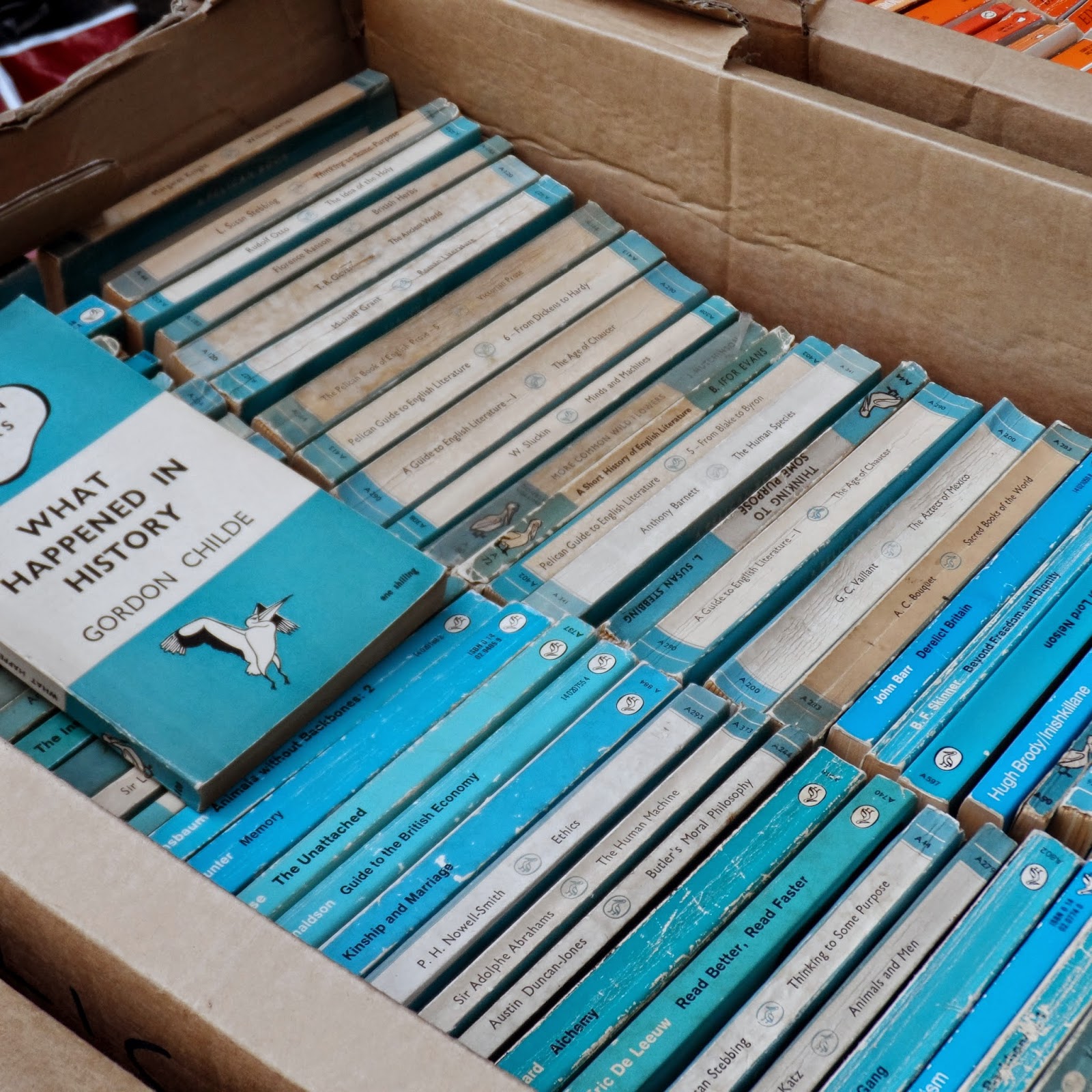
Nothing makes me happier than secondhand book stalls. Such jewels and bargains to be found last week at a Christian Aid book fair in George Street, literary fiction and non-fiction for £1 - boxes and boxes of  books, including Penguins and Pelicans. It was sunny and there were trestle tables outside, it was like Paris. It reminded me of how much I love paper books. And I wondered what secondhand book fairs/shops will be like in fifty years. Will they even exist?

Tuesday, 22 April 2014

Discovering Anita Desai and Malcolm Lowry

I hadn't read anything by Anita Desai before, but just loved her gorgeous, short novel Clear Light of Day, a collection of disappointments and sadnesses, sprinkled with joy as two sisters Bim and Tara look back on their childhood in India in 1940s and their lives post-Partition. Here's a short clip of Desai  talking about Indian writers writing in English. And a longer interview here. Also, I recently discovered the writer Malcolm Lowry (1909-1957), this Oscar-nominated documentary from 1976, 'Volcano, An Inquiry into the Life and Death of Malcolm Lowry' is on YouTube. It's a compelling and disturbing portrayal of the debauchery and devastation of alcoholism and the cycle of perseverance and rejection and success in the writing life. I couldn't watch this film in one go, it's a disquieting experience, I watched it over a few nights,  the soundtrack is jangling and alienating. One of Lowry's friends interviewed, years after his death, wipes away a tear saying: 'The idea of such a talented man going so wrong... He could cope as long as he was drunk...' This resonates,  thinking of my own father.

Friday, 5 October 2012

Always too many on the shelves

There are always books you can give to charity, always too many on your shelves, even when you have given away as many as you can bear. I almost donated George Simenon's La Verité sur Bébé Donge a few weeks ago but when I opened it I realised it was my French prize in fifth year at high school so, of course,  I can't release it. Why we keep these things I do not know. I doubt I'll read it again and it will  continue to gather dust.  I can't release The Lord of the Rings either, that was my Maths Prize.  I've never read it, and I probably won't - though we had to do The Hobbit in English, that's probably why I chose it in the first place. (I  haven't seen any of the hobbit films, but I do remember Bilbo Baggins' name, it's intriguing what stays in your head from books you read years ago.) I'm also quite tempted to give away Doris Lessing's Briefing for a Descent into Hell, I don't think I ever got through it, but it's signed so I can't. I must've seen her at Edinburgh Book Festival but  don't remember when.

Tuesday, 17 April 2012

Osamu Dazai, La Vie Murmureé

Some things just speak to you and you want them straight  away, having discovered they exist. This is how I felt seeing the trailer for La Vie Murmureé (The Whispered Life), a French documentary about the Japanese writer Dazai. I'd never heard of Osamu Dazai. I watched the clip a few times, it just hypnotised me. I wanted to know more about this writer, who killed himself when he was just 38. I could find no info on the DVD in France (or UK or USA). I know Scott of The Friday Project - my publisher - loves Japanese writing so I asked him, and also emailed Rick, a Canadian teacher who lives in Japan (Rick takes brilliant photos by the way). Scott had not heard of the documentary but was going to see what he could find out. Rick then told me there's no DVD released in Japan, and he couldn't unearth any other traces. How frustrating, to see this gorgeous teaser-trailer but nothing more accessible! I have meanwhile downloaded The Schoolgirl onto my Kindle. I know little about Japanese literature apart from Banana Yoshimoto (I loved Kitchen) and Murakami (whom I've, shamefully, never got into) and I also loved Amélie Nothomb's Stupeur et Tremblements, set in Japan (she's a Belgian writer born in Japan).

Thursday, 1 September 2011

'The Threats', a stunning new thriller from UK media

Hoping to draw a line under the hyperbole and bias in the media that have caused so much stress and despair to people with my illness, this last four weeks. We've had the threats of 'suicide bomber' patients ramped up to such an extent that if researchers into ME weren't actually scared off before - a fact which has been ludicrously and harmfully exaggerated - they sure as hell will be now.

Thanks, Simon.

And any letters of reply from our point of view or our charities' - ie people with ME, who live with it, who know it, who research it - have been so brutally edited, we've been lucky to get an adjectival phrase published.

'The Threats' has been a highly entertaining, unnerving mini-series, broadcast over a month:

First, we had Nigel in BMJ.

Then Tom on the BBC, who was so excited he sounded like he was in a spoof documentary.

Then Esther on Radio Five.

Then a panoply of small scale reports.

Then Rod; then David; then Stefanie with Simon himself in the Times.

Then Robin in the Observer.

Then a lovely cartoon in THES (removed).

Then Simon in the Spectator.

Then Max in the Telegraph, unplugged on Friday (then removed, remixed by Monday).

Then Robin on the Guardian Science Weekly Podcast in case we hadn't got the gist in the Observer.

Then Simon repeating himself on the Spectator blog, Coffee House.

So, I think we've got the message now, loud and clear - Simon and his followers will do anything to prevent biomedical research into ME, they desperately want to keep it all to themselves - with their loveable, eccentric and conflating notions of 'false illness beliefs' and 'chronic fatigue syndrome'. I return to an excellent quote regarding this whole stramash, from a journalist in 2007:

“I’m sure there is a lot of psychiatric literature on how denying another person’s reality triggers all sorts of deep hostile responses”.

No one endorses threats, obviously, but the point spectacularly missed by the media is that Simon and his disciples are responsible, in the first place, for creating a climate in which such threats might flourish, by denying the reality of a neurological illness for decades, the way they have.

My final point on this - I am so very, very, very weary with it all - is: Simon, if you want to be a neurologist so much - stealing neurological illnesses and labelling them as psychiatric - then why on earth did you become a psychiatrist?

* I'm pleased 'The Threats' wasn't in any Scottish broadsheet, but I could, of course, be forced to eat my words.

** I just saw this very moving trailer from Voices from the Shadows, premiering this autumn in Mill Valley, California.