Showing posts with label family. Show all posts

Friday, 24 April 2020

Pandemic: foxes and sunsets and suicide


A couple of months ago, I saw a cat run across the garden with a pigeon in its mouth. I’ve never seen a domestic cat hunt such a big bird. The pigeon was upside down, white underneath. I did not see it being killed, just saw it being carried away.

I see foxes occasionally, once a year. One ran across the garden last week. It tarried for fifteen seconds or so on the wall, as if it were checking something. I was able to get a photo. It was huge - red and grey. Beautiful. I’ve seen it again since. Twice in a week.

I want it to come every day.

In between the pigeon being killed and the fox standing on the wall, uncommon events in this garden, the covid19 pandemic has impacted massively in the west. I recall watching reports from China in January, but of course did not think at all it involved ‘us’.

Now we are all affected.

Nothing feels real. 

Being chronically ill, I am used to spending long spells of time indoors, semi-isolated, but now the whole world is the same. It's getting a crash course in isolation and illness, in an alarming and dramatic way. The stuff of fiction.

Spring is happening, but it's dislocating. Daffodils have bloomed and withered, tulips are opening, the sun is warm if you shield yourself from the Scottish wind, but you cannot ever relax, the dread of this coronavirus is always there.

Six days into the lockdown, the weekend the clocks went forward, I heard my childhood friend had taken an overdose and was in intensive care. He has a diagnosis of paranoid schizophrenia. The unfolding of the virus and the isolation it imposed was too much for him, he was simply overwhelmed. I had spoken to him four or five times the week before, which made the news of his overdose even more upsetting. Against all the odds, after six days in intensive care, he regained consciousness and after being treated for bacterial pneumonia was discharged to a surgical ward before being admitted to a psychiatric hospital, where I hope they will be able to look after him for as long as is needed. 

I remembered that when the clocks went back last October, my friend had called me to say he had  put his clock back at 5pm, in case he forgot. Before  the lockdown he was doing a writing class and I told him I would love to see his writing, and asked him to send me some. He said he wanted  to write a book and I told him writing a book was hard. I might just write half a book then, he replied. His mother has since told me it is poetry he has been writing.

What struck me when my friend was in intensive care and we did not know the outcome was that his mother, a close friend of my own mother’s, had been a huge support in the early seventies when my consultant anaesthetist father had taken his own life, living in the same town my friend and his mother still live in.

My current writing project is a (slow) fictionalisation of aspects of my father’s life. There is an early scene in particular, with withered flowers - hydrangea -  in this friend's garden in the 1970s. The scene has been in my head for many years, real, but now re-imagined in the novella-in-progress (I was delighted to discover a couple of  years ago, this poem by Rilke, 'Blue Hydrangea'). More than ever I've been thinking of the importance of storytelling. I have also been thinking of anaesthetists  as they are suddenly very much in the media – the experts on ventilators, so much needed in this crisis. In a 1960s' Polaroid, my father looks like a poet with his Paisley pattern cravate, drinking beer in Amsterdam.

The backs of my hands are cracked, my knuckles slightly bleeding, I've been overdoing disinfecting, using too much bleach, just so very afraid of getting infected from groceries/deliveries coming in. With ME your immune system is already in disarray, and we simply do not know how people with ME would be affected by covid19. It's too frightening to contemplate, given how unpredictably and aggressively this novel virus is affecting youngish, healthy people with no pre-existing conditions. There is talk in the medical community of how some covid19 patients are bound to develop ME afterwards. (Suddenly ME is respectable, the devastating illness you can get after a virus.)

In normal times, I spend much time sitting at my bedroom window watching birds and squirrels and sunsets. It's restorative, a gorgeous way to meditate and contemplate when you cannot do aerobic exercise. This process of contemplation has become even more important. Everyone is commenting on how much louder the birds are, they can be heard everywhere, surely a tiny silver lining of the pandemic.


Friday, 1 November 2019

A woodpecker just when I needed one

I rest a lot in my bedroom. I read there too and also watch garden birds, I have a chair at the window. It is my meditation, my way of being peaceful, my way of 'working out'. It's restorative, I lose myself, nothing else matters. I have had a dreadful few weeks with one thing and another. Last night, I woke up around three with a brutal sinus headache, I am very prone to them and can no longer use steroidal sprays because of ocular hypertension (discovered in 2009 when using steroid drops for uveitis), so I swallowed a handful of Sudafed and Ibuprofen. It's the kind of pain that can make you cry. I had a scan many years ago and have chronic inflammation, possibly from an over-zealous use of mothballs. I declined surgery. Today, I woke early with the pain still on the fringes but bearable. A few hours later, I saw a woodpecker - an adult male great spotted - I've never seen one before. I had on my old glasses and saw a flash of red at feeder, wondered why goldfinches were eating peanuts and when I held up my camera - always in my bedside drawer -  I realised it was a woodpecker. I managed to nab it before it flitted off. It felt auspicious. Today is also the anniversary of my father's death, he died in 1972, and although for many years it was not a date I ever thought about,  since I've  been writing about him, the date has much more resonance. A friend sent me this, the symbolism of a woodpecker. 

Wednesday, 14 November 2018

Autobiographical novel: 'a prosthetic voice' (Alexander Chee). And (films of) Guru Dutt

I recently dipped into Alexander Chee's collection of essays How to Write an Autobiographical Novel. I find reading about writing to be reassuring: you learn things that you already knew but didn't know you knew. It's the kind of book where you want to write down fragments and keep them close to your heart. Chee describes his first (autobiographical) novel as a 'prosthetic voice', which gives voice to those things too difficult to speak about, in his case, sexual abuse. His image of prosthesis is, I think,  quite brilliant.
And so while I wrote this novel, it didn't feel like I could say that I chose to write this novel. The writing felt both like an autonomic process, as compulsory as breathing or the beat of the heart, and at the same time as if an invisible creature had moved into a corner of my mind and begun building itself, making visible parts out of things dismantled from my memory, summoned from my imagination. I was spelling out a message that would allow me to talk to myself and to others. The novel that emerged was about things I could not speak of in life, in some cases literally. I would lie, or I would feel a weight on my chest as if someone was sitting there. But when the novel was done, I could read from it. A prosthetic voice.

The State of Me - hard to believe it was published ten years ago, its message as relevant today - wasn't for me a fictionalisation  about something too difficult to talk about, but rather a representation of the anger and injustice that people with ME have felt for decades due to a wilful reframing/misrepresentation of the illness by a core of the medical/political establishment. The novel had to be written, but the difficulties in writing it were much more the physical/cognitive challenges of ME than an inability to voice the subject. (I also, of course, faced the structural challenges of writing a novel that face all writers, ill or not.)

Chee's concept of  'prosthetic voice' does, though, resonate for me when I go to the project/novella which is partly about my late Pakistani father, the project that often has me thinking of Bernard MacLaverty's description of writing as 'a way of trying out different fathers'. This is exactly what I am doing - when I can - and something in me is a little broken the whole time. The theme of my novella is 'not knowing'.

It's fascinating to learn about writers/artists who would have been contemporaries of my father. I've just discovered Guru Dutt, an Indian director and actor, famous for Pyaasa, Kaagaz Ke Phool (Paper Flowers) and Chaudhvin Ka Chand. Dutt died aged only thirty-nine in 1964 from probable suicide, he had mixed sleeping pills and alcohol.  He had attempted suicide before. Knowing Dutt's life story made it even more emotional watching Pyaasa, the story of a shunned poet, who only finds success when he is (wrongly) presumed dead. And Kaagaz Ke Phool, a melodramatic tale of a director's flop (prescient as Kaagaz Ke Phool also flopped) - had me in tears at the end. Real tears rolling down my cheeks.  When we respond to films we are, of course, not responding to just the fictional narrative but to the narratives in our own lives. I especially love the framing of the film - the opening and closing scenes - with Suresh Sinha as an old man looking back on his life.

I thought of Saddat Hasan Manto and wondered if he had ever met Dutt in Bombay (Manto left his beloved Bombay for Lahore shortly after partition). When googling Manto and Dutt, I came across this review, which likens Guru Dutt's Pyaasa to Nandita Das's recent biopic Manto. Manto and Dutt certainly shared sensibilities, a concern for those in the margins, those disenfranchised, in Manto's case specifically those harmed by Partition (on both sides).

Manto was seven years older than my father. Dutt was six years younger than my father. All were in Bombay in 1947. My father was not working in film, or as a writer, he was a medical student, who had interrupted his studies to join the Indian Air Force during the Second World War. What these three  men would come to have in common was an addiction to alcohol, an addiction tragically implicated in all of their deaths. They were not old men when they died, Manto was forty-two, my father was fifty-three (I was eight). I fancifully allow myself to imagine the three of them meeting up in Bombay before Partition, wondering what they would have spoken about.

I've discovered that Nasreen Munni Kabir made a Channel 4 documentary  in 1989 called In Search of Guru Dutt. I have ordered her book on Dutt. The beautiful and luminous Waheeda Rehman appears in all three films mentioned above. I understand that she and Dutt had an  affair, which ended his marriage to Geeta Dutt.  Geeta Dutt was also the hugely talented playback singer for Rehman's songs. Geeta, I have read, had a breakdown and became alcoholic after Dutt's death. She died in 1972, leaving behind their three children, two sons and a daughter, Nina (Nina was just a baby when her father died). It is heartbreaking that Tarun Gutt, their eldest son also took his own life and Arun Dutt - who was involved in preserving his father's legacy - died of alcohol-related illness in 2014.

Having now also seen Chaudhvin Ka Chand I am left with a huge nostalgia for a period in Indian film-making in 1950s I did not even live through. I think the melodrama, the heightened reality, the muted gorgeousness of monochrome all tap into a process in my head and heart (the not knowing). The wonderful singer for Guru Dutt, in these three films, is Mohammed Rafi, who died aged fifty-five (though it is Hemant Kumar who sings 'Jane Woh Kaise Log' in Pyaasa). I also loved the actor 'Johnny Walker', who brought humanity and slapstick (much needed, to balance the sadness) in his role as the masseur in Pyaasa. I have read Johhny Walker and Guru Dutt were great friends in real life.

Reading Chee's essays and watching Dutt's films, something collided gently in me - it reinforced how important art and film and fiction are in understanding our lives, both for those who create the art and those who consume. Making the hard stuff bearable.


Thursday, 15 March 2018

Zaibunissa Street

I recently learned that Elphinstone Street (named after British official Monstuart Elphinstone) in Karachi was re-named Zaibunissa Street in 1970 after writer and journalist Zaib-un-Nissa Hamidullah. This interests me as Elphinstone was in Saddar, the area my paternal family migrated to in 1950s after Partition. I've read that Saddar was then full of book shops and (Iranian) tea houses. The streets were washed every day. Elphinstone was a street people strolled down. There was ballroom dancing on Elphinstone Street.

Today, the population of Karachi is approximately 16 million, Zaibunissa is a busy shopping street with over one hundred and thirty jewellery stores and most of the book shops have gone. Yesterday, I came across a purse that held earrings my Karachi family gifted me when they visited a few years ago after many years of little contact. The jeweller is in a building on Zaibunissa Street.

I looked up Monstuart Elphinstone, a Scot born in Dumbarton in 1779. I grew up five miles from Dumbarton - in fact, my GP practice was there - that's where we had our innoculations for visiting Karachi in 1974. And in early-mid eighties Coxsackie virus was locally being called 'Dumbarton Disease' because so many had become ill. I love how narratives link together, little synchronicities often appearing.


Monday, 10 April 2017

A Book of Banished Words

Delighted to have a short piece in Nancy Campbell's just published The Polar Tombola: A Book of Banished Words (photo from @BirdEditions).


More on  Nancy's live literature event  here: What happens when a language begins to disappear?


I first met Nancy on Twitter via a photo of a snowdrop three years ago and we came to 'know' each other through my dear late stepdad. My own banished word is described in 'The Hoot of an Owl', here is a fragment:

Coxsackie – pronounced cook-sah-kee – is the name of a small town on the Hudson River in upstate New York. Derived from Native American language, it’s said to mean the ‘hoot of an owl’. Poetic when whispered, but Coxsackie can also be a bully, swaggering its hard-sounding ‘C’s.
*

Life is truly stranger than fiction. How could I have known in winter 1982 that the hellish illness that had ruined my year in France - yet to be diagnosed as Coxsackie virus, which in turn triggered ME - would, thirty-five years later, be represented in a piece in a beautiful art book whose author had (by then) done a residency in my stepdad's childhood home in Greenland?

Monday, 20 February 2017

Bath Flash Fiction Anthology - To Carry Her Home

Delighted to receive this gorgeous anthology of longlisted, shortlisted and winners in past Bath Flash Awards. My own story 'A widow with a bowl of wine and lipstick coming off' - longlisted in early 2016 - was inspired by seeing my dear stepfather in the funeral home just two years ago. I still can't go to that image in my mind without feeling shock.


Someone has remarked this cover has a feel of Vanessa Bell, I agree. I very much look forward to reading the other flash fictions (144 of them). If interested in getting hold of the book, you can order here. And if you want to know more about what flash fiction is, some descriptions here.

Saturday, 7 January 2017

On fathers: Om Puri, Hisham Matar and some short writing

Saddened to learn that Om Puri has died aged only sixty-six. I loved him, of course, as the flawed Pakistani father in East is East. And as the taxi driver in My Son the Fanatic (based on a short story by Hanif Kureishi). I watched him more recently in Satyajit Ray's 1981 film Sadgati/Deliverance - Puri, in his early thirties, gave a devastating performance as an 'untouchable'.

*
The last book I read in 2016 was Hisham Matar's The Return. Anne Enright describes it as a terrible and lovely book, and it is: the writing is lovely and the truth is terrible, the knowing and not knowing the brutality of his father's death at the hands of the Gaddafi regime in the nineties. I underlined several passages as I read, words that stay in my head: 'I have always wondered if it is possible to lose your father without sensing the particular moment of his death'.

*

Happy that 2017 will see with the upcoming publication (print and digital) of Bath Flash Fiction anthology - I had a story longlisted almost a year ago - 'A widow with a bowl of wine and lipstick coming off'. This flash was inspired by seeing my dear stepfather in the funeral parlour in February 2015, the image still shocks me, though it was one of peace, but nothing about it was real, nothing.

I've not written much flash fiction, I've read more, but I think flash titles are very important, they act like a hinge for what's unfolding. I see flash fiction like fireworks - small with a beautiful punch - but still demanding time and energy in creating. Flash lends itself well to low energy writing. And as you tweak even 300 words,  you know more than ever, as you shift the words around in such a small space, how arbitrary it all is.  The story was accepted by an online literary journal at the same time as it was longlisted and I had to decide where I wanted it placed. I look forward to seeing my words - which with time passing now seem 'remote'  - see the light of day.

Tuesday, 5 January 2016

The Appa Dance (made us happy as carpets)

We had much hilarity with MadLibs over the holidays. My eleven year old nephew introduced us to the game. You're asked for adjectives, adverbs, nouns, names and places, but only the questioner knows the title of the story. A narrative emerges, flash fiction, nonsensical and surreal. Appa is my nephews' nickname for me, sometimes they will call me Appa instead of Auntie Nasim. (My brothers and I had a very old aunt in Pakistan when we visited in the seventies, we knew her as Auntie Appa, we did not know then that 'apa' was Urdu for elder sister, we thought Appa (two 'p's) was her name.

The Latest Dance Craze
Have you heard about the latest dance craze sweeping Paris? It's called The Appa! Slip on your hunting shoes, turn up the speakers on your Christmas tree and let's master the moves that put this bleak dance on the map: put your hands on your shins, stomp your nose and strike a sad pose. Take fourteen colourful steps to the left, spin irresponsibly, then take two boisterous steps to the right. Throw your mouth in the air and sway your foxes from side to side. For the big finish, stick out your belly button and wiggle it excitedly. Repeat all of these circular steps until the song is over.

It reminded me of The Time Warp in Rocky Horror. In the early eighties, we spent many a happy night as students in the cinema, doing all the actions. In another Madlibs,  'happy as carpets' came up. I want to use that gorgeous phrase in a story.

*Update I received this photo on Twitter of the 'happiest carpets I know', stunning image of dyed rugs drying in Tangiers:


Sunday, 8 November 2015

The clamjamfry of the PACE trial

It's quite a clamjamfry in the world of ME research at the moment. The dodgiest-of-dodgy-trials aka as the Oxford PACE trial is having the life shaken out of it in the form of American health journalist and academic David Tuller. Tuller has recently and comprehensively demolished the trial over on Prof Vincent Racaniello's virology blog. And James C Coyne, professor of health psychology - and visiting professor at Stirling University - is weighing in too. The Americans have come to save us.

I often speak of the ME narrative being taken over by the CFS narrative in the nineties, and by chance I came across an ITN clip from 1996 - lovely Trevor McDonald informing us that ME was no longer known as ME, but now officially called CFS, and Simon Wessely (not yet knighted) telling us that longterm cases of disability had a psychological component. All interspersed with an exhausted woman telling us how very tired she was - no disrespect, but she apparently had (slow onset) chronic fatigue, not the actual neuroimmune illness ME. And glimpses of a shady-looking medical panel making this name change decision. So now we have actual visual proof of when the trajectory began: Ramsay-ME being buried by the psychiatry-led UK medical establishment. I'm so glad I didn't see this in 1996, the television screen would have been cursed to hell. (And given that the feisty consultant neurologist who diagnosed me in 1983/4 had also studied psychiatry at Harvard, you'd think he *might* just have picked up on any psychological component...)

But it has all come back to bite them on the bottom, as PACE is, of course, rubbish in so many ways. Conflating a complex, poorly understood neuroimmune illness with chronic fatigue was never going to work, was it? Apart from the methodological flaws/holes, what enrages me is that the scaffolding of PACE is that ME - even if virally triggered - is perpetuated by unhelpful illness beliefs - and that changing how you think about your illness (CBT) and a wee graded jog (GET)  round the park will make you all better. No matter that many people with ME are reporting becoming *more* disabled after graded exercise therapy. Once mild or moderately ill, now bedridden. No matter that you can't fucking exercise because your head shuts down and your muscles burn and you become exhausted and weak as  soon as you remotely overdo it. There is mitochondrial dysfunction, that's why. But PACE makes no allowances for post-exertional malaise (PEM).

Anyway, in response to Tuller, Simon last week wrote a defence of PACE - full of rather dull nautical imagery - which was quickly satirised by Graham McPhee, a former maths teacher who had to retire ten years ago due to ME. In the meantime, while PACE implodes, there is great research afoot. At last month's research collaborative meeting in Newcastle, virologist Professor Montoya of Stanford apologised to the ME community and said it was his wish that all USA doctors would apologise to ME patients for the way they been treated (and what a pleasure it was to meet him briefly and shake his hand). The Norwegian government has already apologised, a shame that the UK neither has the impulse nor grace to do the same. Here is the summary of ongoing and new research presented in Newcastle written up on ME Association's site by Dr Charles Shepherd. And the USA's NIH has just pledged a massive injection to research.

My 14 year old nephew sent me the first draft of his short story assignment for school, I love reading both nephews' writing. I'm bemused by the arc of good versus evil - the Americans are all powerful and good, fighting evil terrorists who want to nuke the planet. Of course, in real life, there is much more grey, but as far as PACE is concerned I'm very glad we have the Americans on board. One can sense they are flabbergasted at how the UK media has been bolstering the psychiatric lobby, presenting only one - very flawed - model of ME for the last twenty years.  And on the subject of nephews, my younger nephew, who's ten, almost eleven, dressed up as an assassin at Halloween. *

* update Welcome article by doctor/journalist James Le Fanu in Telegraph on the nonsense of PACE - rare to have intelligent articles on ME by UK journalist.

Saturday, 12 September 2015

Art and death and farewells in Glencoe and Greenland

Twitter can be wonderful. I first met artist and writer Nancy Campbell via Twitter, last year in March. Nancy had favourited a snowdrops photo and I discovered she had produced a beautiful book in the form of artist's cards, How to Say 'I Love you' in Greenlandic. I immediately got the book for my stepdad (I may have traded a copy of my novel for Nancy's work, I can't recall - I've done this several times, used my novel as currency for art).

My stepdad spent many happy hours reading through the cards, enunciating the Greenlandic words - I can see and hear him now - correcting me when I got the pronunciation wrong. Childhood memories are important in dementia, and we didn't know the old songs/fairytales/poems that would stimulate him, so these cards played a special role.  When he died, I wrote a message on one of the cards, wrapped gold ribbon round it - a bit 'blingy', but it was all I could find - and placed it in his coffin. I wanted to put more things in - there is an instinct, I think, to put in many objects of comfort for the departing soul. Though, that is, of course, more to comfort ourselves.

I was delighted when Nancy told me she'd applied for an art residency at Ilulissat's Emanuel Petersen Museum, which, before it was a museum, was my stepdad's childhood home. We could not have known that by the time she did the residency my beloved stepdad would have passed away. By sheer coincidence my mother had planned to scatter his ashes in Glencoe, the same week Nancy was in Ilulissat. Nancy kindly asked if there were any mementoes of my stepdad's we would like her to take to Greenland. We decided to send her his order of service with loving messages written on the back by various members of our Scottish/Scandinavian family. I asked Nancy to perform whatever ceremony she could, I suggested making a wee paper boat and floating it away, but was putting the event entirely in her hands. I knew she would know what to do.

Scattering my stepdad's ashes in Glencoe - or more accurately Glen Etive - was a peaceful and beautiful occasion. The sun shone and we played Local Hero soundtrack gently in the background - he loved this music - and my younger nephew played a sad folk song on the violin. Buachaille Etive Mor stood solid and strong in the background. There were deer,  and house martins diving all around. My stepsister put a few drops of whisky on the ground to send him on his way. I brought back some wild flowers and pink heather, the flowers died straight away, the heather has survived and is on my bookshelves.


Early on in their marriage, my mother had a local artist paint Buachaille Etive Mor for my stepdad as a gift. It was one of his favourite spots in the world. The painting hangs in their house and now when I look at the painting I know he is there, physically part of the landscape. Internet connection in Greenland and Glencoe is, unsurprisingly, fickle, so I did not know what Nancy had done on that day, but I did think about Greenland when we were in Glencoe and was curious.

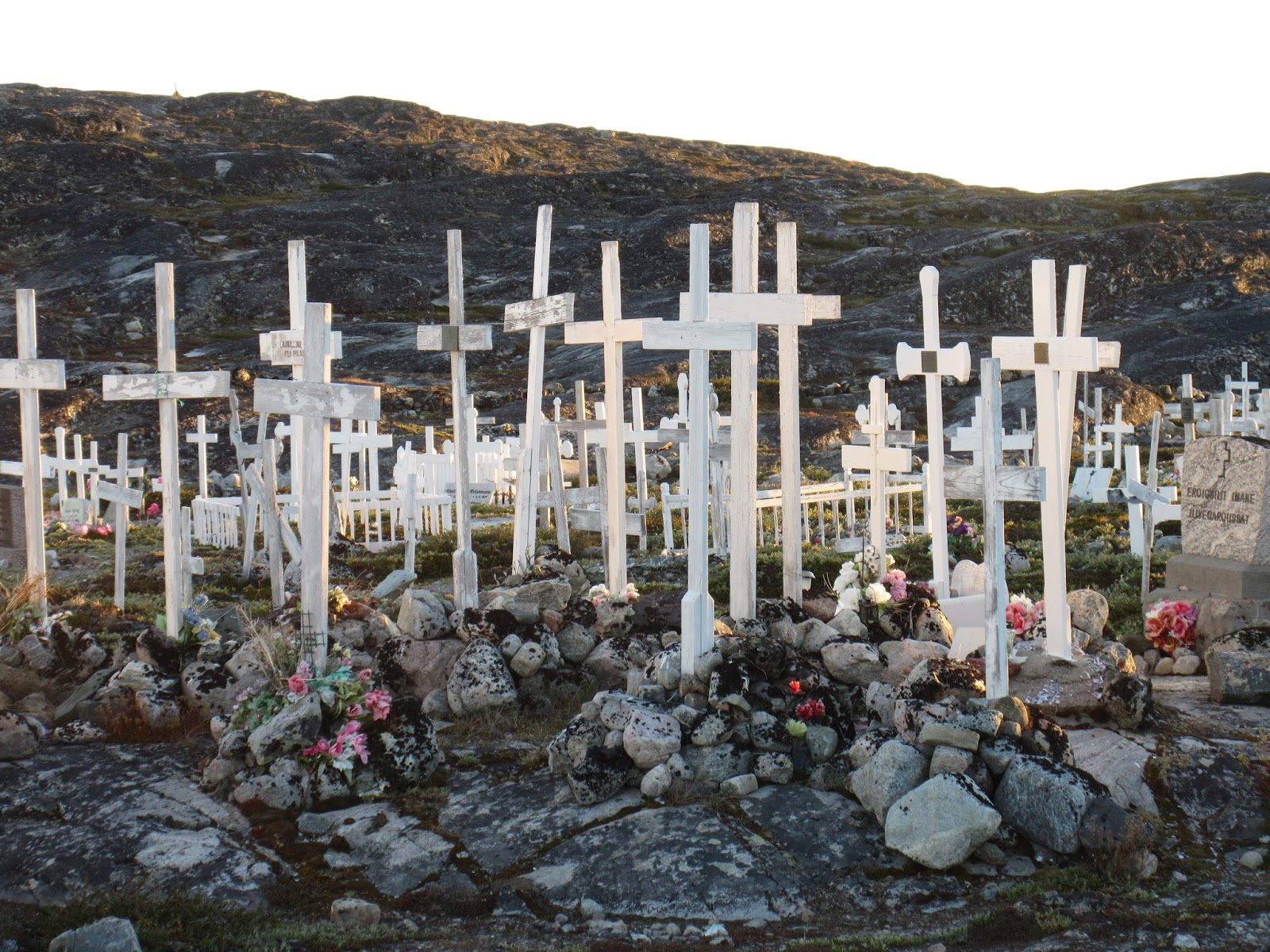
Last week, Nancy sent me a beautifully detailed, long email of what she had done, I read it in tears, touched by her great thoughtfulness and creative gestures. She had placed my stepdad's memorial card on top of the harmonium in the museum for a couple of days, among the stunning Emanuel Petersen paintings. And she put sage leaves around him that she'd brought from her garden in Oxford. She said she liked the idea of sage helping spirits to rest. After the harmonium, for the final goodbye, Nancy chose to place his order of service in an Ilulissat hilltop graveyard, under a piece of gneiss she had chosen as an anchor. She placed him at the southern most tip of the graveyard, pointing towards Scotland. She told me that in Inuit culture, wide views of the sea are important for the location of burial sites. This is a photo of the cemetery taken by Nancy. There are harebells and blueberries growing, and mussel shells and plastic flowers on the graves.

                                                                     Ilulissat, photo by Nancy Campbell, 2015


Nancy and I have never met - though I hope we do, one day - and she did not know my stepdad, but by a quirk of fate, she became intimately involved in our bidding farewell to him. His twin brother, who lives in Copenhagen, hopes to scatter his remaining ashes in Ilulissat next year. Then the farewell will be complete.  I think of how our lives are threaded, my stepdad could never have known that the artist whose cards he enjoyed so much in the last year of his life would be taking him home to Greenland. And Nancy, when she favourited a photograph - garden snowdrops I'd taken on my very unsophisticated phone - could not have known where that would lead.

It is seven months now since my stepdad's passing, my own grief is more gentle, for sure, but it's without exaggeration when I say that he was my best friend. Now that he is gone I know this more than ever. I have yet to meet a kinder man. Thank you, Nancy, for what you did for him.


Sunday, 2 August 2015

Writing, Rituximab & a Japanese film about death

Three pieces on writing I have recently enjoyed:

An interview with Janice Galloway, who has a new collection of short stories out. Speaking about the blurring of memoir and fiction, she says: 'It’s all stories, as far as I’m concerned and your job is to tell the story interestingly and not be dull.'

I agree with her wholeheartedly.

Here, writer Fiona Melrose on how a Caravaggio painting she loves makes her think about story and construct: 'Someone central in your story has to want something that drives some sort of journey, even if the thing they want the most is to stop everything from changing.'

I think that's an interesting point. Writers learn early on their main character has to want something - I remember reading years ago that your character has to really want something, even if it's just a glass of water - but wanting things not to change is often a driving force in real life, so of course applies to fictional characters.

And a very interesting essay on ethnicity and writing - should ethnicity limit what a writer can write? - from  Susan Barker, who describes herself as 'British — mixed-race English and Chinese, but linguistically and culturally British'. I too am British, a Scottish mother and Pakistani father, and I certainly feel culturally and linguistically Scottish. 

I've been thinking recently that Helen Fleet my main character in 'The State of Me' is white, it never occurred to me that she wouldn't be. My novel is about illness, not race. Writing Caucasian characters is natural to me, whereas writing Asian characters is harder as I did not have much Asian influence in my childhood. I am less confident with Asian characters, but that does not mean I should not write them. After all,  fiction-writing is pretending to be someone else. And I am in the slow process. 

I tried to say more about this in the comment thread of an excellent blog post about diversity and fiction  back in June by Nikesh Shukla.

Going back to Susan Barker's essay, she says: 'In a best case scenario, what should determine the legitimacy of fiction is the writing itself, and though this is not always the case, fiction writers should not be deterred from writing from other cultural perspectives.'

Indeed, it's the writing, always the writing.

*
 
Also, good news on Rituximab last month, phase 2 of the Norwegian drug trial was published. I feel cautiously optimistic. Just so gratifying to see actual science in progress, after decades of buffoonery.

And I highly recommend this Japanese film from 2009, 'Departures', a gorgeous film about death.

Friday, 10 July 2015

'Trying out different fathers' - my thoughts on Omar Sharif

Had tears today, hearing that Omar Sharif has died. Sad for his family, but happy for him that he no longer suffers the ravages of dementia. To me, he is more than the handsome Egyptian actor who glittered in Dr Zhivago and Lawrence of Arabia.

I grew up hearing that my father looked like Omar Sharif. My father was my mother's first husband, she met him in the sixties when he was a doctor and she was a nurse, a Mills & Boon romance without the happy ending. My father died in tragic circumstances when I was eight. My memories of him are hazy. He looks handsome in photos, and I can definitely see the resemblance (though I think Omar had the edge). When I first saw Dr Zhivago - aged thirteen? - I couldn't watch Omar Sharif without thinking of  my father. The tram scene had me weeping, and not just because Yuri  doesn't get to see Julie Christie again. I've since seen Dr Zhivago many times over the years, and the tram scene is me watching my father dying, which sounds fanciful, but that is the truth. My memory also tells me that I first saw Dr Zhivago in Karachi, when we visited in 1974 (after my father had passed away), but that is not true, I watched it a few years later at the cinema in Glasgow.

And I still can't even listen to Lara's Theme without welling up.

In May, when the media revealed that Omar Sharif had dementia I had a lump in my throat, having recently lost my beloved stepfather to dementia. To know that this brilliant actor now had dementia  touched me. And when my stepfather passed away, five months ago, I was unable to contemplate even a sentence of the novella I've been slowly, slowly writing, based on my father. My head was full of Greenland, there was no room for Karachi (my father was my father for eight years, my stepfather was my father for thirty-eight years).

The character based on my father is called Omar, I'd juggled many names but Omar fits best. Recently, I've ventured back to the novella when I have 'spare' energy - creative writing is much more physically and mentally demanding that you would think - but I'm a different person writing as I no longer have a stepfather, there is a huge gap where he should be. Moreover, fictionalising my father has its own griefs and complexities: I  think of Bernard MacLaverty who has spoken of 'writing as a way of trying out different fathers'.

I say to my mother sometimes, Did he really look like Omar Sharif? Yes, she says, he did.

RIP, Omar Sharif.  In the meantime, I will try out different fathers.

*I watched Monsieur Ibrahim last year, I recommend it. ** The character is no longer Omar, but I am not saying who he is now, don't want to jinx.


Sunday, 21 June 2015

The longest day

Today is the longest day and also Father's Day - the first one without my beloved stepdad. I can hear his lovely voice. I think of the hours I spent with him showing him pictures of Ilulissat on the iPad. He couldn't grasp how they got there, he thought I had done it, I'd explain, it's the internet and he'd say I didn't know the internet was interested in Greenland.

Since he left, I wear his Harris tweed jacket when I'm cold or missing him, it feels like he's hugging me. Today, I miss him and feel cold, it's freezing, June in Scotland usually is. So the Harris tweed is doubly needed, and I feel like a student in eighties again, when we'd wear  mansized - usually, our boyfriends' - clothes.

An orange poppy bloomed this morning, of course I see it is a sign that he's here.

And below some gorgeous wee pink wildflowers that I rescued before my mother, who was visiting, mowed away.


Thursday, 11 June 2015

Hanging bath mats on the gate

It is eighteen weeks since my wonderful stepdad passed away - I can still not write the word 'died' beside him, in the same sentence. The raw shock and awfulness has faded, but I miss him terribly and still find myself in tears unexpectedly. I found some writing from three years ago, when I was visiting him and my mother:

A seagull shat on me today, I thought, at first, it was a giant raindrop on the back of my hand. I looked up, the sky was empty and blue. My stepdad said he'd seen the shadows of *two* seagulls. Hard to know if he had as he is  retreating more and more into his own world (he puts the olive oil in the fridge, I take it back out, he puts it back in, I take it back out). Then he hung the bath mats on the garden gate to dry, they had been on the clothes horse, but for his own  - perfectly valid, I'm sure - reasons, he wanted the clothes horse back in the garage, and the mats on the garden gate. 

I remember him hanging the bath mats on the garden gate: a chemical engineer with a head full of equations and science, hanging the bath mats on the back gate.

*

So, to mark eighteen weeks without this lovely man,  here he is with his identical twin in their beloved Greenland, probably 1933.