The world seems abominable at the moment, but I smiled this Easter weekend. I saw two rainbows yesterday, one in the afternoon, a portion, stubby and thick, and one in the evening, a thin huge arc. And today a goldfinch as high on a tree as you can be; starlings that could be female blackbirds until you get close, a chaffinch singing its heart out and two princely beautiful male eider ducks. The world seemed almost bearable again. By the way, a broken rainbow is called a watergaw in Scots.
Monday, 28 March 2016

Thursday, 11 February 2016
Penelope Lively on ageing reminds me of getting used to being ill at twenty
I've just started Penelope Lively's memoir Ammonites and Leaping Fish, I had not heard of this book and am glad that artist and writer Nancy nudged me in its direction. For a long time, I've been reading about South Asia in 1940s and 1950s in an attempt to put together some kind of fictionalised version of my father, and Nancy told me Penelope talks about Suez in 1950s, which is perfect as my dad travelled by ship from Pakistan to UK at least once in that decade (I even found the passenger list). I'm not yet at the Suez part, but Penelope's chapter on old age makes me smile. Talking about adapting to old age - she is 80 - she says:
You get used to it. And that surprises me. You get used to diminishment, to a body that is stalled, an impediment? Well, yes, you do. An alter ego is amazed, aghast perhaps - myself in the roaring forties, when robust health was an assumption, a given, something you barely noticed because it was always there. Acceptance has set in, somehow, has crept up on you, which is just as well, because the alternative - perpetual rage and resentment - would not help matters. You are now this other person, your earlier selves are out there, familiar, well remembered, but you have to come to terms with a different incarnation.
Getting used to a different incarnation is, of course, very different when you are young and the catastrophe of illness has punched into your life. I always say it takes about a decade to get used to having ME. That's probably how long it took me. In The State of Me when Helen is still horribly ill, aged 21, in bed, she lists 10 things about her old life:
6. Looking at photos of other self in other life. Tracing finger over old self, a smiling girl in a hockey team. My hockey stick lay like a corpse in the back of my cupboard, club foot poking through my clothes, reminding me of my frailty. I had tried to throw it out twice, but Nab had brought it back in.And in real life I didn't really ever have difficulty accepting, it just was, though at the beginning, when acutely ill, I was more terrified than anything of how ill you could feel and not be dying. I think I have always dealt with my illness with dignity, but there may well be some rage at the fucking circus of psychiatrists who have made life so hard for us by denying our illness is physical. The PACE trial is crumbling though. And we have Americans - journalist and academic David Tuller and professor of psychology James Coyne - to thank for that.
(And I had to look up ammonite. )

Tuesday, 12 January 2016
'Five Years'
I cried last night watching this BBC Two documentary 'Five Years', which focuses on five key years of David Bowie's work. I loved most of his seventies' stuff, the later music less so. I also loved the clips - 1 hour 9 minutes into the programme - of him
playing John Merrick in The Elephant Man, with exquisite vulnerability
and beautiful ugliness.
I had not followed Bowie's music for a long time but there was a time when he was all I listened to, in my teens and twenties (alongside Leonard Cohen and Frank Zappa). The outpouring of sadness on social media is, of course, not just the passing of an extraordinary and unique artist - aged only 69 - but the mourning of our own Bowie-wrapped memories (and that wrapping has beautiful, silver bows).
But now a shift has taken place and our memories are, in a way, suddenly hollow.
I had not followed Bowie's music for a long time but there was a time when he was all I listened to, in my teens and twenties (alongside Leonard Cohen and Frank Zappa). The outpouring of sadness on social media is, of course, not just the passing of an extraordinary and unique artist - aged only 69 - but the mourning of our own Bowie-wrapped memories (and that wrapping has beautiful, silver bows).
But now a shift has taken place and our memories are, in a way, suddenly hollow.
I had all of his albums, my cousin and I exchanged 'Heroes' and 'Space Oddity' as Christmas gifts one year, I don't remember who gave what, but he was so physically beautiful on both covers. I remember how the 'Diamond Dogs' cover folded out. It was sumptuous. And how I could never get into 'Lodger', I'd play it over and over, hoping to like it more, but having to admit to myself I didn't...
I remember seeing the German film Christiane F. at a Glasgow cinema (no longer there), mesmerised by the Bowie soundtrack. The boyfriend I went with died many years ago from a brain haemorrhage, I don't know the circumstances, we had lost touch, but I remember what I wore to the cinema that night, a long red cotton Indian print dress.
(I also remember the pink trousers I wore, dancing to 'John I'm Only Dancing' in the QM Union.)
I remember seeing the German film Christiane F. at a Glasgow cinema (no longer there), mesmerised by the Bowie soundtrack. The boyfriend I went with died many years ago from a brain haemorrhage, I don't know the circumstances, we had lost touch, but I remember what I wore to the cinema that night, a long red cotton Indian print dress.
(I also remember the pink trousers I wore, dancing to 'John I'm Only Dancing' in the QM Union.)
I don't have a favourite track, it's almost impossible to choose one, but the song that always pierces me is 'Five Years' and it is in my novel. When I was told by a consultant neurologist in 1984 - almost eighteen months after becoming ill with Coxsackie virus - that I had myalgic encephalomyelitis (ME) and it could last for five years, I was horrified and truly didn't know how I could bear feeling so ill for another five years. I was twenty years old. My character Helen Fleet says:
On the way home in the car, I hoped we’d crash and that I’d be killed instantly and Rita would walk away without a scratch. I kept thinking of the David Bowie song ‘Five Years’: . . . five years left to cry in . . . steady drums, louder and louder and louder . . . five years, stuck on my eyes, high violiny bit. (The State of Me, Chapter Five)
It's hard, I think, to describe Bowie without resorting to dreadful clichés - all I can say is I have a lump in my throat and even writing this I have tears. Yesterday, I realised how much of a part he had played in my growing up. When I hear the tinkling at the beginning of 'Ashes to Ashes', I am back in my childhood living room in 1980, aged sixteen, not yet ill, watching Top of the Pops. At New Year, I tweeted this, it feels a bit dislocating now.
Tuesday, 5 January 2016
The Appa Dance (made us happy as carpets)
We had much hilarity with MadLibs over the holidays. My eleven year old nephew introduced us to the game. You're asked for adjectives, adverbs, nouns, names and places, but only the questioner knows the title of the story. A narrative emerges, flash fiction, nonsensical and surreal. Appa is my nephews' nickname for me, sometimes they will call me Appa instead of Auntie Nasim. (My brothers and I had a very old aunt in Pakistan when we visited in the seventies, we knew her as Auntie Appa, we did not know then that 'apa' was Urdu for elder sister, we thought Appa (two 'p's) was her name.
The Latest Dance Craze
Have you heard about the latest dance craze sweeping Paris? It's called The Appa! Slip on your hunting shoes, turn up the speakers on your Christmas tree and let's master the moves that put this bleak dance on the map: put your hands on your shins, stomp your nose and strike a sad pose. Take fourteen colourful steps to the left, spin irresponsibly, then take two boisterous steps to the right. Throw your mouth in the air and sway your foxes from side to side. For the big finish, stick out your belly button and wiggle it excitedly. Repeat all of these circular steps until the song is over.
It reminded me of The Time Warp in Rocky Horror. In the early eighties, we spent many a happy night as students in the cinema, doing all the actions. In another Madlibs, 'happy as carpets' came up. I want to use that gorgeous phrase in a story.
*Update I received this photo on Twitter of the 'happiest carpets I know', stunning image of dyed rugs drying in Tangiers:

*Update I received this photo on Twitter of the 'happiest carpets I know', stunning image of dyed rugs drying in Tangiers:

Sunday, 8 November 2015
The clamjamfry of the PACE trial
It's quite a clamjamfry in the world of ME research at the moment. The dodgiest-of-dodgy-trials aka as the Oxford PACE trial is having the life shaken out of it in the form of American health journalist and academic David Tuller. Tuller has recently and comprehensively demolished the trial over on Prof Vincent Racaniello's virology blog. And James C Coyne, professor of health psychology - and visiting professor at Stirling University - is weighing in too. The Americans have come to save us.
I often speak of the ME narrative being taken over by the CFS narrative in the nineties, and by chance I came across an ITN clip from 1996 - lovely Trevor McDonald informing us that ME was no longer known as ME, but now officially called CFS, and Simon Wessely (not yet knighted) telling us that longterm cases of disability had a psychological component. All interspersed with an exhausted woman telling us how very tired she was - no disrespect, but she apparently had (slow onset) chronic fatigue, not the actual neuroimmune illness ME. And glimpses of a shady-looking medical panel making this name change decision. So now we have actual visual proof of when the trajectory began: Ramsay-ME being buried by the psychiatry-led UK medical establishment. I'm so glad I didn't see this in 1996, the television screen would have been cursed to hell. (And given that the feisty consultant neurologist who diagnosed me in 1983/4 had also studied psychiatry at Harvard, you'd think he *might* just have picked up on any psychological component...)
But it has all come back to bite them on the bottom, as PACE is, of course, rubbish in so many ways. Conflating a complex, poorly understood neuroimmune illness with chronic fatigue was never going to work, was it? Apart from the methodological flaws/holes, what enrages me is that the scaffolding of PACE is that ME - even if virally triggered - is perpetuated by unhelpful illness beliefs - and that changing how you think about your illness (CBT) and a wee graded jog (GET) round the park will make you all better. No matter that many people with ME are reporting becoming *more* disabled after graded exercise therapy. Once mild or moderately ill, now bedridden. No matter that you can't fucking exercise because your head shuts down and your muscles burn and you become exhausted and weak as soon as you remotely overdo it. There is mitochondrial dysfunction, that's why. But PACE makes no allowances for post-exertional malaise (PEM).
Anyway, in response to Tuller, Simon last week wrote a defence of PACE - full of rather dull nautical imagery - which was quickly satirised by Graham McPhee, a former maths teacher who had to retire ten years ago due to ME. In the meantime, while PACE implodes, there is great research afoot. At last month's research collaborative meeting in Newcastle, virologist Professor Montoya of Stanford apologised to the ME community and said it was his wish that all USA doctors would apologise to ME patients for the way they been treated (and what a pleasure it was to meet him briefly and shake his hand). The Norwegian government has already apologised, a shame that the UK neither has the impulse nor grace to do the same. Here is the summary of ongoing and new research presented in Newcastle written up on ME Association's site by Dr Charles Shepherd. And the USA's NIH has just pledged a massive injection to research.
My 14 year old nephew sent me the first draft of his short story assignment for school, I love reading both nephews' writing. I'm bemused by the arc of good versus evil - the Americans are all powerful and good, fighting evil terrorists who want to nuke the planet. Of course, in real life, there is much more grey, but as far as PACE is concerned I'm very glad we have the Americans on board. One can sense they are flabbergasted at how the UK media has been bolstering the psychiatric lobby, presenting only one - very flawed - model of ME for the last twenty years. And on the subject of nephews, my younger nephew, who's ten, almost eleven, dressed up as an assassin at Halloween. *
* update Welcome article by doctor/journalist James Le Fanu in Telegraph on the nonsense of PACE - rare to have intelligent articles on ME by UK journalist.
I often speak of the ME narrative being taken over by the CFS narrative in the nineties, and by chance I came across an ITN clip from 1996 - lovely Trevor McDonald informing us that ME was no longer known as ME, but now officially called CFS, and Simon Wessely (not yet knighted) telling us that longterm cases of disability had a psychological component. All interspersed with an exhausted woman telling us how very tired she was - no disrespect, but she apparently had (slow onset) chronic fatigue, not the actual neuroimmune illness ME. And glimpses of a shady-looking medical panel making this name change decision. So now we have actual visual proof of when the trajectory began: Ramsay-ME being buried by the psychiatry-led UK medical establishment. I'm so glad I didn't see this in 1996, the television screen would have been cursed to hell. (And given that the feisty consultant neurologist who diagnosed me in 1983/4 had also studied psychiatry at Harvard, you'd think he *might* just have picked up on any psychological component...)
But it has all come back to bite them on the bottom, as PACE is, of course, rubbish in so many ways. Conflating a complex, poorly understood neuroimmune illness with chronic fatigue was never going to work, was it? Apart from the methodological flaws/holes, what enrages me is that the scaffolding of PACE is that ME - even if virally triggered - is perpetuated by unhelpful illness beliefs - and that changing how you think about your illness (CBT) and a wee graded jog (GET) round the park will make you all better. No matter that many people with ME are reporting becoming *more* disabled after graded exercise therapy. Once mild or moderately ill, now bedridden. No matter that you can't fucking exercise because your head shuts down and your muscles burn and you become exhausted and weak as soon as you remotely overdo it. There is mitochondrial dysfunction, that's why. But PACE makes no allowances for post-exertional malaise (PEM).
Anyway, in response to Tuller, Simon last week wrote a defence of PACE - full of rather dull nautical imagery - which was quickly satirised by Graham McPhee, a former maths teacher who had to retire ten years ago due to ME. In the meantime, while PACE implodes, there is great research afoot. At last month's research collaborative meeting in Newcastle, virologist Professor Montoya of Stanford apologised to the ME community and said it was his wish that all USA doctors would apologise to ME patients for the way they been treated (and what a pleasure it was to meet him briefly and shake his hand). The Norwegian government has already apologised, a shame that the UK neither has the impulse nor grace to do the same. Here is the summary of ongoing and new research presented in Newcastle written up on ME Association's site by Dr Charles Shepherd. And the USA's NIH has just pledged a massive injection to research.
My 14 year old nephew sent me the first draft of his short story assignment for school, I love reading both nephews' writing. I'm bemused by the arc of good versus evil - the Americans are all powerful and good, fighting evil terrorists who want to nuke the planet. Of course, in real life, there is much more grey, but as far as PACE is concerned I'm very glad we have the Americans on board. One can sense they are flabbergasted at how the UK media has been bolstering the psychiatric lobby, presenting only one - very flawed - model of ME for the last twenty years. And on the subject of nephews, my younger nephew, who's ten, almost eleven, dressed up as an assassin at Halloween. *
* update Welcome article by doctor/journalist James Le Fanu in Telegraph on the nonsense of PACE - rare to have intelligent articles on ME by UK journalist.
Sunday, 20 September 2015
Two papers and two films
I very much enjoyed this paper by Rose Richards: Writing the Othered Self: Autoethnography and the Problem of Objectification in Writing About Illness and Disability - she writes from the point of view of someone who has had a kidney transplant and notes that there are not many narratives around her particular illness. I found lots resonated, although the paper refers to non-fiction/academic writing.
Also, a recent USA report via ME Research UK is well worth a look, I have not read the whole report, it's very long, but the key arguments about ME are there. I've quoted a short paragraph via a tweet.
And I recommend two films I saw on DVD this month - both, by chance, about actors rehearsing for a play, and the lines they rehearse echoing real life. Cycling with Molière (in French with Fabrice Luchini whom I adore) is lighthearted and funny, though slight. Still, I probably enjoyed it more than the somewhat pretentious though clever Clouds of Sils Maria (with Juliette Binoche, but in English). We studied Molière's L'Avare at university all those years ago and I recall the mirth like yesterday.
Saturday, 12 September 2015
Art and death and farewells in Glencoe and Greenland
Twitter can be wonderful. I first met artist and writer Nancy Campbell via Twitter, last year in March. Nancy had favourited a snowdrops photo and I discovered she had produced a beautiful book in the form of artist's cards, How to Say 'I Love you' in Greenlandic. I immediately got the book for my stepdad (I may have traded a copy of my novel for Nancy's work, I can't recall - I've done this several times, used my novel as currency for art).
My stepdad spent many happy hours reading through the cards, enunciating the Greenlandic words - I can see and hear him now - correcting me when I got the pronunciation wrong. Childhood memories are important in dementia, and we didn't know the old songs/fairytales/poems that would stimulate him, so these cards played a special role. When he died, I wrote a message on one of the cards, wrapped gold ribbon round it - a bit 'blingy', but it was all I could find - and placed it in his coffin. I wanted to put more things in - there is an instinct, I think, to put in many objects of comfort for the departing soul. Though, that is, of course, more to comfort ourselves.
My stepdad spent many happy hours reading through the cards, enunciating the Greenlandic words - I can see and hear him now - correcting me when I got the pronunciation wrong. Childhood memories are important in dementia, and we didn't know the old songs/fairytales/poems that would stimulate him, so these cards played a special role. When he died, I wrote a message on one of the cards, wrapped gold ribbon round it - a bit 'blingy', but it was all I could find - and placed it in his coffin. I wanted to put more things in - there is an instinct, I think, to put in many objects of comfort for the departing soul. Though, that is, of course, more to comfort ourselves.
I was delighted when Nancy told me she'd applied for an art residency at Ilulissat's Emanuel Petersen Museum, which, before it was a museum, was my stepdad's childhood home. We could not have known that by the time she did the residency my beloved stepdad would have passed away. By sheer coincidence my mother had planned to scatter his ashes in Glencoe, the same week Nancy was in Ilulissat. Nancy kindly asked if there were any mementoes of my stepdad's we would like her to take to Greenland. We decided to send her his order of service with loving messages written on the back by various members of our Scottish/Scandinavian family. I asked Nancy to perform whatever ceremony she could, I suggested making a wee paper boat and floating it away, but was putting the event entirely in her hands. I knew she would know what to do.
Scattering my stepdad's ashes in Glencoe - or more accurately Glen Etive - was a peaceful and beautiful occasion. The sun shone and we played Local Hero soundtrack gently in the background - he loved this music - and my younger nephew played a sad folk song on the violin. Buachaille Etive Mor stood solid and strong in the background. There were deer, and house martins diving all around. My stepsister put a few drops of whisky on the ground to send him on his way. I brought back some wild flowers and pink heather, the flowers died straight away, the heather has survived and is on my bookshelves.


Early on in their marriage, my mother had a local artist paint
Buachaille Etive Mor for my stepdad as a gift. It was one of his
favourite spots in the world. The painting hangs in their house and now
when I look at the painting I know he is there, physically part
of the landscape. Internet connection in Greenland and Glencoe is, unsurprisingly, fickle, so I did not know what Nancy had done on that day, but I did think about Greenland when we were in Glencoe and was curious.
Last week, Nancy sent me a beautifully detailed, long email of what she had done, I read it in tears, touched by her great thoughtfulness and creative gestures. She had placed my stepdad's memorial card on top of the harmonium in the museum for a couple of days, among the stunning Emanuel Petersen paintings. And she put sage leaves around him that she'd brought from her garden in Oxford. She said she liked the idea of sage helping spirits to rest. After the harmonium, for the final goodbye, Nancy chose to place his order of service in an Ilulissat hilltop graveyard, under a piece of gneiss she had chosen as an anchor. She placed him at the southern most tip of the graveyard, pointing towards Scotland. She told me that in Inuit culture, wide views of the sea are important for the location of burial sites. This is a photo of the cemetery taken by Nancy. There are harebells and blueberries growing, and mussel shells and plastic flowers on the graves.
Last week, Nancy sent me a beautifully detailed, long email of what she had done, I read it in tears, touched by her great thoughtfulness and creative gestures. She had placed my stepdad's memorial card on top of the harmonium in the museum for a couple of days, among the stunning Emanuel Petersen paintings. And she put sage leaves around him that she'd brought from her garden in Oxford. She said she liked the idea of sage helping spirits to rest. After the harmonium, for the final goodbye, Nancy chose to place his order of service in an Ilulissat hilltop graveyard, under a piece of gneiss she had chosen as an anchor. She placed him at the southern most tip of the graveyard, pointing towards Scotland. She told me that in Inuit culture, wide views of the sea are important for the location of burial sites. This is a photo of the cemetery taken by Nancy. There are harebells and blueberries growing, and mussel shells and plastic flowers on the graves.
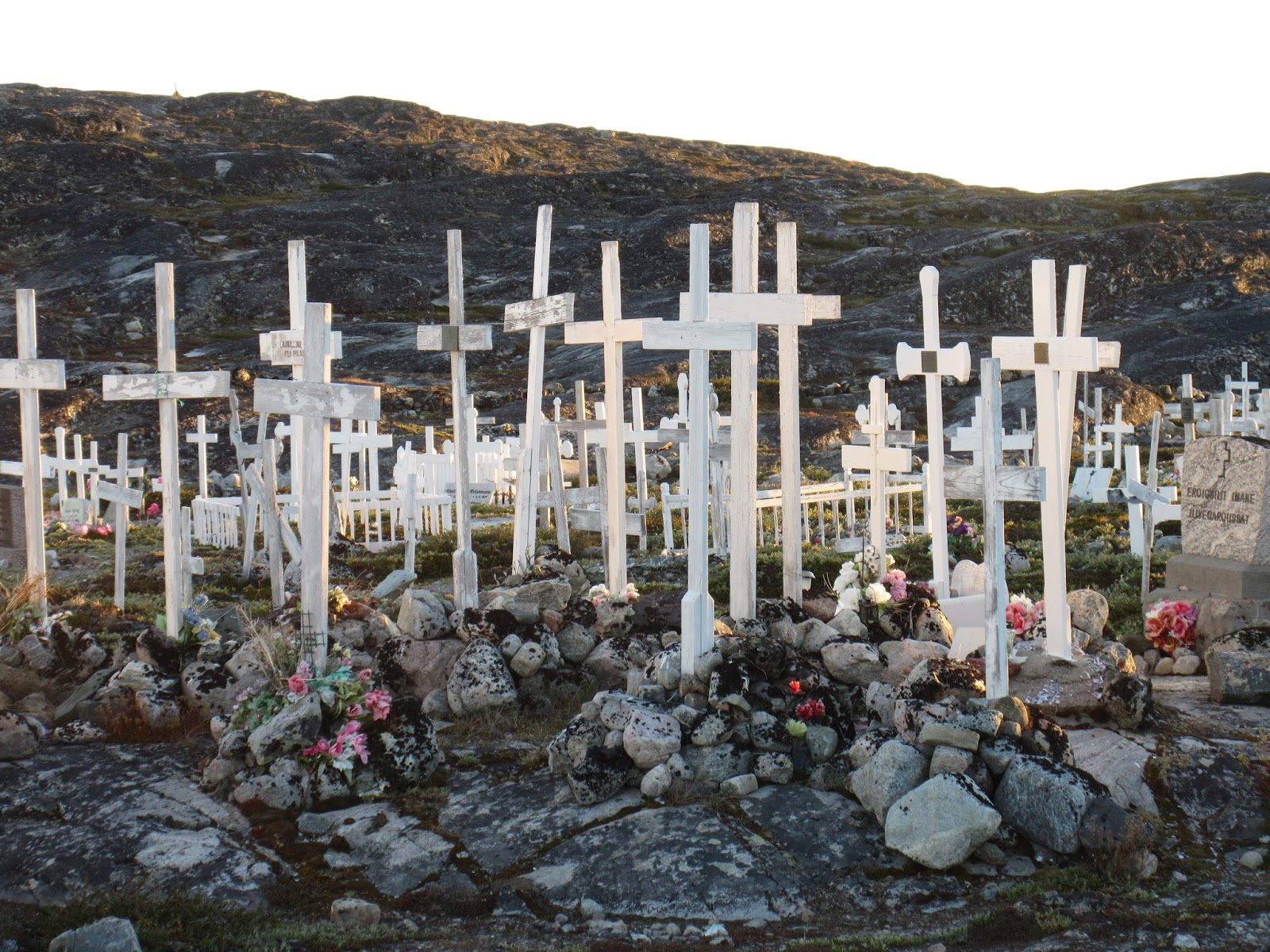
Ilulissat, photo by Nancy Campbell, 2015
Nancy and I have never met - though I hope we do, one day - and she did not know my stepdad, but by a quirk of
fate, she became intimately involved in our bidding farewell to him. His twin brother, who lives in Copenhagen, hopes to scatter his remaining
ashes in Ilulissat next year. Then the farewell will be complete. I think of how our lives are threaded, my stepdad could never have known that the artist whose cards he enjoyed so much in the last year of his life would be taking him home to Greenland. And Nancy, when she favourited a photograph - garden snowdrops I'd taken on my very unsophisticated phone - could not have known where that would lead.
It is seven months now since my stepdad's passing, my own grief is more gentle, for sure, but it's without exaggeration when I say that he was my best friend. Now that he is gone I know this more than ever. I have yet to meet a kinder man. Thank you, Nancy, for what you did for him.
Thursday, 13 August 2015
Prof Julia Newton's excellent severe ME research; & active verbs & buffoonery
Terrific to see Julia Newton's recent research project: identifying those with severe ME in Newcastle area.
Real science. That might actually help people.
Real science. That might actually help people.
The buffoons are, to be sure, slowly retreating. The new BACME - those self-appointed experts - medical guidelines state that 'CFS/ME is not a mental health issue'. No shit, Sherlock! You can tell they are trying weakly to embrace the biomedical model, having, of course, previously supported the horribly flawed biopsychosocial model, but their true colours are still there - no mention of pacing, which is how people with ME fucking survive.
And still predictably promoting PACE/CBT nonsense - psychobabble galore, it really is a hoot, active verbs and everything:

But they can't give up all their beliefs at once, can they? And who is regulating BACME?
Perhaps being part of the ME Research Collaborative has reigned them in a bit.
And still predictably promoting PACE/CBT nonsense - psychobabble galore, it really is a hoot, active verbs and everything:

Perhaps being part of the ME Research Collaborative has reigned them in a bit.
Sunday, 2 August 2015
Writing, Rituximab & a Japanese film about death
Three pieces on writing I have recently enjoyed:
An interview with Janice Galloway, who has a new collection of short stories out. Speaking about the blurring of memoir and fiction, she says: 'It’s all stories, as far as I’m concerned and your job is to tell the story interestingly and not be dull.'
I agree with her wholeheartedly.
Here, writer Fiona Melrose on how a Caravaggio painting she loves makes her think about story and construct: 'Someone central in your story has to want something that drives some sort of journey, even if the thing they want the most is to stop everything from changing.'
I think that's an interesting point. Writers learn early on their main character has to want something - I remember reading years ago that your character has to really want something, even if it's just a glass of water - but wanting things not to change is often a driving force in real life, so of course applies to fictional characters.
And a very interesting essay on ethnicity and writing - should ethnicity limit what a writer can write? - from Susan Barker, who describes herself as 'British — mixed-race English and Chinese, but linguistically and culturally British'. I too am British, a Scottish mother and Pakistani father, and I certainly feel culturally and linguistically Scottish.
I've been thinking recently that Helen Fleet my main character in 'The State of Me' is white, it never occurred to me that she wouldn't be. My novel is about illness, not race. Writing Caucasian characters is natural to me, whereas writing Asian characters is harder as I did not have much Asian influence in my childhood. I am less confident with Asian characters, but that does not mean I should not write them. After all, fiction-writing is pretending to be someone else. And I am in the slow process.
I tried to say more about this in the comment thread of an excellent blog post about diversity and fiction back in June by Nikesh Shukla.
I tried to say more about this in the comment thread of an excellent blog post about diversity and fiction back in June by Nikesh Shukla.
Going back to Susan Barker's essay, she says: 'In a best case scenario, what should determine the legitimacy of fiction
is the writing itself, and though this is not always the case, fiction
writers should not be deterred from writing from other cultural
perspectives.'
Indeed, it's the writing, always the writing.
*
Also, good news on Rituximab last month, phase 2 of the Norwegian drug trial was published. I feel cautiously optimistic. Just so gratifying to see actual science in progress, after decades of buffoonery.
And I highly recommend this Japanese film from 2009, 'Departures', a gorgeous film about death.
Friday, 10 July 2015
'Trying out different fathers' - my thoughts on Omar Sharif
Had tears today, hearing that Omar Sharif has died. Sad for his family, but happy for him that he no longer suffers the ravages of dementia. To me, he is more than the handsome Egyptian actor who glittered in Dr Zhivago and Lawrence of Arabia.
I grew up hearing that my father looked like Omar Sharif. My father was my mother's first husband, she met him in the sixties when he was a doctor and she was a nurse, a Mills & Boon romance without the happy ending. My father died in tragic circumstances when I was eight. My memories of him are hazy. He looks handsome in photos, and I can definitely see the resemblance (though I think Omar had the edge). When I first saw Dr Zhivago - aged thirteen? - I couldn't watch Omar Sharif without thinking of my father. The tram scene had me weeping, and not just because Yuri doesn't get to see Julie Christie again. I've since seen Dr Zhivago many times over the years, and the tram scene is me watching my father dying, which sounds fanciful, but that is the truth. My memory also tells me that I first saw Dr Zhivago in Karachi, when we visited in 1974 (after my father had passed away), but that is not true, I watched it a few years later at the cinema in Glasgow.
And I still can't even listen to Lara's Theme without welling up.
I grew up hearing that my father looked like Omar Sharif. My father was my mother's first husband, she met him in the sixties when he was a doctor and she was a nurse, a Mills & Boon romance without the happy ending. My father died in tragic circumstances when I was eight. My memories of him are hazy. He looks handsome in photos, and I can definitely see the resemblance (though I think Omar had the edge). When I first saw Dr Zhivago - aged thirteen? - I couldn't watch Omar Sharif without thinking of my father. The tram scene had me weeping, and not just because Yuri doesn't get to see Julie Christie again. I've since seen Dr Zhivago many times over the years, and the tram scene is me watching my father dying, which sounds fanciful, but that is the truth. My memory also tells me that I first saw Dr Zhivago in Karachi, when we visited in 1974 (after my father had passed away), but that is not true, I watched it a few years later at the cinema in Glasgow.
And I still can't even listen to Lara's Theme without welling up.
In May, when the media revealed that Omar Sharif had dementia I had a lump in my throat, having recently lost my beloved stepfather to dementia. To know that this brilliant actor now had dementia touched me. And when my stepfather passed away, five months ago, I was unable to contemplate even a sentence of the novella I've been slowly, slowly writing, based on my father. My head was full of Greenland, there was no room for Karachi (my father was my father for eight years, my stepfather was my father for thirty-eight years).
The character based on my father is called Omar, I'd juggled many names but Omar fits best. Recently, I've ventured back to the novella when I have 'spare' energy - creative writing is much more physically and mentally demanding that you would think - but I'm a different person writing as I no longer have a stepfather, there is a huge gap where he should be. Moreover, fictionalising my father has its own griefs and complexities: I think of Bernard MacLaverty who has spoken of 'writing as a way of trying out different fathers'.
The character based on my father is called Omar, I'd juggled many names but Omar fits best. Recently, I've ventured back to the novella when I have 'spare' energy - creative writing is much more physically and mentally demanding that you would think - but I'm a different person writing as I no longer have a stepfather, there is a huge gap where he should be. Moreover, fictionalising my father has its own griefs and complexities: I think of Bernard MacLaverty who has spoken of 'writing as a way of trying out different fathers'.
I say to my mother sometimes, Did he really look like Omar Sharif? Yes, she says, he did.
RIP, Omar Sharif. In the meantime, I will try out different fathers.
*I watched Monsieur Ibrahim last year, I recommend it. ** The character is no longer Omar, but I am not saying who he is now, don't want to jinx.
Sunday, 21 June 2015
The longest day

Today is the longest day and also Father's Day - the first one without my beloved stepdad. I can hear his lovely voice. I think of the hours I spent with him showing him pictures of Ilulissat on the iPad. He couldn't grasp how they got there, he thought I had done it, I'd explain, it's the internet and he'd say I didn't know the internet was interested in Greenland.
Since he left, I wear his Harris tweed jacket when I'm cold or missing him, it feels like he's hugging me. Today, I miss him and feel cold, it's freezing, June in Scotland usually is. So the Harris tweed is doubly needed, and I feel like a student in eighties again, when we'd wear mansized - usually, our boyfriends' - clothes.
An orange poppy bloomed this morning, of course I see it is a sign that he's here.
Since he left, I wear his Harris tweed jacket when I'm cold or missing him, it feels like he's hugging me. Today, I miss him and feel cold, it's freezing, June in Scotland usually is. So the Harris tweed is doubly needed, and I feel like a student in eighties again, when we'd wear mansized - usually, our boyfriends' - clothes.
An orange poppy bloomed this morning, of course I see it is a sign that he's here.
And below some gorgeous wee pink wildflowers that I rescued before my mother, who was visiting, mowed away.

Saturday, 20 June 2015
The daft neurologist (cont'd) ...
My book being published in 2008 has been one of the happiest times in my life - though the process was certainly not without its trials (and I developed very frightening uveitis afterwards - the whole fiasco took its toll) - and on the launch night I was in heaven. The room was packed, copies of my novel piled up beside me, my nephews - then just three and six - were sitting in the audience and walked up to the front with roses during the reading. That was the only actual launch event I did, I can't possibly run around the country/world doing writerly things and that breaks my heart.
Still.
You would think/hope that thirty years after my diagnosis of ME - abnormal muscle biopsy, abnormal EMG, abnormal blood tests etc etc etc - all would be fine and dandy, we would be waiting patiently and quietly for the elusive biomarker, as dedicated researchers worked hard to help us find a cause and cure. No chance.
*
You would think/hope that thirty years after my diagnosis of ME - abnormal muscle biopsy, abnormal EMG, abnormal blood tests etc etc etc - all would be fine and dandy, we would be waiting patiently and quietly for the elusive biomarker, as dedicated researchers worked hard to help us find a cause and cure. No chance.
The (ever more desperate) psychiatric lobby is always hiding behind you, waiting to jump out and squeeze the very soul out of you. This past fortnight we have been treated to a work called 'It's all in your Head: True Stories of Imaginary Illness' by a daft neurologist called Suzanne O'Sullivan, who apparently googled ME and then wrote her ridiculous chapter on ME/CFS and false illness beliefs. Her book sits on the table in the same Waterstones I had my launch. It is very tempting to place copies of The State of Me, offer a 2-for-1, prevent readers being duped. And Suzanne is of course, doing the whole literary trail, book festivals galore. She seems wholly unperturbed about spreading medical misinformation.
This Bookseller article referred to her book as 'groundbreaking and controversial'.
I can confirm however that it is certainly not groundbreaking, more a dreary recycling of the biopsychosocial narrative because as I already reviewed here on Goodreads, it includes a case study 'Rachel', a young woman with 'ME/CFS' who 'fails' to manage her fatigue and doesn't get better. Naughty Rachel. She refuses psychiatric treatment (Good for you, Rachel). The chapter is manipulative and incoherent. Vacuous too.
This is 2015, let's just remind ourselves. Yet Suzanne has not managed to keep up with the science in spite of having it all at her fingertips. If Suzanne were not so dangerous, she would be a hoot, but this is, frankly, indefensible:
The icing on the cake (this part is also in my Goodreads review but is worth repeating for those of us who actually have an understanding of the stinking politics around this illness):
There is something very interesting alone in the fact that Suzanne does not seem to have actually met (m)any patients with classic Ramsay-ME - in 1990s when she was training, the Wessely/CFS school was just taking root. ME was being 'disappeared'. The patients she sees with dissociative seizures most likely don't have classic ME in first place. (Who knows what they have, given that ME/CFS has become a dustbin diagnosis, thanks to Oxford criteria, so loved by Wessely school.)
But O'Sullivan seems not to be unaware of the problems with criteria. (She really ought to watch Leonard Jason, professor of psychology, his 2014 presentation on case definitions and criterion variance is excellent.)
And we don't ever find out what happens to Rachel, she is not followed up. O'Sullivan also fails spectacularly to describe the experience of probably all of us with ME, of pushing ourselves to recover only to relapse catastrophically.
So, a doctor who is not an expert in ME feels entitled to devote a whole chapter of her book to ME, in which she shamefully undermines all the years of hard work those of us with the illness have done to educate. She is taking the piss. She will not rock the science, of course, it is progressing nicely, but she could well do damage to someone with ME who has faced disbelief from friends or family.
This Bookseller article referred to her book as 'groundbreaking and controversial'.
I can confirm however that it is certainly not groundbreaking, more a dreary recycling of the biopsychosocial narrative because as I already reviewed here on Goodreads, it includes a case study 'Rachel', a young woman with 'ME/CFS' who 'fails' to manage her fatigue and doesn't get better. Naughty Rachel. She refuses psychiatric treatment (Good for you, Rachel). The chapter is manipulative and incoherent. Vacuous too.
This is 2015, let's just remind ourselves. Yet Suzanne has not managed to keep up with the science in spite of having it all at her fingertips. If Suzanne were not so dangerous, she would be a hoot, but this is, frankly, indefensible:
'I will not be obtuse. I believe that psychological factors and behavioural issues, if they are not the entire cause, at the very least contribute in a significant way to prolonging the disability that occurs in chronic fatigue syndrome. Do I know that for sure? No, nobody does...'
'...So is it a somatisation disorder? ME/CFS is an illness in its own right that has not traditionally been referred to as a somatisation disorder, but that is not to say that it does not share common ground with psychosomatic disorders. It manifests as multiple medically unexplained symptoms. Sufferers of both disorders carry similar behaviours and illness beliefs and neither leads to evidence of organic disease however long you wait.'
'There is certainly evidence that ME/CFS can be precipitated by exposure to an infecting agent (no shit, Sherlock!) but once the infection has cleared, there is no way of explaining how the syndrome of chronic fatigue develops, except perhaps to consider the psychological vulnerability of those affected and their behavioural response to the illness.'
The icing on the cake (this part is also in my Goodreads review but is worth repeating for those of us who actually have an understanding of the stinking politics around this illness):
'In my early years training in neurology I encountered many patients with CFS, but more recently neurologists have distanced themselves from this disorder and patients are more likely to seek help from immunologists or endocrinologists. I do not currently see patients for the purpose of diagnosing or treating ME/CFS, but many of my patients with dissociative seizures have a history of ME/CFS, and there is something very interesting in that fact alone.'
There is something very interesting alone in the fact that Suzanne does not seem to have actually met (m)any patients with classic Ramsay-ME - in 1990s when she was training, the Wessely/CFS school was just taking root. ME was being 'disappeared'. The patients she sees with dissociative seizures most likely don't have classic ME in first place. (Who knows what they have, given that ME/CFS has become a dustbin diagnosis, thanks to Oxford criteria, so loved by Wessely school.)
But O'Sullivan seems not to be unaware of the problems with criteria. (She really ought to watch Leonard Jason, professor of psychology, his 2014 presentation on case definitions and criterion variance is excellent.)
And we don't ever find out what happens to Rachel, she is not followed up. O'Sullivan also fails spectacularly to describe the experience of probably all of us with ME, of pushing ourselves to recover only to relapse catastrophically.
So, a doctor who is not an expert in ME feels entitled to devote a whole chapter of her book to ME, in which she shamefully undermines all the years of hard work those of us with the illness have done to educate. She is taking the piss. She will not rock the science, of course, it is progressing nicely, but she could well do damage to someone with ME who has faced disbelief from friends or family.
What I have realised, though, is there is little point in railing against the oafs, it only makes you more ill. And to my surprise, even book review threads contain oafs, I did not know this. I was naive and thought that book threads might be a useful way of educating other readers about ME. People who read are nice, friendly, reasonable. Not so.
Oafs abound. And they steal your energy, they are noise in your head. They are self-important, bloated and entirely lacking in self-awareness. They know best, you see. Your thirty-three years of lived illness does not equal their opinion. And they also have a skill of blocking out hard, objective science. They have convinced themselves that 250 000 people in the UK are somatising across the decades. As someone on the book thread said, their blocking out of evidence is a psychologial phenomenon in itself.
The Countess of Mar has written a stonkingly good letter to O'Sullivan and copied it to her publisher Chatto and Windus (and also to Simon W's seemingly joined-at-the-hip friend David Aaronovitch). It is just so dispiriting that Suzanne's publisher saw no harm in her framing of ME as psychosomatic. I guess they just see £ signs (ooh, controversial, edgy science).
The truth is, of course, that O'Sullivan has indulged herself at our expense, and her publishers have indulged her too, by including a neuroimmune illness in a book of 'all in your head' disorders. It goes without saying that no one in the ME patient/research community had heard of her until a few weeks ago, and yet readers - frighteningly gullible - are willing to bestow authority on her.
Dearie me.
Happily, the Annals of Internal Medicine have just put this very fine NIH report online: National Institutes of Health Pathways to Prevention Workshop: Advancing the Research on Myalgic Encephalomyelitis/Chronic Fatigue Syndrome
I have decided not to blog about ME any more, not unless there is good news to report, advances in research, positive events. I have educated others as much as I can, but it is simply too draining, physically and emotionally to challenge nonsense.
Science is winning, it always has been.
But in the meantime, I have banished the oafs.
Oafs abound. And they steal your energy, they are noise in your head. They are self-important, bloated and entirely lacking in self-awareness. They know best, you see. Your thirty-three years of lived illness does not equal their opinion. And they also have a skill of blocking out hard, objective science. They have convinced themselves that 250 000 people in the UK are somatising across the decades. As someone on the book thread said, their blocking out of evidence is a psychologial phenomenon in itself.
The Countess of Mar has written a stonkingly good letter to O'Sullivan and copied it to her publisher Chatto and Windus (and also to Simon W's seemingly joined-at-the-hip friend David Aaronovitch). It is just so dispiriting that Suzanne's publisher saw no harm in her framing of ME as psychosomatic. I guess they just see £ signs (ooh, controversial, edgy science).
The truth is, of course, that O'Sullivan has indulged herself at our expense, and her publishers have indulged her too, by including a neuroimmune illness in a book of 'all in your head' disorders. It goes without saying that no one in the ME patient/research community had heard of her until a few weeks ago, and yet readers - frighteningly gullible - are willing to bestow authority on her.
Dearie me.
Happily, the Annals of Internal Medicine have just put this very fine NIH report online: National Institutes of Health Pathways to Prevention Workshop: Advancing the Research on Myalgic Encephalomyelitis/Chronic Fatigue Syndrome
I have decided not to blog about ME any more, not unless there is good news to report, advances in research, positive events. I have educated others as much as I can, but it is simply too draining, physically and emotionally to challenge nonsense.
Science is winning, it always has been.
But in the meantime, I have banished the oafs.
Thursday, 11 June 2015
Hanging bath mats on the gate
It is eighteen weeks since my wonderful stepdad passed away - I can still not write the word 'died' beside him, in the same sentence. The raw shock and awfulness has faded, but I miss him terribly and still find myself in tears unexpectedly. I found some writing from three years ago, when I was visiting him and my mother:
A seagull shat on me today, I thought, at first, it was a giant raindrop on the back of my hand. I looked up, the sky was empty and blue. My stepdad said he'd seen the shadows of *two* seagulls. Hard to know if he had as he is retreating more and more into his own world (he puts the olive oil in the fridge, I take it back out, he puts it back in, I take it back out). Then he hung the bath mats on the garden gate to dry, they had been on the clothes horse, but for his own - perfectly valid, I'm sure - reasons, he wanted the clothes horse back in the garage, and the mats on the garden gate.
I remember him hanging the bath mats on the garden gate: a chemical engineer with a head full of equations and science, hanging the bath mats on the back gate.
*
So, to mark eighteen weeks without this lovely man, here he is with his identical twin in their beloved Greenland, probably 1933.

Friday, 5 June 2015
A Series of Unexpected Events - The Well Made Project
As part of London Creativity and Wellbeing week 4-12 June, The Well Made Project is hosting an online exhibition called A Series of Unexpected Events.

'Over the course of a week, this online exhibition on art and health will publish an artwork by a different artist each day. These distinct pieces, each conveying the impact of a life event, will gradually build up a wider narrative around wellbeing.'
Extracts of my novel will be used at some point, I don't know how/when/where, which makes it even more interesting!
Even if you are not on Tumblr you can subscribe to the event here.
Enjoy.
Tuesday, 2 June 2015
Do No Harm by Henry Marsh; & another doctor turned writer (Suzanne O'Sullivan, who believes ME is psychosomatic) *updated
I'd read a couple of chapters of Do No Harm before I realised that Henry Marsh is the subject of Geoffrey Smith's 2007 award-winning documentary The English Surgeon, which I saw four or five years ago. The film first came to my attention because at that time a production company was planning to use my novel as the scaffolding of a documentary about ME and Geoffrey Smith was the director (it fell through, as these things do, and the film seems now to have halted). I warmed very much to Henry Marsh in the documentary and I love him again in Do No Harm: his humility and self-deprecation shine through his brilliance as a surgeon, he is honest about his faults - he can be short-tempered and vain. He mocks himself for getting annoyed at having to queue at a supermarket check-out when he is an important neurosurgeon. His gorgeous, pared down prose reflects a surgical precision, he says what has to be said, no more, no less. The details of the neurosurgery he practices can be hard to read, I grimaced more than once, and while the technicalities are fascinating, it is Marsh's humanity and wry humour that makes the book so readable. A doctor who admits wholeheartedly to the luck that is involved in a complicated operation succeeding or failing, a doctor who admits to his own mistakes and can't bear to think of the patients who have suffered at his hands. My favourite line is when he describes how important it is for doctors themselves to experience the anguish of being an angry or anxious relative (or patient) - his baby son had a, thankfully, treatable brain tumour: Doctors, I tell my trainees with a laugh, can't suffer enough.
I often think that doctors who have experienced illness themselves make better doctors.
Just imagine for a moment you had ME and you were referred to this neurologist, what would she say to you, that it is all in your mind? My consultant neurologist ordered a muscle biopsy and EMG in order to confirm suspected abnormalities, but this of course was pre-'CFS' days (nowadays, you can apparently google 'chronic fatigue', pop down to your local fatigue clinic to get a diagnosis of ME, then get better in a few hours after the Lightning Process, this is one journalist's experience - and he actually confirms O'Sullivan's suggestion that some patients are ill because they google symptoms, he refers to himself as a prolific 'cyberchondriac'. This, of course, is not the experience of patients who have actual ME).
These doctors, such as O'Sullivan, who continue to deny that ME is a physical illness are making a choice not to listen, to ignore the research and abundance of literature, it is very worrying. Their position is untenable, but still they hang on. Who benefits? - not patients with ME, that's for sure. The ME Association has just published a report on the harms of CBT and GET as primary treatments for ME, I wonder if it will make a blind bit of difference.
First, do no harm...
Precisely.
_________________________________________________________________________
*Update
Suzanne O'Sullivan's book does indeed include a chapter on 'ME/CFS' - 'Rachel'. It is, unsurprisingly, manipulative and incoherent. In Suzanne's world, you google ME and decide it matches your symptoms and that is what you have got. (She also patronisingly said on Radio 4: 'I don't think the internet has been so much of a problem for doctors as such, I think it is a problem for patients and people.')
And this may, in fact, be the most revealing passage in the chapter:
There is something very interesting in the fact that Suzanne does not seem to have actually met (m)any patients with classic Ramsay-ME (in 1990s when she was training the Wessely/CFS school was just taking root). Rachel, the girl in her book with ME/CFS is, to my mind, an artificial construct, a composite character with the 'behaviours' of ME patients - internet diagnosis, increasingly helpless, 'over-helpful' parents - that the Wessely school adores. Rachel rejects the psychiatric treatment offered her. We never find out what happens to her, though Suzanne says: 'The impact of our emotional well-being on our health is not a trifling problem. I only wish I could convince Rachel of this'.
Her apparent lack of contact with patients who actually have ME - coupled with not following the science - would perhaps explain why she felt that including ME in a book of imaginary illnesses was acceptable. But hallelujah! Suzanne is still at pains to tell us that she does believe we are ill, honestly, she believes us, but we just have to be good and understand that it is all in our heads.
I have reviewed the chapter on Goodreads (and Amazon).
The ME Association has complained to the Times about David Aaronovitch's review of the book - and his re-assertions - yawn yawn - that ME is probably psychosomatic. Invest in ME has also complained to The Times. How many hundreds of hours have we had to waste challenging these oafs?
How many hours?
I often think that doctors who have experienced illness themselves make better doctors.
*
Not all doctors can write although the publishing world seems awestruck when they do. A new book came to my attention at the weekend by Suzanne O'Sullivan, she has been at Hay promoting It's All in your Head: 'True stories of Imaginary Illness', and the papers have had interviews and extracts. The Sunday Times reported that she controversially thinks ME is psychosomatic. So there you go, a doctor I've never heard of, her opinion slips in like a wee sharp knife - I'm hardly going to warm to her. Still, I can admire good writing even if I dislike the writer's opinions, but the extract in the Guardian is plodding and dull, this happened and then that happened, clichés sprinkled here and there, my interest flagged. And the subject seems derivative, a mix of Oliver Sacks (whose writing I loved) and Elaine Showalter (the horror, the horror!).Just imagine for a moment you had ME and you were referred to this neurologist, what would she say to you, that it is all in your mind? My consultant neurologist ordered a muscle biopsy and EMG in order to confirm suspected abnormalities, but this of course was pre-'CFS' days (nowadays, you can apparently google 'chronic fatigue', pop down to your local fatigue clinic to get a diagnosis of ME, then get better in a few hours after the Lightning Process, this is one journalist's experience - and he actually confirms O'Sullivan's suggestion that some patients are ill because they google symptoms, he refers to himself as a prolific 'cyberchondriac'. This, of course, is not the experience of patients who have actual ME).
These doctors, such as O'Sullivan, who continue to deny that ME is a physical illness are making a choice not to listen, to ignore the research and abundance of literature, it is very worrying. Their position is untenable, but still they hang on. Who benefits? - not patients with ME, that's for sure. The ME Association has just published a report on the harms of CBT and GET as primary treatments for ME, I wonder if it will make a blind bit of difference.
First, do no harm...
Precisely.
_________________________________________________________________________
*Update
Suzanne O'Sullivan's book does indeed include a chapter on 'ME/CFS' - 'Rachel'. It is, unsurprisingly, manipulative and incoherent. In Suzanne's world, you google ME and decide it matches your symptoms and that is what you have got. (She also patronisingly said on Radio 4: 'I don't think the internet has been so much of a problem for doctors as such, I think it is a problem for patients and people.')
And this may, in fact, be the most revealing passage in the chapter:
'In my early years training in neurology I encountered many patients with CFS, but more recently neurologists have distanced themselves from this disorder and patients are more likely to seek help from immunologists or endocrinologists. I do not currently see patients for the purpose of diagnosing or treating ME/CFS, but many of my patients with dissociative seizures have a history of ME/CFS, and there is something very interesting in that fact alone.'
There is something very interesting in the fact that Suzanne does not seem to have actually met (m)any patients with classic Ramsay-ME (in 1990s when she was training the Wessely/CFS school was just taking root). Rachel, the girl in her book with ME/CFS is, to my mind, an artificial construct, a composite character with the 'behaviours' of ME patients - internet diagnosis, increasingly helpless, 'over-helpful' parents - that the Wessely school adores. Rachel rejects the psychiatric treatment offered her. We never find out what happens to her, though Suzanne says: 'The impact of our emotional well-being on our health is not a trifling problem. I only wish I could convince Rachel of this'.
Her apparent lack of contact with patients who actually have ME - coupled with not following the science - would perhaps explain why she felt that including ME in a book of imaginary illnesses was acceptable. But hallelujah! Suzanne is still at pains to tell us that she does believe we are ill, honestly, she believes us, but we just have to be good and understand that it is all in our heads.
I have reviewed the chapter on Goodreads (and Amazon).
The ME Association has complained to the Times about David Aaronovitch's review of the book - and his re-assertions - yawn yawn - that ME is probably psychosomatic. Invest in ME has also complained to The Times. How many hundreds of hours have we had to waste challenging these oafs?
How many hours?
Tuesday, 26 May 2015
Jean Luc Godard's 'Film Socialisme'
I first tried to watch Jean Luc Godard's 'Film Socialisme' the Friday after the general election but I was just too upset to absorb the very disjointed narrative. It hurt my head. I tried again - twice - and finally last Saturday night was able to watch without being annoyed by the complete lack of plot. In the end, I came to love the images, they forgave the tedium. The subtitles, for some reason, kept disappearing and my French is far from fluent so I have to concentrate enormously without subtitles, which is exhausting and takes away any enjoyment. But then I realised it didn't matter, none of the film makes sense in any conventional way, so I just watched the images and that was enough. The cruise ship scenes I loved.
Tuesday, 12 May 2015
12 May: ME Awareness Day; and people who think they are made of glass (updated 17 May)
Today, 12 May, is ME Awareness Day. I have nothing new to say, nothing that I haven't said a million times before. My friend Catherine has written a brilliant post for mumsnet blog about life with ME, I urge you to read this if you want to understand more.
I also want to thank the ME Association for all they do for us.
I also want to thank the ME Association for all they do for us.
*
Yesterday, I came across an article about people who think they are made of glass, it fascinated me, this exceedingly rare mental illness. I imagined 'glass delusion' sufferers - almost mythical, fairytale creatures - perhaps being prescribed CBT (cognitive behavioural therapy) and graded exercise (GET). I thought of them protesting: But we can't do graded exercise, our legs will break! I thought of them being told, your legs won't break, there's nothing wrong with you, it's in your head that you're made of glass. In the case of believing you are made of glass, this would indeed be true, that it's in your head. In the case of the neuroimmune illness ME, our legs do indeed break when we are *forced* to do exercise. Our muscles cannot cope and we might as well be made of glass, so fragile do we feel. But the PACE brigade continue to support the insupportable theory that ME is perpetuated by false illness beliefs. GET and CBT as a primary treatment for sufferers of ME is a grotesque fairytale, the PACE trial, an evil stepmother.
***Update 17 May: Have just listened to 'The Glass Delusion' programme on Radio 4, v interesting, though tainted somewhat by the appearance approx 20 mins in of Prof Edward Shorter, a medical historian in Toronto, who has been in the past extremely hostile towards ME sufferers. He wrote this article in February in response to the USA's Institute of Medicine proposing new criteria for and naming - Systemic Exercise Intolerance Disease (SEID) - of CFS. He seems to have edited the original article to make it slightly less unpalatable. I see Shorter is actually mentioned in the original BBC article I posted above, but I didn't notice, is very far down, near end. This is what comes of not reading the whole article...seems anyway that my blog post was prescient. Also, good to see Dr Enlander challenge Shorter when his nasty article came out.
Still, 'The Glass Delusion' is very worth listening to. I liked the novelist's comment that Cinderella's slippers would be much less fascinating were they made of velvet.
***Update 17 May: Have just listened to 'The Glass Delusion' programme on Radio 4, v interesting, though tainted somewhat by the appearance approx 20 mins in of Prof Edward Shorter, a medical historian in Toronto, who has been in the past extremely hostile towards ME sufferers. He wrote this article in February in response to the USA's Institute of Medicine proposing new criteria for and naming - Systemic Exercise Intolerance Disease (SEID) - of CFS. He seems to have edited the original article to make it slightly less unpalatable. I see Shorter is actually mentioned in the original BBC article I posted above, but I didn't notice, is very far down, near end. This is what comes of not reading the whole article...seems anyway that my blog post was prescient. Also, good to see Dr Enlander challenge Shorter when his nasty article came out.
Still, 'The Glass Delusion' is very worth listening to. I liked the novelist's comment that Cinderella's slippers would be much less fascinating were they made of velvet.
Monday, 30 March 2015
Michael Wolf's 'bastard chairs'
I love this project bastard chairs by German photographer Michael Wolf. I want to sit on them all (I am always looking for somewhere to sit and wish there were more benches, though Edinburgh is not too bad).

Wednesday, 25 March 2015
Didn't expect to see ME mentioned in Neel Mukherjee's novel
Am enjoying Neel Mukherjee's 2010 novel A Life Apart - a novel within a novel - and was surprised to come across this observation from the main character Ritwik Ghosh, a student from Calcutta studying English Lit at Oxford in 80s/90s:
'And then there is the steady rise of illnesses Ritwik's never heard of - glandular fever and ME, chronic fatigue syndrome and RSI. God, these are the very people who take a dozen jabs before they go to India and carry a whole pharmacy with them! At least you get nothing more serious than diarrhoea or worms out there but here you get incurable, unheard of things such as BSE and CFS and ME, the acronyms themselves trying to hide the dreaded nature of the new-fangled confections.'
It's not often you come across references to ME in fiction. Ritwik has had an impoverished, traumatic childhood in Calcutta, at the hands of a violent mother - those passages are hard to read - and the point here is that these new 'British' illnesses scare him - in a way, India is safer.
I would like Ritwik to read The State of Me, though it was not yet written then, but Helen Fleet, also an English Lit student in eighties, was of course already ill with ME.
I also love this paragraph:
'These presences and shadows scare him sometimes. He has taken to sitting with his back firmly pressed to the corner where two walls meet at right angles. He has become like a cat: at least two sides are covered and nothing can startle him from behind. Whatever encounter there is in store for him will be face to face; he's prepared for it, ready to look it in the eye.'
Heartbreaking, he has become like a cat.
How I love novels.
Tuesday, 10 March 2015
Sliding down Mt Everest
This is utterly gorgeous footage of the Himalayas. Made me think of both my dad and my stepdad. In the seventies, we visited Murree Hill Station - in the Himalayan foothills - with my dad's family in Pakistan, after his death. And a couple of years ago, my step dad had taken to telling us that he had climbed Mount Everest in a day and slid all the way down. He was very well travelled, but we are sure this didn't happen. We got used to his false memories and stopped contradicting him, it was more gentle just to listen.
Subscribe to:
Posts (Atom)