Thursday, 19 February 2015

It's hard to be original about grief

It's very hard to be original about grief; it's a time to be got through, that is all. Today, I find it hard to believe that I lost my beloved stepfather two weeks ago. After the phone call, the immediate minutes, hours, days passed in a blur. I veered between wailing and relief for the first week. He was 85 years old and had been spiralling further into severe (vascular) dementia, but we did not know he was so poorly, we thought we had him for a good while longer. He died peacefully in his sleep, but his passing was a shock, especially for my mother. He will be spared the indignity of not knowing who he is, not knowing who we are, and so will we. But he has left a huge gap, he was a wonderful man, the kindest man I knew. I was lucky to have him for my stepdad for thirty-eight years. A few weeks ago, I had underlined and tweeted a quote from Damon Galgut's In a Strange Room: 'In every departure, deep down and tiny, like a black seed, there is the fear of death.' I could not have known then I would not see my stepdad again.

The day before he died, he was sitting up in bed eating trifle and reading one of his many Greenland books. When, a few days later, my brother and I accompanied my mother to register the death, the registrar asked us what my stepfather's father's occupation had been, we answered, the governor of western Greenland. The registrar half-smiled as she typed and said, I've never heard that one before. We smiled too and the sun shone and we glimpsed a time when the ache of not having him will have given way to gorgeous memories. Meanwhile, we wait.

Monday, 26 January 2015

The pantomime of PACE

More nonsense from the PACE trial/biopsychosocial gang in mid-January. The BMJ and the Lancet and the Telegraph and the Times and the Guardian and the Independent and the BBC and god knows where else reported with varying degrees of ignorance and insult that people with ME were exercise phobic, as insulting a red rag as you can get. And they wonder why people with my illness feel hostile towards such  'research'. It's a fucking pantomime. The BMJ did not at first post my comment but a week later, it has appeared. You can see the other rapid responses too, though the fact it took them a week to put mine up is not exactly rapid (and my comment should read biomedical research consistently *ignored*, ignored is missing). Lots of great comments from doctors and patients and charities. We all keep saying there is a wind of change, that this idiocy has been stamped out, finally, and then they pull another mendacious rabbit out of the bag. Professor Trudie Chalder, one of the lead actors in the pantomime - but not the only one in a tightly-knit clique of offenders - has been gloriously satirised here, described as having an advanced degree in rocket science from the church of behave therapy. That sounds about right, considering the nonsense she comes out with. I was also amused to discover that chalder is an old Scots word for a measurement of grain. The possibilities are endless.

Monday, 29 December 2014

Carlos Acosta on BBC4

With television so dumbed down and dispiriting, was a joy to come across Carlos Acosta on Boxing Day night. My favourite dance was this piece, 'Derrumbe', about a marriage ending. The female dancer is Pieter Symonds. She is mesmerising. The music is spellbinding too. The whole BBC4 programme is available here for a while.

Saturday, 29 November 2014

The Missing Story

A couple of months ago my friends lent me Tagore's selected stories, recommending one in particular, 'Kabuliwallah'. When I looked it up I thought I had the wrong page because the story was not there and after checking several  times, I realised the story was missing, it had been removed. So I read another couple of stories instead and loved 'Exercise-book', a story about a little girl who loves writing so much she will write on any surface she can get her hands on. His stories can be saccharine but there are gorgeous details, and unexpected harshnesses that stab you like drawing pins in a warm bath. When I mentioned the missing story to my friends they explained they had given me the wrong book, that they had another identical edition, and that 'Kabuliwallah' had indeed been carefully removed a long time ago to fax to someone. So we swapped over the books and they gave me the edition that did have 'Kabuliwallah' on page 115. As  I was reading it, the pages fell out and I thought what have I done, only to realise that these were the few pages that had been removed from the first edition, now slotted into the wrong book.  In the end, I got two 'Kabuliwallah's; these are the tiny beautiful details that make the world go round.


Wednesday, 5 November 2014

Autumn: research & lumberjacks & novel reprinted

Watching the 2003 film Monsieur Ibrahim et les Fleurs du Coran the other night, I was reminded of my time in France at L'Université de Caen, in the scene where the son feeds his father cat food and passes it off as pâté. My flatmate and I used to buy jars of pâté, from Carrefour that looked and tasted like cat food. I still remember the red and white chequered lids. I came across my carte de séjour the other day, which gave me a pang, more than just the nostalgia of finding student items from the '80s, it was when my life changed forever. In this student ID photo, I'd already picked up the Coxsackie B4 virus (while still at home in Scotland) and was having bizarre, frightening symptoms, with no clue, of course, of what lay ahead. In the photo, I'm wearing a purple and red and white lumberjack shirt - my then boyfriend's. Lumberjack shirts were fashionable then. 

The lumberjack theme is resonant:

In interesting new research from Professor Montoya's team at Stanford, they've found specific brain anomalies in ME patients:

The analysis yielded three noteworthy results, the researchers said. First, an MRI showed that overall white-matter content of CFS patients’ brains, compared with that of healthy subjects’ brains, was reduced. The term “white matter” largely denotes the long, cablelike nerve tracts carrying signals among broadly dispersed concentrations of “gray matter.” The latter areas specialize in processing information, and the former in conveying the information from one part of the brain to another. That finding wasn’t entirely unexpected, Zeineh said. CFS is thought to involve chronic inflammation, quite possibly as a protracted immunological response to an as-yet unspecified viral infection. Inflammation, meanwhile, is known to take a particular toll on white matter.

In the reporting of these findings, one news outlet accompanied its article with a photo of a tired looking lumberjack. It's hard to overstate how fucking irresponsible this is, though we are used to articles about ME with stock photos of fatigued women decoratively slumped over laptops, or sitting on beautiful white sofas looking a wee bit peaky. And as for the illness being 'real', well, the wise/informed among us have known that for decades. But when you get idiots in the medical community renaming a serious neuroimmune illness as 'chronic fatigue syndrome' - as happened in the late eighties/nineties - and reframing the illness to suit their own agenda - you probably can't expect the media to be anything other than sloppy.

*

I used to count the years after I got ill in 1982, I stopped some time in the late nineties. But, still, when autumn comes, I know deep down that another year has passed. The State of Me has, happily, just been reprinted. The cat food scene is in there, of course.

Friday, 10 October 2014

'Dans la rue': a few thoughts on Patrick Modiano

Like many, I had not heard of Patrick Modiano when he was announced yesterday as the 2014 winner of the Nobel Literature prize.  He sounds like a lovely man, overwhelmed by the news. I listened to a short interview here in French and this illuminating discussion in English. He was walking in the Jardin du Luxembourg when he got the call he'd won.  I love that he was 'dans la rue' when he heard the news. 'Dans la rue' is one of the first, most simple phrases you learn in  French and  Patrick Mondiano is 'dans la rue' when he hears his words have just won him the Nobel prize for literature. I also love - from a writer's perspective -  that his work fuses autobiography and fiction and his books are only 100 pages, shorter than the length of the typical publishing house model - probably that is why he has not (yet) been widely translated into English.

I can still read French novels - slowly, slowly - if they are not too taxing. I downloaded a Kindle sample of Modiano's Pour que tu ne perdes pas dans le quartier yesterday but it will most likely be on the virtual shelf for a good wee while with all the other samples. (I started reading  Véronique Olmi's Bord de mer in paperback a couple of years ago but it was too bleak to finish.  I may go back though.)

*
I was living in France 32 years ago, exactly, I'd just started my year abroad, the third year of my joint Honours French and English degree. I was ill from the start, I'd gone off to France, not knowing I had picked up the Coxsackie B4 virus (there had been an outbreak of this enterovirus at home in the west of Scotland). The rest, as they say, is history. I just  hope the next 32 years bring some real hope to people with  ME. I believe that if I had not spent the first decade fighting my illness, pushing myself, I would be more recovered than I am today. I didn't do GET, it was not yet invented, and I would have refused to do it, but I did do real damage by 'forcing' myself better even when I was clearly still very ill. So, please, can I say again if you have classic ME, rest, rest, rest, do not go near GET, the bizarre therapy peddled by those bizarre medics. They don't know what they are talking about. Listen to the doctors who *do* know, the informed ones, the educated ones.

Thursday, 2 October 2014

Colm Toibin & Hanif Kureishi & Bach

This is just perfect from Colm Tóibín, a five minute film on writing generally, and specifically on fictionalising family trauma. I agree with him about having to write the loss: using fiction to fix it and 'get it back'. A kind of rearranging, putting things back in place. I strongly feel my own writing of fiction is a response to catastrophe. I also love his comment about being able to go back to a piece of writing ten years later (what I'm currently doing, my progress is a just faster than glacial but I'm happy with the words I'm getting down). And I've been listening to Hanif Kureishi snippets on Radio 3's 'Essential Classics' - he always has gems. He says that in a world of 'lies and silence', we need art and music and novels - especially novels - to tell us the truth (1 hr and 45 mins in). I've fallen in love with this Bach piece - Prelude in B minor - from the same program (1 hr and 38 mins in). And writing this I have realised I have something in common with both these writers: like Colm Tóibín I lost my father at a young age (though I was younger), and like Hanif Kureishi I have a Pakistani father. I don't think, though, I have anything in common with Bach.

Wednesday, 24 September 2014

Five days after the morning after

It seems like months ago we voted to stay or go - I had a tear in the polling booth, it felt like destiny was weighing on you -  a real chance to make a fairer country - but not even a week has passed since the Scottish referendum. Last Thursday night, it felt like Hogmanay, but you didn't know when the bells would be, or if there would even be bells. I sat up 'til just after midnight but had to go to bed, woke up at six, so nervous, saw a FB message from a friend in Australia, saying, I don't understand all these Nos, my heart sank, and I turned on television to see that No had just won. Alex Salmond made a speech. I wept. My mother - I was staying with her for a few days while my stepdad was in respite care -  knew before me - she'd been up during the night. Friday was a day like no other I have experienced: a tangible grief being felt by 1.6 million people in Scotland, while 2 million others were celebrating, or, if they'd voted No out of fear, thanking their lucky stars. Worth noting, again, I think, that many of us who voted Yes - I think almost half - are not nationalists We simply want a better country, a better everything.

But there was  an 85% turnout, which is, in itself, a wonderful thing. Most of my family voted Yes, half of my friends voted No. There were interesting discussions to be had, certainly, but no one fell out.

Of course, the extra powers promised - aka the vow/bribe made to Scotland by a sleekit, panicked Westminster galloping up north when it thought Yes might just win - were instantly clipped onto wider constitutional reform - the question of only English MPs voting on English issues - when Cameron made his victory speech early on Friday morning. When - if at all - we will see those extra powers remains to be seen. I'm not holding my breath. As Lesley Riddoch said, we've been put to the back of the constitutional queue.

I read so much before and after the 18th, it has all blurred into one, but I thought this was a good article by Jonathan Freedland, the day after.  Also enjoyed this yesterday, by Iain Macwhirter.  I am gutted we didn't get independence, but the referendum was a fascinating event to live through and I will keep my polling card forever. I do believe that politics in the UK will never be the same again. SNP membership has doubled since the result on Friday. The Greens and Scottish Socialist Party are enjoying increases too. Labour is standing in the corner in disgrace for its part in joining with Team Tory to scare the bejesus out of us if we voted Yes.

My stepdad came home from respite on Monday and my mother asked him what he thought of the referendum  results. He replied, What referendum?  Knocking his forehead with his knuckles, he said to me: My brain is mud. My intelligence is still here, but my memory is not. He had a postal vote, but has no recollection.  Later, as he poured himself a wee whisky, he shouted through from the kitchen, Where is Arran?

I've had a *horrible* few days of illness, classic ME, and was mostly in bed for three days (tweeting from my pillow). Thirty years on, this is beyond a fucking joke. Still, on Monday I had an hour in my parents' garden reading, an Indian summer indeed (though it's dark now by half seven).

The article in the photo is from The Sunday Herald - the only newspaper to back independence - well worth reading, by Paul Hutcheon. And I ordered 'Autobiography of an Unknown Indian' by  Nirad C Chaudhuri after reading Ian Jack's very interesting pre-Indyref article last week: Is This the End of Britishness?  Personally,  while I love some things about Britain - our precious NHS - increasingly under threat - is a gem of gems - I've never felt particularly British. I feel Scottish, emotionally and psychologically, though my outlook by default is international. My mother is Scottish, my late father was an Indian-born Pakistani (I'm slowly exploring my Pakistani side, such as it is, in my current writing project). My stepfather is Danish, my sister-in-law is German. My most meaningful longterm relationship has been with someone not from UK. Moreover, the referendum to me was not about Britishness or Scottishness, or anti-Englishness - the worst accusation slung around by media - it was about fairness and social justice. I knew we weren't going to wake up in Norway, but a Yes vote would have surely given us the template for a more equal society.
 *
I'm home now and desperately hoping the baby squirrels haven't been hurt by the ever-present, prowling gangster neighbourhood cats. And I just love the poem 'The Morning After' by Christine de Luca: here it is being recited by Scottish 16 and 17-year-olds, first-time voters. Indeed, 'there are dragons to slay whatever happens'.

And here are the results in full. But, as Jonathan Freedland above said, 'When close to half the population of a nation inside a union wants to break away, the state of that union is not strong. It is fragile'.

There are, for sure, interesting times ahead.

*Update And this by Gerry Hassan worth reading too.

Wednesday, 27 August 2014

The Istanbul Review: Issue 5

Delighted that the gorgeous The Istanbul Review Issue 5 is now on sale in Looking Glass Books, a wonderful indie book store in Edinburgh. I have flash fiction in this one. This issue also has writing by Elif Shafak and Lesley Glaister. And the stunning cover artwork - and art within - is by Canan  Berber. The Istanbul Review gives 2.5% of its profits to NGOs across the world promoting literacy.


Tuesday, 29 July 2014

I don't know what to say about Gaza

I don't know what to say about Gaza, writers should have words, but I have no words. I just want to scream with despair and rage and grief when I watch the news (I watch Channel 4 and Al Jazeera's coverage,  have given up on the BBC). I can't go on marches (though how effective marching is, any more, I don't know, though it demonstrates to Gazans that many in the world are aghast at their suffering). I already boycott Israeli produce in my own tiny way, I never buy fruit or vegetables that,  to my knowledge, are grown there. I have donated to this relief agency,  Medical Aid for Palestinians. And I've signed this open letter to David Cameron. But it all, to be honest, feels pointless, Israel goes on killing with impunity, it seems there is no line it can't cross. I feel powerless to help in any real way. I don't know how anyone in Gaza stays sane. I just don't know. The average age of the 1.8 million population is seventeen, approximately a quarter of a million are children under ten. Last night, one news bulletin showed a hospital ward with horribly injured children, and a forlorn paper lantern hung up for Eid celebrations. Such details of trying to have 'normality' in the face of terror and devastation break your heart.

Jon Snow's short film is well worth watching, his reflections on reporting live from there last week.

*


I have to look for meaning in other people's words, as I have lost my own words, I feel more numb and uncomprehending than ever. There is much to read. I recommend the following:

Giles Fraser, a priest in South London London: How can journalists be objective when writing about dead children?

Aaron Bady, a post-doc fellow who teaches African Literature at University of Texas: Texas Stands with Gaza.

Tariq Ali in the London Review of Books: Disgrace.

Egyptian novelist Ahdaf Soueif's recent op-ed in the LA Times: Dead Palestinian Children in Gaza Tell Story of Impunity.

And Israeli journalist Gideon Levy in Haaretz:  It's All Hamas' fault, right, Israel?

Thursday, 19 June 2014

Books, glorious books, and a moth that looks embroidered

In the last week, the postman has brought three classy books.

I won a copy of Maggie Gee's  Virginia Woolf in Manhattan on Twitter  (Saqi Books asked which woman writer we would most like to meet, I said Ismat Chughtai). Lovely to have this gorgeous hardback to add to my bookshelves. And I very much look forward to reading (though my TBR pile is simply scary).


My publisher, The Friday Project, sent me up Charles Lambert's wonderfully titled With a Zero at its Heart. It's getting great reviews. Though as I am in the fragile process of fictionalising childhood and fathers - at such a snail's place it feels like slow motion, but I will get there, fingers crossed -  that I may hold off on reading it. This meticulously constructed book of fragmented, themed memories is very different to my novella-in-progress - but you don't necessarily want another writer's (brilliant) words to be in your head when you are writing. Though I won't be able to resist and will dip in. It's a beautiful book to touch too.


And I ordered the second edition of Dr Melvin Ramsay's 1986 book on ME: Postviral Fatigue Syndrome: The saga of Royal Free Disease from the ME Association. My original copy from the mid-80s is worn out so I wanted to update. This is such an important, informative and honest text - I just wish more doctors and health editors and journalists would read it and educate themselves. And the references to Professor Behan and Coxsackie virus in west of Scotland in 80s, obviously resonate for me.


And last but not least, I love this moth, it looks embroidered.


Saturday, 7 June 2014

Six years on, still getting lovely feedback on novel

Almost six  years on, lovely to get feedback from readers of The State of Me: this from Merry Speece in Ohio:

I just finished reading The State of Me and wanted to tell you how much I liked it. I particularly admire your intelligence and sense of humor and your commitment to advocacy. I enjoyed the story (you are a born novelist), and you did a good job explaining the illness ME. I have been ill for more than 45 years. My mother was also ill; I have no memory of her as well.

Full comment is here.


I see that Merry writes poetry and prose.

And on subject of poetry, I came across Rosemary Tonks in an article last week, fascinating woman, I must look up her work.

Sunday, 25 May 2014

Glasgow School of Art, always there like a jewel...

It was like watching an old friend dying right in front of you and being unable to do anything except witness the event, helplessly. This is how many of us felt seeing the pictures and footage - all over social media - on Friday of our stunning Glasgow School of Art on fire.

Even if you didn't attend the art school, it was always there like a jewel, and you knew someone who did. I recall in the eighties going to the degree show of a flatmate of one of my brother's, who looked like David Bowie and had a handsome lover, Mick. (Rumour had it, Mick died of a heroin overdose in the nineties. I have no idea if this is true).  I was in tears watching the news on Friday, not just for the art school, but for Glasgow, I lived there, after all, for many years and it was the closest city to us when I was growing up in west of Scotland. And Charles Rennie Mackintosh is in your DNA, he just is. It seems his glorious  library has been lost but, miraculously, damage to the rest of the building is less than initially feared. And not all of the students' work has been lost. I can't imagine the devastation of losing your degree show project. At least if you lose your novel it is backed up, but how can you back up years of precious art? The most important thing is that everyone got out safely, but as Hugh Pearman said on Twitter: 'Today's destruction proves one thing: if so many people feel bereaved by the loss of a building, then it can be said to have had a soul'.

If you want to help, in any way, here are the details.

Tuesday, 20 May 2014

Reading a novel when you have dementia

I've been thinking about what it's like to read a novel when you have moderate to severe dementia. My stepdad can no longer follow the plot in a film or drama or Antiques Road Show, constantly asking my mother who is who and what is what and when is Thursday, but he still loves to read. Whenever I visit, he always has a book on the go, on the table downstairs and at night by his bedside. I love to see him reading, absorbed in what he is doing, getting pleasure. I watch and wonder how much he is remembering, I'm fascinated by what he retains from page to page. If you ask him what  the book is about he can't really tell you but he might turn it over and read out the blurb on the back.

Monday, 19 May 2014

Good things: film, dance, books

Last week, I got the DVD of  the documentary film Voices in the Shadows, which came out in 2011 -  of course, I've known about the film for ages, but have never felt in the frame of mind to watch it, until now. The portrayal of severe ME - the most severe imaginable - is harrowing and although I was not this severe, it still taps into my very bad times, and chills me to be reminded of them. This film is beautiful in its simplicity: the multi-systemic, devastating illness ME  has been hijacked by psychiatry, the criteria diluted, the research polluted. Patients are being made worse by brutal regimes of graded exercise. It is well worth watching. The narratives will shock you, even when you think you are jaded and can no longer be shocked by the neglect - and abuse - of the medical profession towards patients with ME. Dr Nigel Speight and  Professors Leonard Jason and Malcolm Hooper  articulate the plight of severe ME sufferers with such grace and compassion, it's hard not to have tears. My anger at the gang of medics who are guilty is reignited. And my heart breaks - again - for those who suffer from severe, unremitting illness. Dr Speight talks of a 'sort of new Stalinism coming into British medicine'.

As I got ill in autumn 1982, before the Wessely school nonsense/conflation/denial -  I had Dr Behan and Dr Ramsay on my side - I was myself never forced by powerful medics to pretend that I was not actually physically ill. Although, it was not a walk in the park getting diagnosed, it took 18 months. And like most PWME, there were people in my life I simply blocked out because of their  lack of understanding. You have to, in order to survive. And I will never forgive those people. I often say that without strong family support this illness could undo you. I also think that it is actually impossible to truly ever understand ME unless you have it. Even now, borderline moderate/severe - housebound much of the time because of post-exertional malaise (PEM) - I can look fine and seem fine for a window, but behind the scenes I feel as I've been hit all over with a mallet and my brain is on fire. I can't form a sentence, I drop words. I  bump into things.

*

And this is gorgeous,  I love the energy in the performance -  actor Sarah Gordy  dancing in 'Violence of Discovery, Calm of  Acceptance'.

*

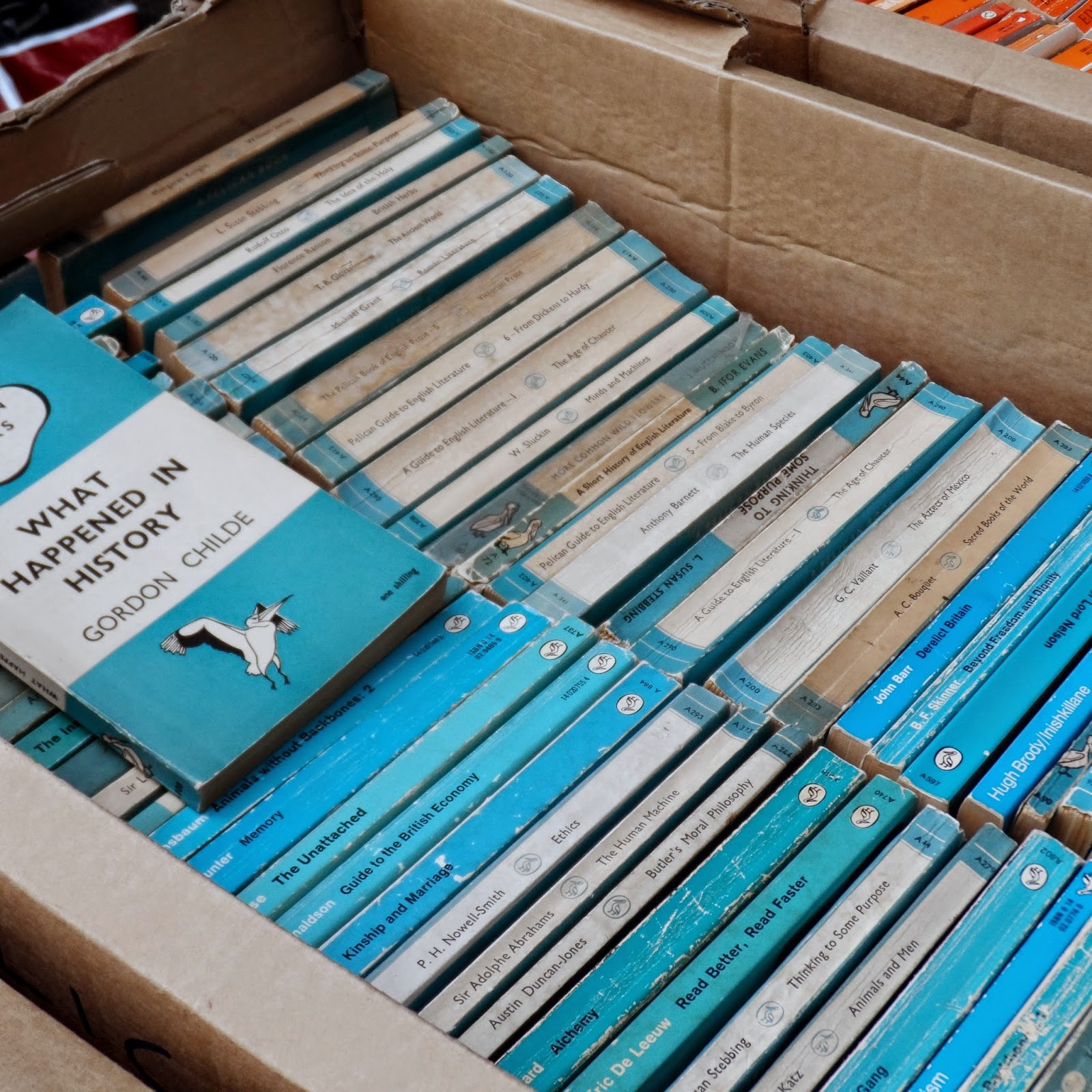
Nothing makes me happier than secondhand book stalls. Such jewels and bargains to be found last week at a Christian Aid book fair in George Street, literary fiction and non-fiction for £1 - boxes and boxes of  books, including Penguins and Pelicans. It was sunny and there were trestle tables outside, it was like Paris. It reminded me of how much I love paper books. And I wondered what secondhand book fairs/shops will be like in fifty years. Will they even exist?

Wednesday, 30 April 2014

ME Association report on IACFS/ME conference in San Francisco last month

This is interesting, a 16-page supplement - easy to download - from the ME Association on the recent  IACFS/ME conference in San Francisco. I haven't read it all, but is heartening to see the research that is going on, the possibilities. When I was in San Francisco all those years ago - I knew Stanford medical students, friends of my brother who was at Stanford at the time -  I was the girl with the strange illness. Good to see progress.

Tuesday, 22 April 2014

Discovering Anita Desai and Malcolm Lowry

I hadn't read anything by Anita Desai before, but just loved her gorgeous, short novel Clear Light of Day, a collection of disappointments and sadnesses, sprinkled with joy as two sisters Bim and Tara look back on their childhood in India in 1940s and their lives post-Partition. Here's a short clip of Desai  talking about Indian writers writing in English. And a longer interview here. Also, I recently discovered the writer Malcolm Lowry (1909-1957), this Oscar-nominated documentary from 1976, 'Volcano, An Inquiry into the Life and Death of Malcolm Lowry' is on YouTube. It's a compelling and disturbing portrayal of the debauchery and devastation of alcoholism and the cycle of perseverance and rejection and success in the writing life. I couldn't watch this film in one go, it's a disquieting experience, I watched it over a few nights,  the soundtrack is jangling and alienating. One of Lowry's friends interviewed, years after his death, wipes away a tear saying: 'The idea of such a talented man going so wrong... He could cope as long as he was drunk...' This resonates,  thinking of my own father.

Wednesday, 2 April 2014

'Mongol' by Uuganaa Ramsay

I finished Uuganaa Ramsay's memoir 'Mongol' the night before last night. Uuganaa, who is Mongolian, and grew up in a  'ger' (yurt), is now in her mid-thirties, and lives in Scotland with her husband and their three children. Four years ago, she had a baby boy, Billy. Billy had Down's Syndrome and, tragically, because of heart complications, died at just three months old. In writing his story, and her own story, Uuganaa has turned her precious boy's short life - and her grief - into something beautiful.

She has become passionate about educating others about Down's. She's certainly in a unique position to comment on the misuse of the word 'mongol', historically used to describe people with Down's Syndrome. I learned that it was actually British doctor John Langdon Down  -  who had coined the term 'mongol' in 1860. Of course, conflating a disability with an ethnicity is both offensive and unhelpful.  The word mongolism was officially dropped by WHO in 1965.  I don't recall the word mongol ever being associated with my wee aunt, certainly not within our family. It's not uncommon, though, to hear people still using the word 'mong' pejoratively. I imagine it is heard in playgrounds. In 1970s/80s, when I was at school,  'spaz' was the word most likely to be used.

I enjoyed the honesty and simplicity of Uuganaa's prose: there's a certain clarity, I think, that comes with writing in a language that is not your native tongue. The final chapter made me cry (I don't often cry at books). And the early and middle chapters describing Billy are compelling and moving. I also enjoyed learning about Mongolia, gorgeous details like the pale blue paint behind the goats' horns to identify them as her family's herd. When we were kids, we would refer to somewhere very far away as being in Outer Mongolia, with little or no idea of where Mongolia actually is. This book is an education. The only yurt I have ever been in is the hallowed writers' yurt at the book festival, and it was fascinating to learn of lives lived in yurts, the daily routines. The strength of (extended) family bonds is very much highlighted.

'Mongol' is, as memoirs are, necessarily time-driven rather than plot-driven, and while I learned a lot about Mongolia, I felt there were some sections, where we perhaps get too many 'facts' and not much story. It can feel a *little* dry at times. However, halfway through, the narrative takes an unexpected turn and feels almost novelistic - I couldn't put the book down after this.  And, as I said above, the final section, which deals with Billy's passing, made me cry. I read towards the inevitable event and I felt my throat tighten. I'm glad that Uuganaa and her husband had lovely hospital staff to support them through this dreadful time, though the image stays with me of an insensitive young doctor who came to Uuganaa's ward, earlier  in the story,  to see the 'floppy baby'.

I saw  Uuganaa launch her book at a packed event a few weeks ago in Edinburgh. I was struck by her poise and grace when she read. I highly recommend her memoir, which is published by Scottish indie press Saraband. I'd love to read what she writes next.

Monday, 17 March 2014

Down's Syndrome Awareness Week

Today is the start of Down's Syndrome Awareness Week and I think of my wee aunt. We grew up together, she was our pal, she was the boss! She was adored by all of her nephews and nieces, ranging from her own age to almost thirty years younger. My youngest cousin, in her mid-twenties, tells me she still kisses her photo every day. And this beautiful film for World Down's Syndrome Day is stunning in its simple message, Everyone Has the Right to be Happy. I can't watch it without an overflowing of tears. More on the awareness week here.

Thursday, 13 March 2014

I used to hate Twitter, now I love it

Before I'd ever used it, I hated Twitter, I was a bit Jonathan Franzen and thought it was nonsense. Now, I love it. It's perfect for low energy, you can dip in and out and say what you need to in 140 characters. And there are links to some great resources: I can bookmark articles in a jiffy and read later when my head is up to it (in truth, not all that's bookmarked gets read). My ME symptoms have been pretty bad this last ten days, that feeling of having weights in your head and neck and legs. And dizzy, so damned dizzy. I have fought it, tried to go out - I have shops on my doorstep, literally - only to end up spending long spells of the day in bed. I do restrict the number of people I follow to 500, otherwise it's too much like a flashing cockpit that I can't process. And I'm always tweaking who I follow: I hate to give up on someone whose tweets I like, but needs must.

The truth is that Twitter can be an Aladdin's cave (of course, it can be a hell-hole too, but you just don't go to those dark places of jabber-babble). I was so pleased before Christmas to discover The Mushin Museum in Cardiff, I was directed there by an anaesthetist when I was looking for information on anaesthesia in 1950s/60s for a novella I'm slowly, slowly writing, inspired by my doctor father. You don't use all the facts you learn, but you still need to know them, you need the mental 'furniture'. The curator at the Mushin museum  has been enormously helpful to me. By coincidence, I learned from an old CV just this week that my father had actually worked under Professor Mushin  - whom the museum is named after - in the early 60s. That gave me shivers. 

Then, the other day, I discovered artist/writer Nancy Campbell when she favourited a photo of snowdrops I'd put up that found its way to her. I learned that Nancy has written a gorgeous book called How to Say I Love You in Greenlandic, which I know will be perfect for my stepdad, it will revive his Greenland memories, so important now as he slips further into dementia. Through Twitter, we were able to be in touch directly and I have ordered her book.

I also came across The Istanbul Review recently. This gorgeous Turkey-based literary journal, 'with a presence in Edinburgh', is distributed in the UK by local indie store Looking Glass Books. I submitted some flash fiction to them last week on the off-chance and was delighted to have it accepted.

We all know Franzen gets his knickers in a twist about writers bragging on Twitter, sure, that happens, there can be dreadfully off-putting self-promotion - across all platforms - but you just avoid it. For me, social media is something of a godsend as I can't run around all over the place promoting my novel - but most of us use Twitter wisely when we self-promote - and why the hell shouldn't we publicise our writing, after the blood, sweat and tears that goes into writing, and having a book published!  But we also have a generosity of spirit towards other writers we admire, and that is invaluable.

Twitter is also a great tool for those who are chronically ill,  especially in housebound or bedbound phases. You can feel like shit with a capital S, but send out a tweet, a wee firework into the world, from your pillow. I often think back to my horribly ill days in 80s: unless you had physical visitors, it was a case of writing letters and phoning. Hard to believe now. I was 'amused' - if that is the right word - to come across a young woman with ME who had her many symptoms listed on an App on her phone, ready to present to the specialist she was seeing. We were both diagnosed at twenty, with the same hellish illness, but very different worlds, technologically. Her blog is here, she makes me smile. She loves her lipstick too, never a bad thing.

And, of course, Twitter is great for hearing about the latest research papers on ME - and the skulduggery - without having to trawl through the internet. I follow the excellent Tom Kindlon for this.